Modern coal mines often rely on controlled explosions to relieve pressure in the rock above their tunnels and prevent dangerous rockbursts. But every blast also sends powerful shock waves through the underground space. This study asks a practical question with life-or-death consequences: how much explosive can be safely used before the roof or sidewalls of a mine roadway suddenly collapse, and how can engineers predict that tipping point in advance?
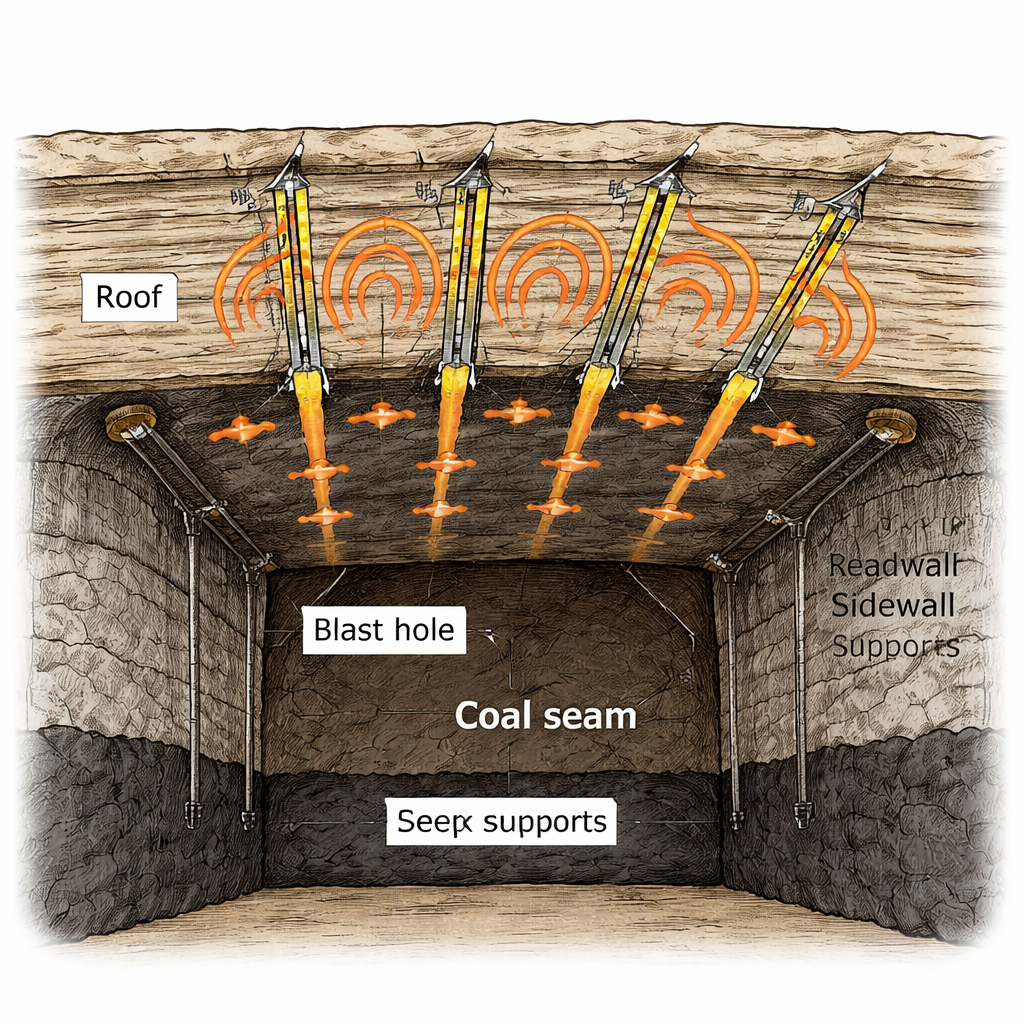
Picture of a stressed underground tunnel Figure 1.
The researchers focused on a deep coal mine in Songshan, China, where the roadway roof is made of thick, layered sandstone and the coal sidewalls are relatively soft and weak. To reduce the extreme stresses caused by mining, engineers drill deep holes into the roof ahead of the working face and fill them with explosives. When detonated, these charges intentionally crack and weaken the strong roof so that it fails in a controlled way, rather than violently and without warning. However, the same blasts also shake the roadway itself. Strong vibration can drive the already stressed rock around the tunnel past a critical point, triggering sudden, “catastrophic” deformation instead of gradual, manageable movement.
Turning rock movement into an energy balance
To understand when this sudden failure might occur, the authors treated the layered roof above the roadway as a simple beam resting on its supports. They wrote an equation for the total energy stored and released in this beam, including bending of the rock, the weight of the overlying strata, the resistance of support systems such as bolts, and the extra push from blasting vibrations. Using a branch of mathematics called catastrophe theory, they converted this energy expression into a standard “cusp” model that describes systems which stay quiet and then abruptly jump to a new state once conditions cross a threshold. In this framework, the amount of explosive and the strength of support act as control knobs, while the roof deflection is the response of the system.
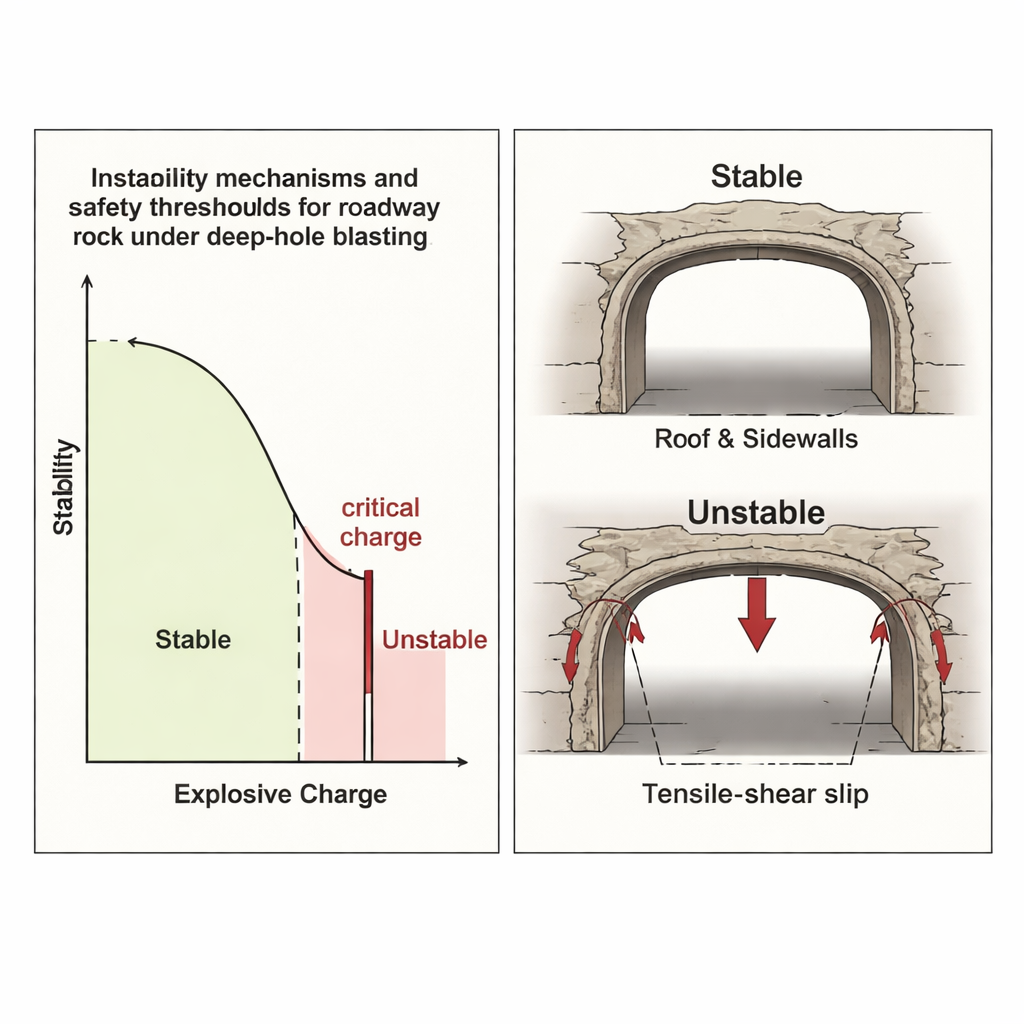
How much explosive is too much? Figure 2.
From the cusp model, the team derived formulas for a critical blasting load and, from that, a critical explosive charge for the roof. If the actual charge is below this value, the roof can absorb the disturbance and remain stable; if it exceeds the value, the model predicts sudden loss of stability. A similar approach was used for the sidewalls, which can fail through a combination of vertical cracking and sliding along a weakened zone. Here the authors built a mechanical model of a potential sliding block of coal and rock, again wrote a total energy expression, and applied catastrophe theory to obtain a second critical charge limit for sidewall stability. In both cases, the results show that larger charges, shorter distances from the blast source, and weaker rock or supports all lower the safe limit.
What the Songshan mine taught the model
Armed with laboratory measurements of rock strength, field measurements of blasting vibrations, and the geometry of the 2205 working face roadway in Songshan Mine, the researchers calculated specific critical charge values. The layered roof could theoretically tolerate nearly 100 kilograms of explosive per blast cycle, while the more fragile sidewalls limited the safe charge to about 93 kilograms. The mine initially used only 26 kilograms per cycle to avoid damage, which slowed work. Guided by the new criteria, engineers increased the charge to about 79 kilograms—well below the calculated limit but high enough to improve efficiency. Monitoring showed only small extra roof subsidence (5 millimeters) and modest sidewall movement (11 millimeters) in the days after blasting, confirming that the roadway remained stable.
Practical rules for safer blasting
For non-specialists, the main message is that dangerous tunnel failures under blasting are not random: they emerge when vibration energy pushes the rock system past a mathematically definable tipping point. By combining measurements of rock properties, tunnel geometry, support strength, and blast vibration, this study provides formulas for the maximum safe explosive charge for both roof and sidewalls. It also highlights clear levers for safety: increase support, move blasts farther from the roadway, stiffen weak rock with techniques like grouting, and limit the charge per blast. Applied together, these ideas help mines use powerful deep-hole blasting to control roof pressure while keeping underground roadways—and the people working in them—safely intact.
Citation: Guo, D., Chen, J., Wang, H. et al. Catastrophic instability criterion for roadway roof and sidewall rock mass under deep-hole roof blasting in Songshan coal mine.
Sci Rep16, 6448 (2026). https://doi.org/10.1038/s41598-026-36794-7
Keywords: deep-hole blasting, coal mine roadway, rock mass stability, roof and sidewall support, catastrophe theory