Clear Sky Science · en
Ischemic preconditioning modulates iron metabolism, acute inflammatory and neurotrophic responses to anaerobic exercise in untrained individuals: a randomized controlled trial
Why briefly cutting off blood flow might help your workouts
Most of us think of exercise benefits in terms of stronger muscles or better endurance. But under the surface, your blood, immune system, and even brain-supporting molecules are constantly adjusting. This study asked a striking question: if you briefly and repeatedly restrict blood flow to the legs before exercise—a technique called ischemic preconditioning—can you reshape how the body handles iron, inflammation, and brain-related growth factors during an all-out sprint effort, even in people who are not regularly trained?
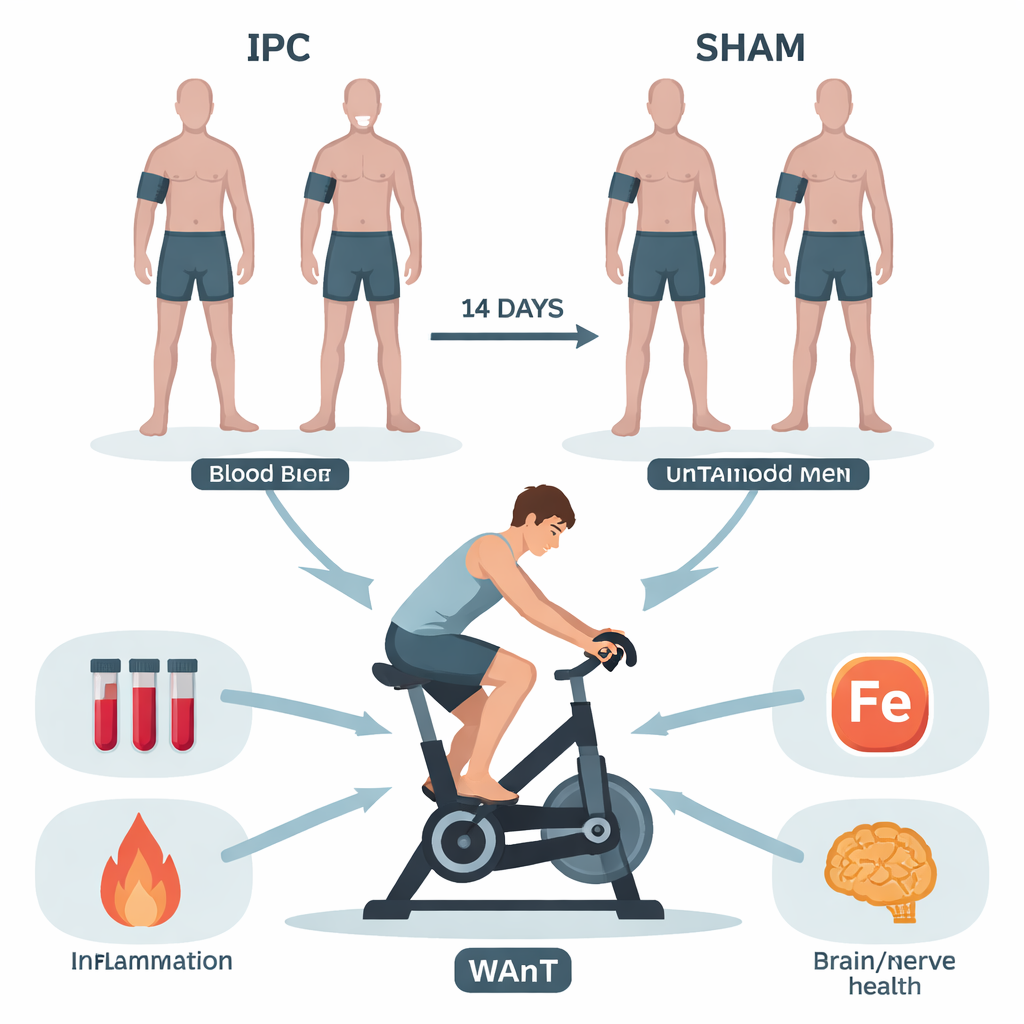
A simple but intense experiment in everyday young men
Researchers recruited healthy young men who were only casually active and randomly split them into two groups. One group received a "real" ischemic preconditioning routine every morning for 14 days: high-pressure cuffs were wrapped around the upper thighs and fully squeezed for five minutes, then released for five minutes, repeated four times. The other group went through the same ritual but with very low cuff pressure, serving as a placebo. Before and after this two-week period, all participants did a brutal 30-second cycling sprint test known as the Wingate test—twice in a row—to strongly stress their muscles and metabolism. Blood samples were taken at rest, right after the sprints, and two hours later to track changes in iron handling, inflammatory signals, and molecules that support nerve and brain health.
Iron storage and control get a quiet tune-up
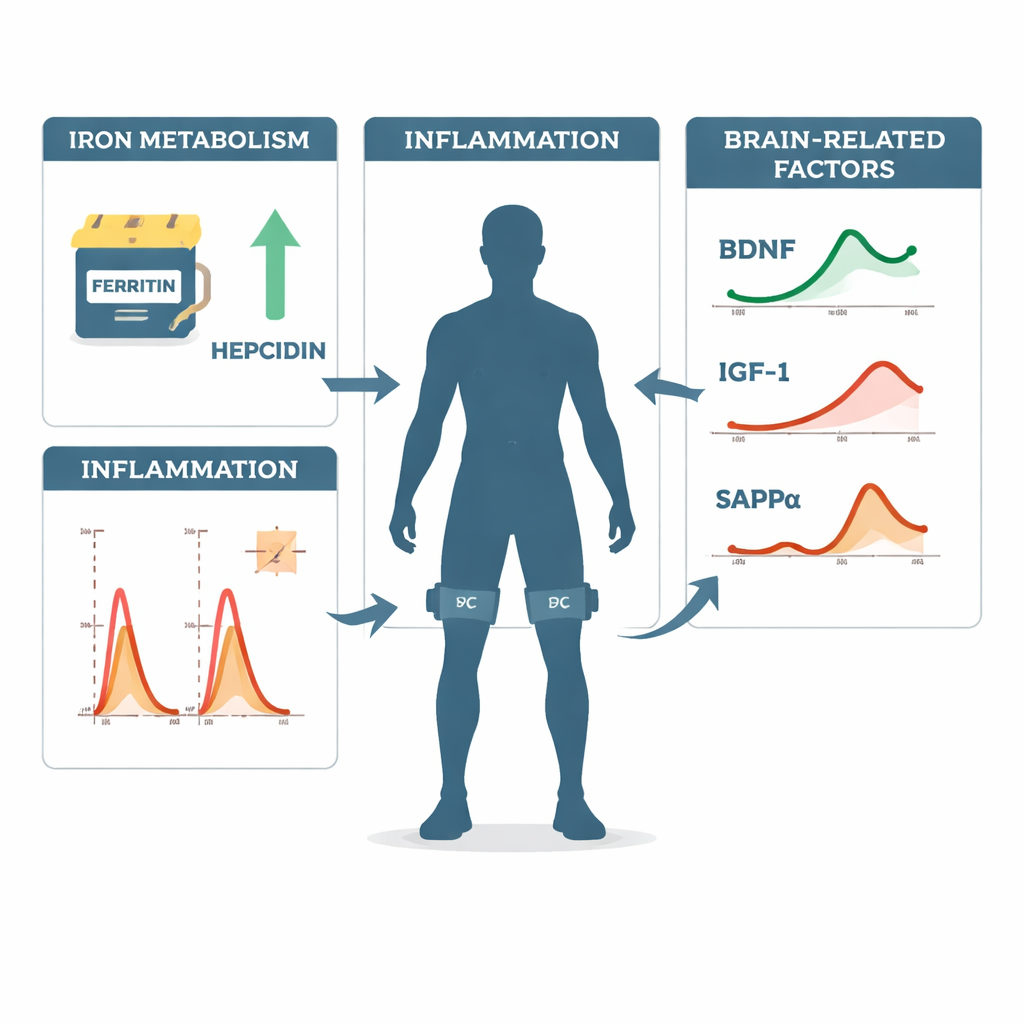
Iron is vital for carrying oxygen, but too much freely circulating iron can worsen inflammation and tissue damage. After two weeks of real blood-flow restriction, participants showed coordinated increases in several key iron-related markers at rest. Levels of erythroferrone, a messenger that links red blood cell production to iron needs, went up by about 10 percent. Ferritin, the main iron storage protein, rose by roughly 9 percent, and hepcidin, a hormone that limits iron entry into the bloodstream, increased by about 12 percent. Together, these shifts suggest that ischemic preconditioning nudged the body to tuck more iron safely into storage and to tighten control over how much iron circulates, without actually raising the amount of free iron in the blood. In contrast, the placebo group developed higher blood iron after two weeks, but without matching increases in storage proteins, hinting at a looser, less protective form of regulation.
Inflammation becomes sharper but cleans up faster
All-out sprinting normally sparks a brief burst of inflammatory signals that help the body respond to stress and repair tissues. Before the intervention, both groups showed modest, short-lived changes in several of these markers. After two weeks, however, the men who had undergone true ischemic preconditioning displayed a distinct pattern: certain stress-related proteins, such as GDF-15 and IL-15, spiked more strongly right after the sprint, while another protein linked to tissue stress, FSTL-1, dropped back toward baseline within two hours instead of staying elevated. This combination—strong early activation followed by quicker normalization—suggests a more focused and efficient inflammatory response, potentially offering protection without prolonged, low-grade inflammation that can be harmful over time.
Brain-supporting signals shift without boosting power
Exercise is known to raise levels of neurotrophic factors—molecules that help nerve cells grow, adapt, and communicate. In this study, sprinting initially caused brief increases in markers like BDNF and sAPPα, and a dip in NGF, in line with how hard exercise can stimulate the nervous system. After the ischemic preconditioning period, the pattern changed. The IPC group showed a clear, temporary rise in IGF‑1 and sAPPα right after the sprints, while BDNF levels actually ended up lower two hours later than in the placebo group. One interpretation is that the body may be redirecting these brain-related molecules toward local repair and adaptation rather than leaving them elevated in the bloodstream. Despite these biochemical shifts, the cyclists’ peak and average power outputs in the Wingate test did not improve—suggesting the main effects of this two-week protocol were protective and regulatory rather than performance-boosting, at least in untrained individuals.
What this means for health and everyday exercise
To someone outside the lab, these results show that a simple, non-exercise procedure—briefly restricting and restoring blood flow—can quietly reprogram how the body handles iron, inflammation, and brain-related signals during intense effort, without changing how much power you can produce in a short sprint. By encouraging iron to be stored more safely and helping inflammatory and neurotrophic responses become sharper and more controlled, ischemic preconditioning may support healthier recovery and cellular resilience, especially in people who are not regular exercisers. While it is too early to recommend this as a routine self-help method, the study points to new ways of using controlled blood-flow restriction to protect the body from the hidden stresses of intense activity.
Citation: Brzezińska, P., Kochanowicz, A., Borkowska, A. et al. Ischemic preconditioning modulates iron metabolism, acute inflammatory and neurotrophic responses to anaerobic exercise in untrained individuals: a randomized controlled trial. Sci Rep 16, 7258 (2026). https://doi.org/10.1038/s41598-026-36790-x
Keywords: ischemic preconditioning, anaerobic sprint exercise, iron metabolism, exercise-induced inflammation, neurotrophic factors