Clear Sky Science · en
Evaporative cooling exceeded albedo-induced warming in greening areas of global drylands
Why greener deserts matter
Dry regions across the globe are not just seas of sand; they are home to billions of people and are warming faster than many other places. At the same time, satellites show that many of these drylands have been getting greener over the past two decades, as shrubs, grasses, and crops expand or grow more vigorously. This study asks a deceptively simple question with big consequences: when drylands green, do they cool the land by using more water, or warm it by darkening the surface and soaking up more sunlight?
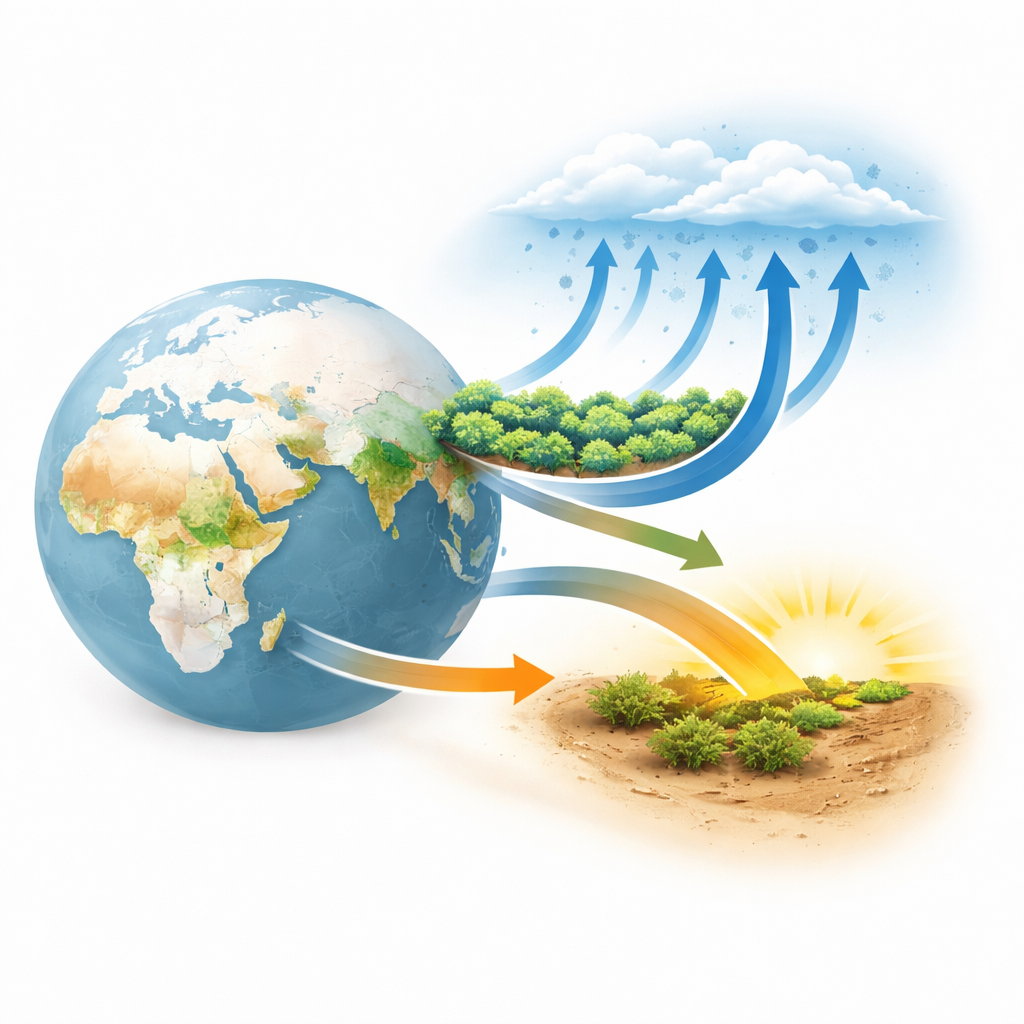
Two competing ways plants reshape heat
Plants change how energy moves between the land and the air in two main ways. First, when plants draw water from the soil and release it to the air, they act like a natural air conditioner: the evaporation of water uses energy and cools the surface. Second, plants usually make the land darker than bare soil, so it reflects less sunlight and absorbs more, a change known as reduced reflectivity. That process tends to warm the surface. The key to understanding whether greening cools or warms drylands is figuring out which of these two pathways dominates under real-world conditions.
Tracking green-up and drying from space
The researchers combined two decades of satellite images with climate and land-surface model data to track changes from 2001 to 2020 across all of the world’s drylands, defined by how little rain they receive compared with their evaporative demand. They used a standard vegetation index based on how plants reflect light to map where landscapes were greening or browning. They then linked these changes to surface temperature, air temperature, soil moisture, evaporation, and the split between heat carried away by water loss and heat directly warming the air. Advanced statistical tools allowed them to tease apart the separate roles of water loss and surface reflectivity in shaping temperature trends.
Where the land is greening and where it is fading
Overall, drylands have become noticeably greener, especially in western India, Pakistan, northern China, parts of North America’s Great Plains and Rockies, and bands across the Sahel and central Africa. At the same time, some regions—including parts of eastern Europe, western Australia, and northeastern Brazil—have browned as vegetation declined. Greening areas tended to show more total evaporation, driven mainly by plant water use, while bare-soil evaporation often fell because plant canopies shaded the ground and reduced direct drying. In contrast, browning areas lost evaporation, particularly in shrublands, which coincided with some of the strongest local warming signals in the study.
Cooling by water beats warming by darker ground
When the team compared greening and browning zones with nearby areas where vegetation stayed about the same, a pattern emerged. In greening regions, daytime land-surface temperatures dropped by around half to almost one degree Celsius per decade, while in browning regions they rose by roughly a similar or larger amount. Air just above the surface still warmed overall, but it warmed more slowly where greening occurred than where browning did. By separating the influence of water loss from that of surface reflectivity, the authors found that increased evaporation explained between about half and more than four-fifths of the vegetation-driven temperature response. This cooling dominance was strongest for daytime surface temperatures, where the effect of evaporation exceeded that of reflectivity changes by up to two-thirds.
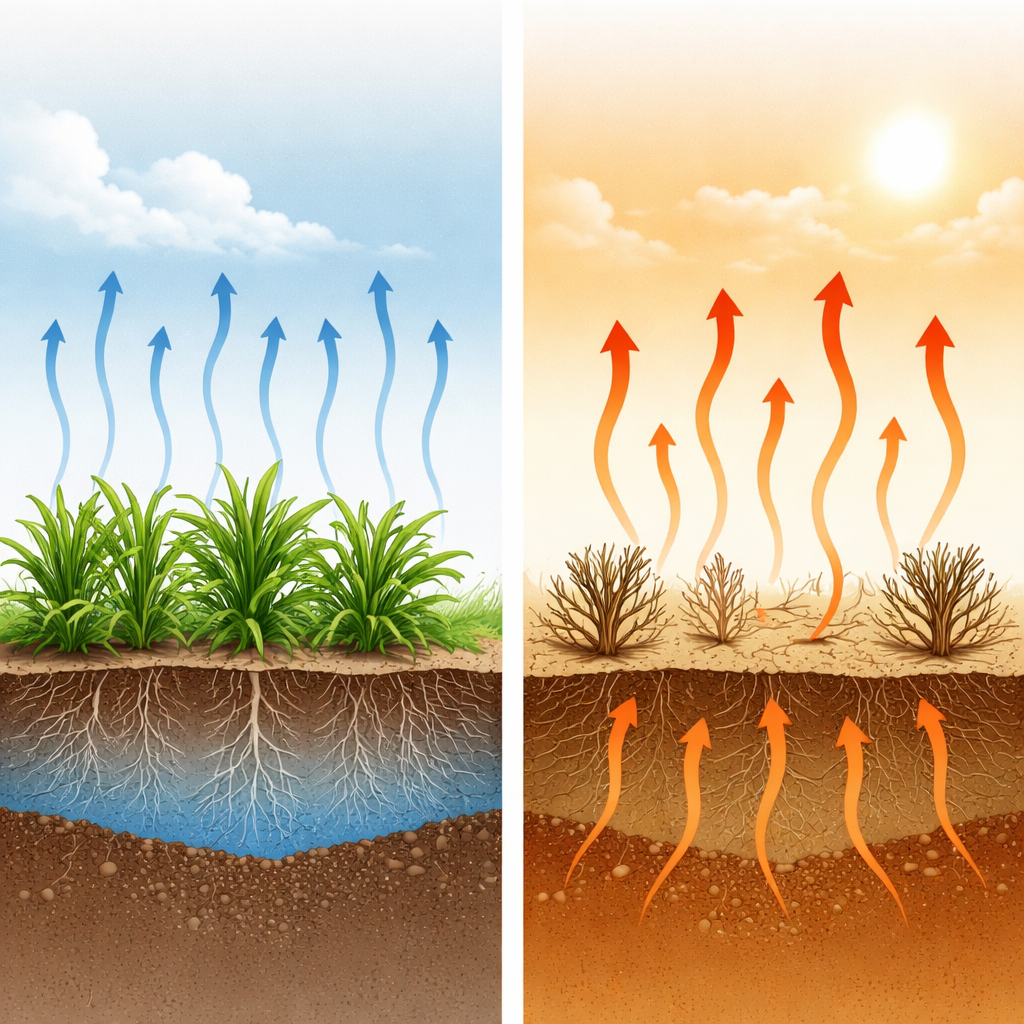
Soil moisture as the hidden switch
The cooling power of greening was far from guaranteed. In places where vegetation increased but soils dried, total evaporation often stalled or even declined, and the land warmed despite the extra green cover. Maps of heat flow showed that wetter soils favored the energy-consuming pathway of water loss, while drying soils shifted energy into directly heating the air. In many shrubland regions, where greening did little to boost evaporation, warming was especially pronounced. In a few pockets, changes in surface reflectivity played a larger role, but even there the broader pattern pointed back to the availability of soil water as the master control.
What this means for future drylands
For non-specialists, the study’s main message is that simply making drylands greener is not a guaranteed recipe for cooling a warming world. Plants can indeed act as powerful air conditioners, and in many drylands their evaporative cooling has outweighed the extra sunlight absorbed by darker, greener ground. But that cooling depends critically on having enough moisture in the soil. As climate change pushes many drylands toward hotter and drier conditions, greening without water may do little to slow warming and could coincide with stronger heat waves, degraded ecosystems, and greater risks to people who depend on these fragile landscapes.
Citation: Daramola, M.T., Li, R. & Xu, M. Evaporative cooling exceeded albedo-induced warming in greening areas of global drylands. Sci Rep 16, 9013 (2026). https://doi.org/10.1038/s41598-026-36781-y
Keywords: drylands, greening, evapotranspiration, soil moisture, surface temperature