Clear Sky Science · en
The influence of freeze-thaw action and particle size characteristics on the shear resistance of black soil
Why frozen fields matter
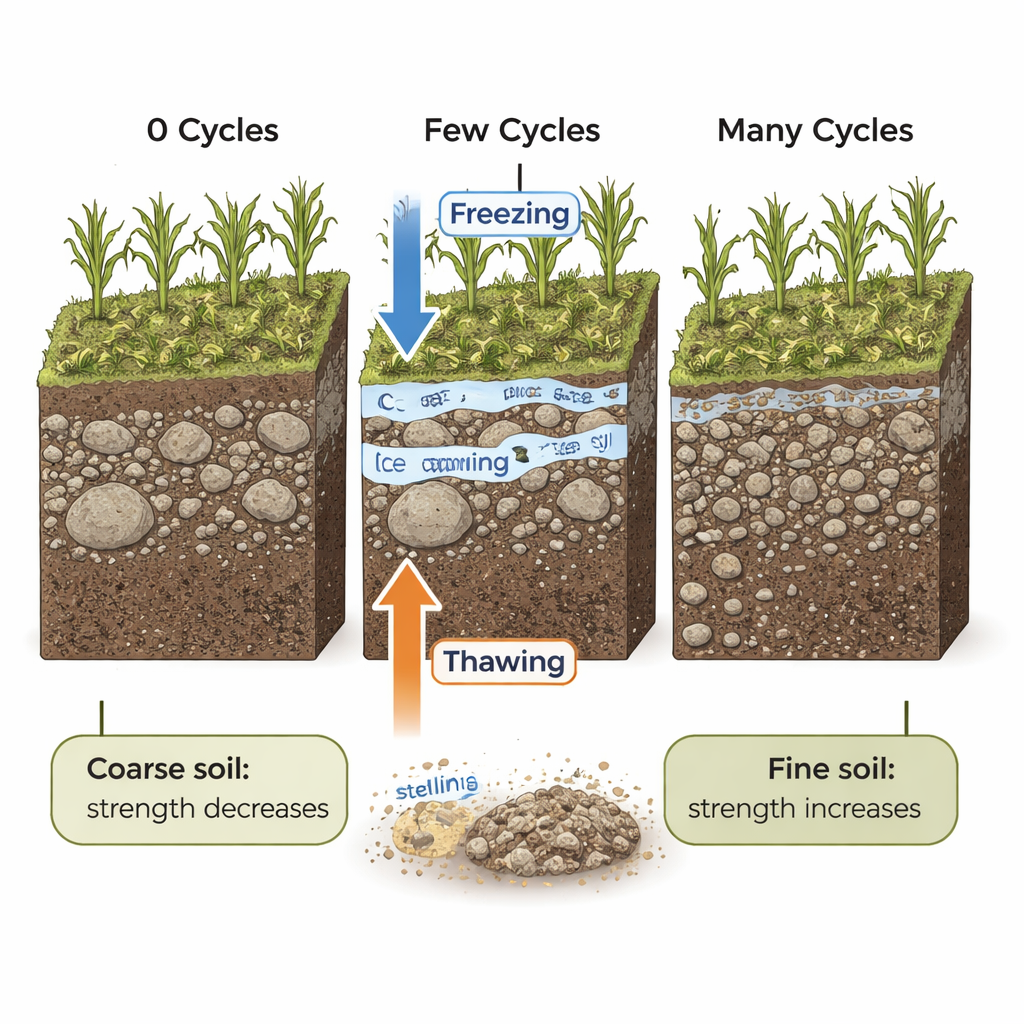
In the black soil plains of Northeast China, farmers depend on some of the most fertile earth on the planet. Yet every year, this soil is repeatedly frozen in winter and thawed in spring. Those temperature swings quietly change how tightly soil grains hold together and how easily they can be washed or blown away. This study asks a simple but crucial question: how do repeated freeze–thaw cycles, combined with different soil grain sizes, alter the strength and stability of this treasured black soil?
How the study was set up
The researchers collected black soil from a major farming area in Heilongjiang Province, where crops like corn and soybeans are widely grown. They carefully removed roots and stones, then sorted the soil into seven groups: one with a natural mixture of grain sizes, and six made of narrow size ranges from coarse pieces larger than 5 millimeters down to very fine particles smaller than a quarter of a millimeter. All samples were adjusted to a low, realistic winter moisture level of about 4%, then exposed to controlled cycles of freezing at −8 °C and thawing at 10 °C, for up to 30 cycles—similar to the harshest seasonal conditions in the region.
Measuring how strongly soil holds together
To see how these treatments changed the soil, the team used a standard laboratory device that pushes one part of a soil sample past another to measure its resistance to sliding. From these tests they calculated three key properties. Cohesion reflects the “glue-like” bonding between grains. The internal friction angle describes how well grains lock and rub against each other. Together, these determine overall shear strength—the soil’s ability to resist being torn apart or eroded by water and gravity. They also used statistical methods to separate the influence of freeze–thaw cycles from that of grain size and to see how the two interact.
Coarse versus fine grains: opposite trends
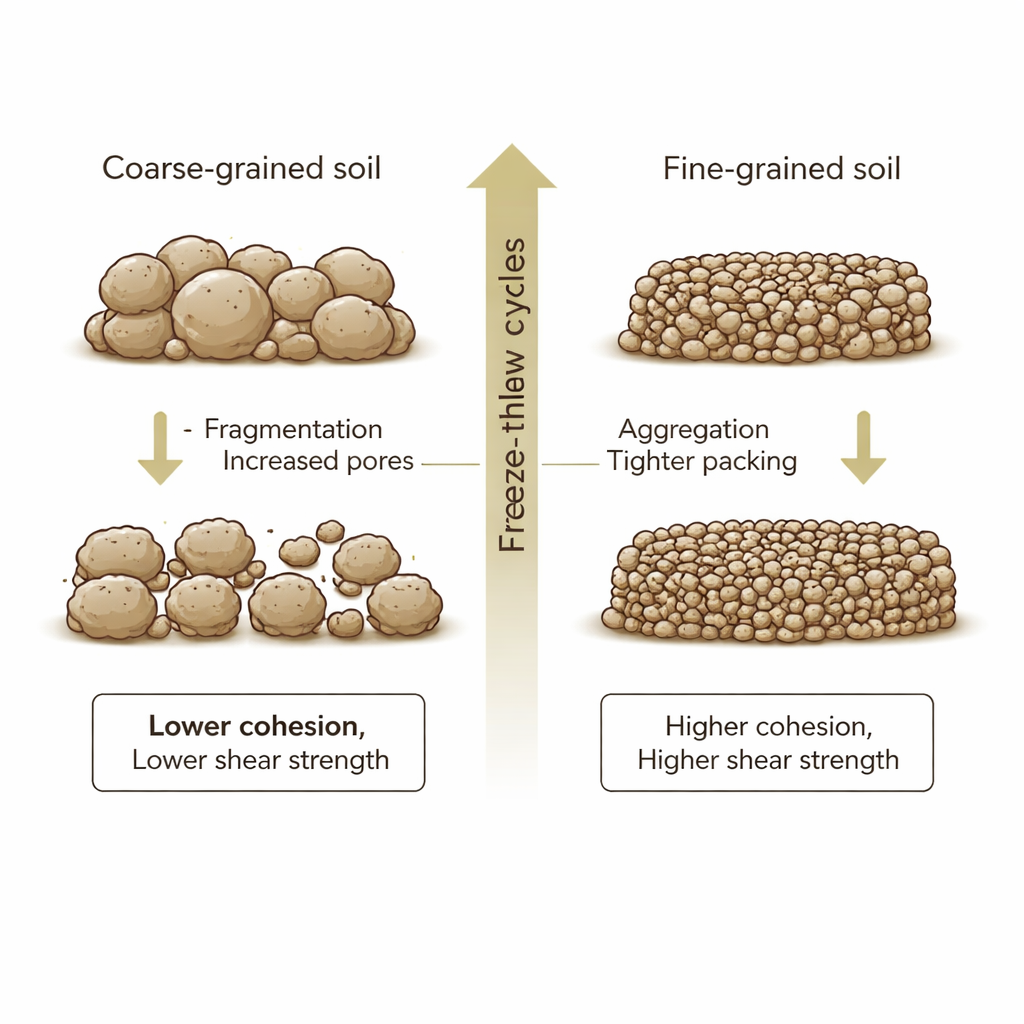
The results revealed a striking split between coarse and fine soils. In the natural mixed soil and in samples dominated by grains larger than 1 millimeter, cohesion and shear strength mostly declined as the number of freeze–thaw cycles increased. The first cycle did the most damage, and by 30 cycles these coarse groups had lost up to about one-third of their bonding strength. In contrast, soils made mostly of grains smaller than 1 millimeter behaved in the opposite way: repeated freezing and thawing made them stronger. Their cohesion more than doubled in some cases, and their shear strength rose slightly. For the internal friction angle, the key threshold shifted to 2 millimeters: fine soils tended to gain or maintain friction, while coarser soils tended to lose it. Overall, the natural mixed soil still had the highest strength because grains of many sizes can pack and support each other more effectively than uniform grains.
Why freezing changes soil this way
The study suggests that water turning to ice and then melting repeatedly shuffles soil grains and changes their contact points. In coarse soil, freezing water expands the gaps between large grains and loosens the structure; when the ice melts, particles have room to move, so they slide more easily and the soil becomes weaker. In fine soil, by contrast, small grains can be pushed and compacted closer together by the same freeze–thaw motions, locking into a denser, more interlaced structure that increases cohesion. Across all tests, grain size turned out to be the main controller of shear strength, with freeze–thaw cycles playing a strong but secondary role.
What this means for protecting black soil
For non-specialists, the takeaway is that not all soil responds to winter in the same way. In Northeast China’s black soil belt, repeated freezing can weaken coarse, cloddy soil while gradually tightening and strengthening very fine soil. Because erosion risk depends heavily on how easily soil can be broken and carried away, knowing the local mix of grain sizes helps predict where fields are most vulnerable after hard winters. These findings can guide better land management, such as reducing disturbance in areas dominated by coarse aggregates, and offer a scientific basis for protecting one of China’s most important agricultural resources.
Citation: Zhao, R., Chang, H., Yu, J. et al. The influence of freeze-thaw action and particle size characteristics on the shear resistance of black soil. Sci Rep 16, 6176 (2026). https://doi.org/10.1038/s41598-026-36780-z
Keywords: freeze-thaw soil, black soil erosion, soil shear strength, soil particle size, cold region agriculture