Clear Sky Science · en
Fast-powerformer achieves accurate and memory-efficient mid-term wind power forecasting
Why better wind forecasts matter
Electric grids are leaning ever more on wind turbines to keep the lights on without burning fossil fuels. But wind is fickle: breezes can fade or surge over the course of a day, forcing grid operators to scramble backup power on short notice. This paper introduces “Fast-Powerformer,” a new computer model that looks several days ahead to predict how much electricity a wind farm will deliver, while using far less computing power and memory than many existing methods. The work targets a practical question: how can we make wind forecasts accurate enough for markets and grid control, yet light enough to run on ordinary hardware at remote wind farms?
The challenge of looking days ahead
Forecasting wind power is not just about guessing tomorrow’s breeze. Grid operators care about the next one to three days to plan which power plants to turn on, how to trade electricity in day-ahead markets, and how to avoid wasting wind energy when the grid is overloaded. This “mid-term” window is tricky because the model must read subtle patterns in many variables at once—wind speed and direction at different heights, temperature, pressure, humidity—and follow how they evolve over hundreds of time steps. Traditional physics-based weather models are accurate but heavy, while classic statistical and machine-learning tools either assume simple trends or ignore the ordering of data in time, making them ill-suited to such complex, long sequences.
What makes existing AI models stumble
Recent advances in artificial intelligence, especially Transformer-based models originally designed for language, have improved time-series forecasting by learning relationships across long histories. Yet these models strain under mid-term wind tasks. Standard Transformers compare every time step with every other, so their computing cost grows rapidly with sequence length, and they treat each time point separately, making it hard to understand how different weather variables interact. Some newer designs speed things up by reorganizing the data, but in doing so they can lose track of short-lived wiggles and daily cycles—exactly the features that drive real turbine output. As a result, model designers often face a trade-off: either keep forecasts sharp but pay a high computing bill, or simplify the model and accept duller predictions.
A streamlined model built for wind farms
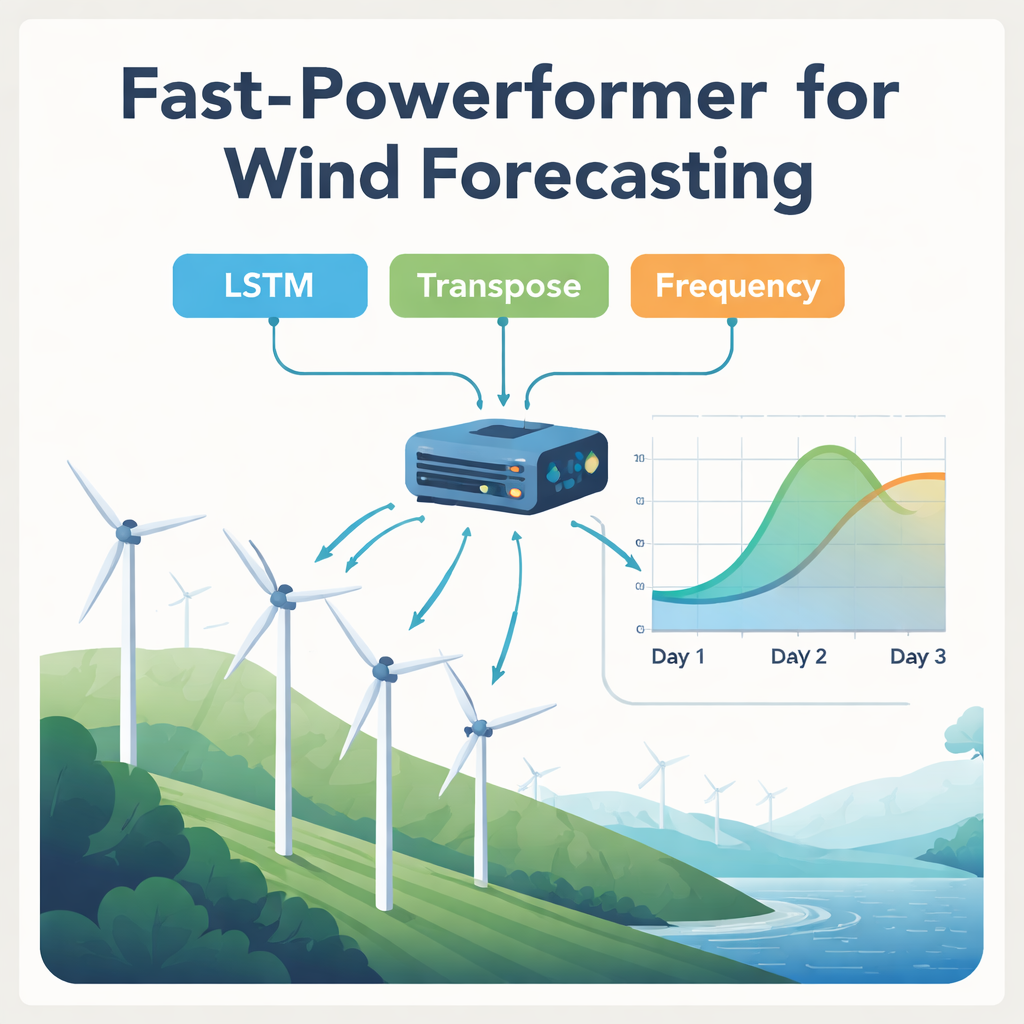
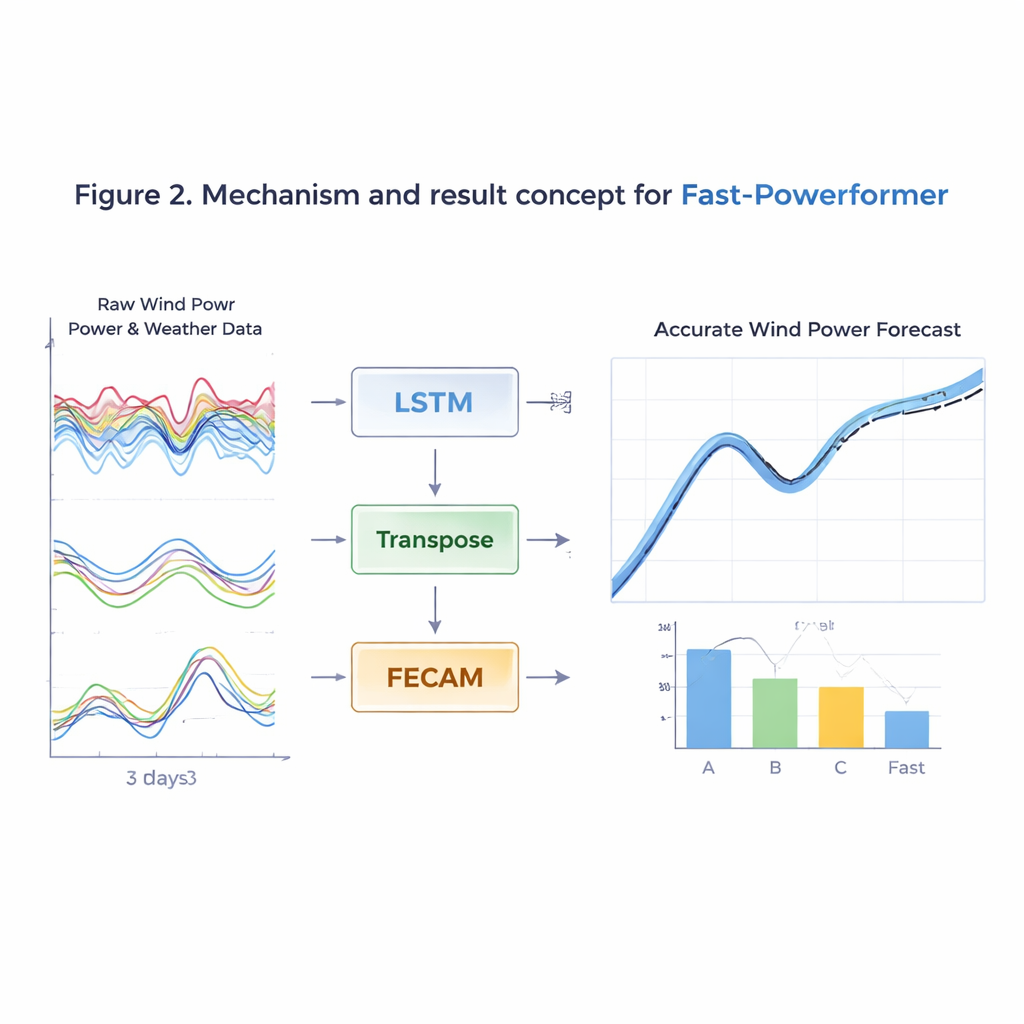
Fast-Powerformer tackles this trade-off with three coordinated ideas built on a leaner Transformer variant called Reformer. First, it reshapes the input so that each weather variable (such as hub-height wind speed) becomes a single “token” summarizing its behavior over the full input period. This drastically shrinks the number of tokens the model must handle and focuses attention on how variables influence one another, instead of tracking every time stamp separately. Second, because this reshaping could blur the fine temporal details, the model passes the raw sequences through a small recurrent network (LSTM) up front. That step distills short-term rises and drops into a compact representation before the data are reorganized. Third, Fast-Powerformer explicitly looks at patterns in frequency—using a cosine-based transform to emphasize daily and multi-day cycles—through a specialized attention block that boosts variables whose rhythms matter most for power production.
Testing on real wind farms
The authors evaluate Fast-Powerformer on two years of high-resolution measurements from three Chinese wind farms in very different landscapes, ranging from deserts to mountains. The model relies solely on on-site sensor data rather than full-blown weather simulations, mirroring what many operators actually have available. Against a lineup of standard tools—including classic statistical models, neural networks, and several popular Transformer designs—Fast-Powerformer delivers smaller average errors in most cases and particularly strong performance on measures that matter for operations, such as absolute and percentage deviations between forecasted and actual power. At the same time, it trains and runs noticeably faster and uses substantially less graphics-card memory than competing Transformer-based approaches, making it practical for deployment on modest servers or edge devices at wind farms.
What this means for clean energy planning
To a lay reader, the main message is that smarter, leaner algorithms can make wind a more reliable part of the power mix without demanding supercomputer resources. By combining a clever rearrangement of input data, a light touch of short-term memory, and an ear for repeating cycles, Fast-Powerformer forecasts several days of wind power more accurately and efficiently than many existing methods. Better mid-term forecasts help grid operators schedule other plants, reduce costly last-minute adjustments, and cut down on wasted renewable energy. Looking ahead, the authors suggest adding richer weather inputs and adapting models trained at one site to new locations, aiming for forecasting tools that travel easily from farm to farm while keeping computation—and emissions—low.
Citation: Zhu, M., Li, Z., Lin, Q. et al. Fast-powerformer achieves accurate and memory-efficient mid-term wind power forecasting. Sci Rep 16, 6737 (2026). https://doi.org/10.1038/s41598-026-36777-8
Keywords: wind power forecasting, renewable energy grids, time series models, Transformer neural networks, energy market planning