Clear Sky Science · en
Riprap mitigation of downstream scour at grade-control structures considering tailwater depth and layer thickness
Why river engineers care about hidden holes
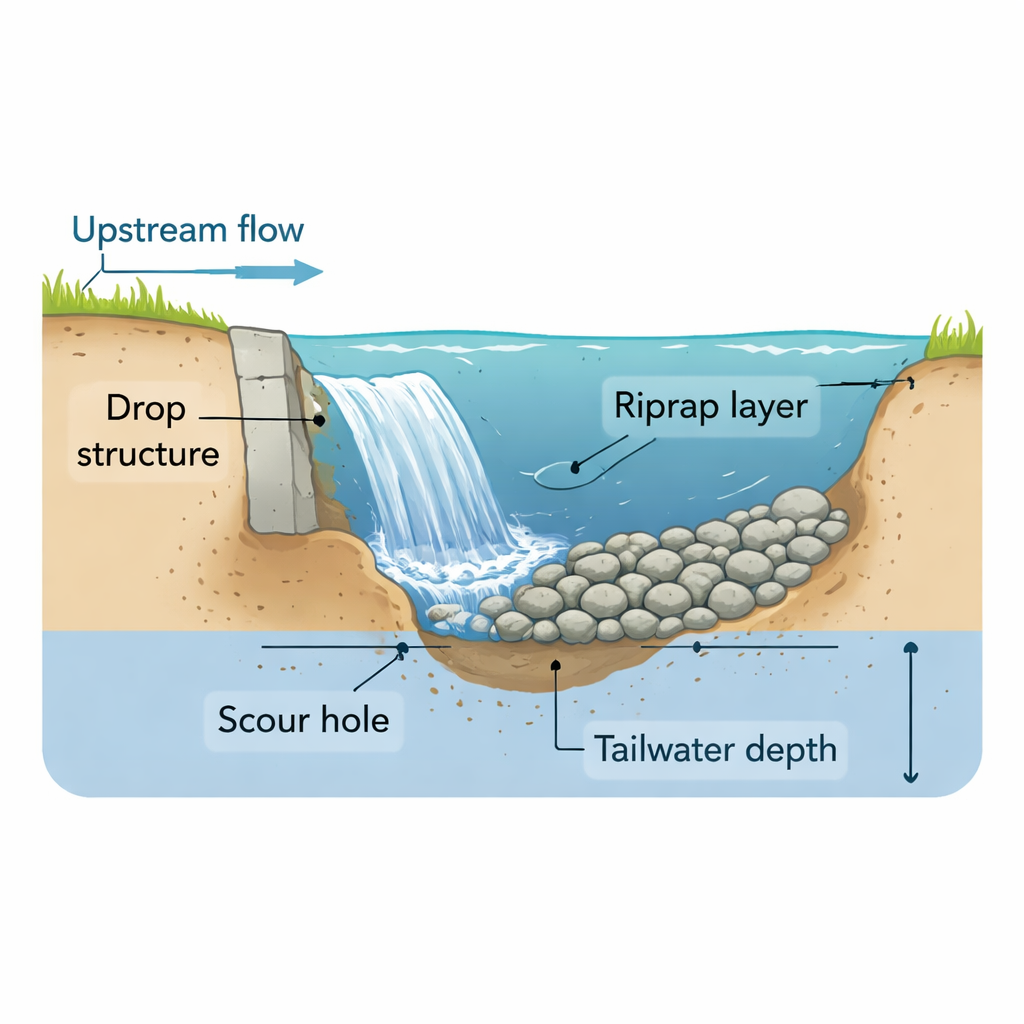
When water drops over a small man‑made step in a river, it can quietly dig a deep hole in the riverbed just downstream. These scour holes can undermine concrete structures, damage riverbanks, and threaten bridges and farmland. This study shows how a simple layer of stones, known as riprap, and careful control of water depth below the drop can dramatically shrink these hidden holes and keep river structures safer for the long term.
Man‑made steps in rivers and their hidden risks
Engineers often build low step‑like structures, called grade‑control structures, to stop riverbeds from eroding downward in steep streams. While these steps slow erosion upstream, the falling water forms a powerful jet that crashes into the bed downstream, scooping out a scour hole. Over years and floods, this hole can deepen and lengthen, threatening the stability of the structure and the surrounding channel. The central question of this research is how to use a simple stone cover on the bed and the depth of water downstream to keep that hole small and manageable.
Testing stone armor in a controlled flume
The researchers built an 18‑meter‑long rectangular laboratory channel and installed a glass model of a vertical drop structure. They filled the downstream reach with uniform sand and, in many tests, covered it with a layer of relatively large stones representing riprap. By running clear water (with no incoming sediment) at three flow rates, they measured how a scour hole formed and evolved over time, using laser scanning to capture the shape of the bed. They varied two key factors: the thickness of the riprap layer relative to the drop height, and the depth of water just downstream of the structure (the tailwater). This allowed them to see how each factor, alone and together, changed the size and growth of the scour hole.
How stones and water depth tame the digging jet
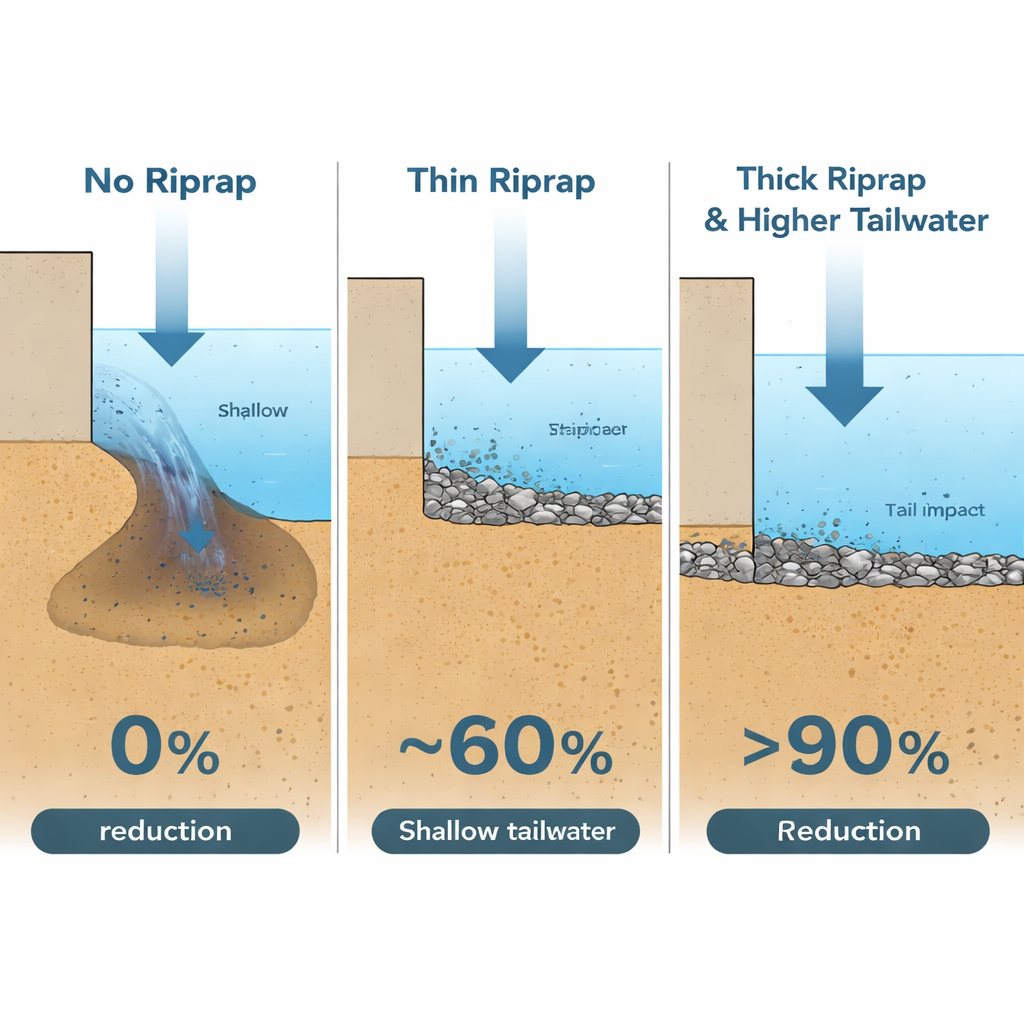
Without any protection, the plunging jet cut holes as deep as about 1.2 times the height of the structure under the highest flows. When riprap was added, the pattern changed. The stones acted like armor and roughness: they broke up the jet, absorbed energy through impacts between stones, and spread the flow more evenly across the bed. As the riprap layer became thicker, the scour hole became much shallower and shorter, and the disturbed zone shifted slightly farther downstream. A layer about half as thick as the structure height reduced maximum scour depth by nearly 70 percent, and increasing the thickness to roughly two‑thirds cut depth reductions by more than 89 percent, almost eliminating scour at lower flows. At the same time, the time needed for the bed to “settle” into a stable shape dropped from about six hours without protection to under three hours with riprap.
Helping the stones with a deeper downstream pool
The depth of water downstream acted like an additional cushion. With shallow tailwater, the jet struck the bed with high speed, creating strong swirling motions and steep, deep holes. Doubling the tailwater depth reduced the impact speed of the jet and weakened these vortices, trimming scour depth and length by roughly 20 to 30 percent even without stones. When this higher tailwater was combined with a thick riprap layer, the effect was striking: both the depth and length of scour were reduced by more than 90 percent across the tested flows, and at the lowest flow the scour was almost completely suppressed. A sensitivity study confirmed that riprap thickness and tailwater depth were the most powerful levers for limiting scour, while flow intensity and the natural critical depth mainly controlled how strongly the hole tried to grow.
Turning laboratory insights into simple design guidance
To make their findings useful in practice, the authors built simple equations that relate normalized scour depth and length to four dimensionless quantities: flow strength, tailwater depth, riprap thickness, and a characteristic depth. These formulas reproduced the measured scour sizes with high accuracy, capturing most data within about 10 percent. For non‑specialists, the message is straightforward: a generous layer of stones, at least half as thick as the drop is tall, combined with a reasonably deep downstream pool, can almost eliminate dangerous holes that form below small river steps. While real rivers are more complex than a laboratory flume, this work provides clear, physics‑based guidelines showing that modest investments in riprap and water‑level management can greatly extend the life and safety of river structures.
Citation: Mohammadnezhad, H., Mohammadi, M. & Ghaderi, A. Riprap mitigation of downstream scour at grade-control structures considering tailwater depth and layer thickness. Sci Rep 16, 6680 (2026). https://doi.org/10.1038/s41598-026-36776-9
Keywords: river erosion, scour protection, riprap, grade-control structures, hydraulic engineering