Clear Sky Science · en
Biofilms of Bacillus subtilis as biostimulants for plant resilience to drought and flooding
Friendly microbes that help crops face wild weather
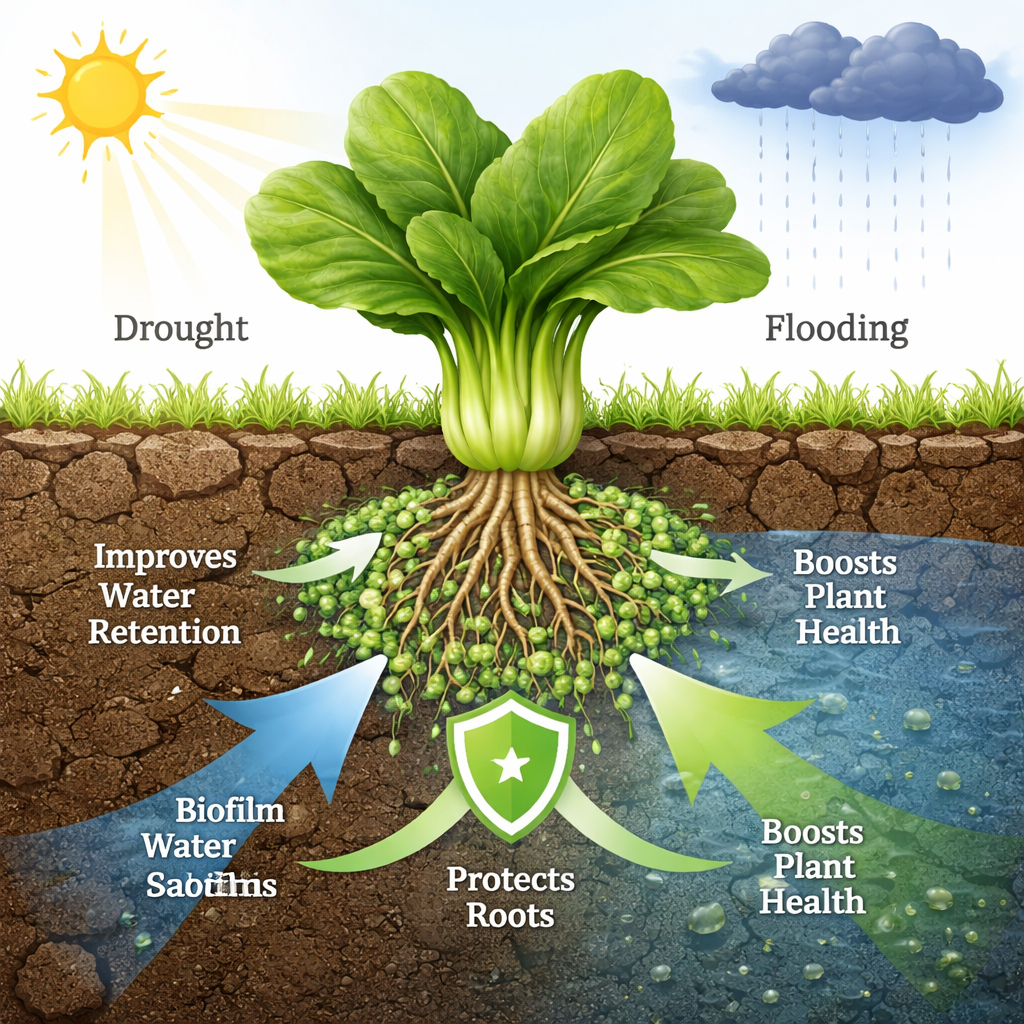
Heat waves, water shortages, and sudden floods are becoming more common as the climate changes, and farmers are under pressure to keep crops alive when the weather swings from too dry to too wet. This study explores how helpful soil bacteria living in slimy coatings on plant roots can act like tiny bodyguards, helping a leafy vegetable called pak choi survive both drought and flooding while turning agricultural waste into a useful resource.
Why root-clinging bacteria matter
Many crops already host communities of helpful bacteria on their roots. Some strains of Bacillus subtilis can form biofilms—thin, sticky layers where bacteria live together in a protective matrix. These biofilms help the microbes resist harsh conditions and stay attached to plant roots. The researchers asked whether biofilm-forming strains could also strengthen pak choi against two major threats: lack of water and too much water. They compared three types of B. subtilis: a strong biofilm-forming strain (3A1), a naturally isolated Taiwanese strain (WMA1), and a lab strain (168) that has lost much of its ability to form biofilms.
Stronger root partners give stronger plants
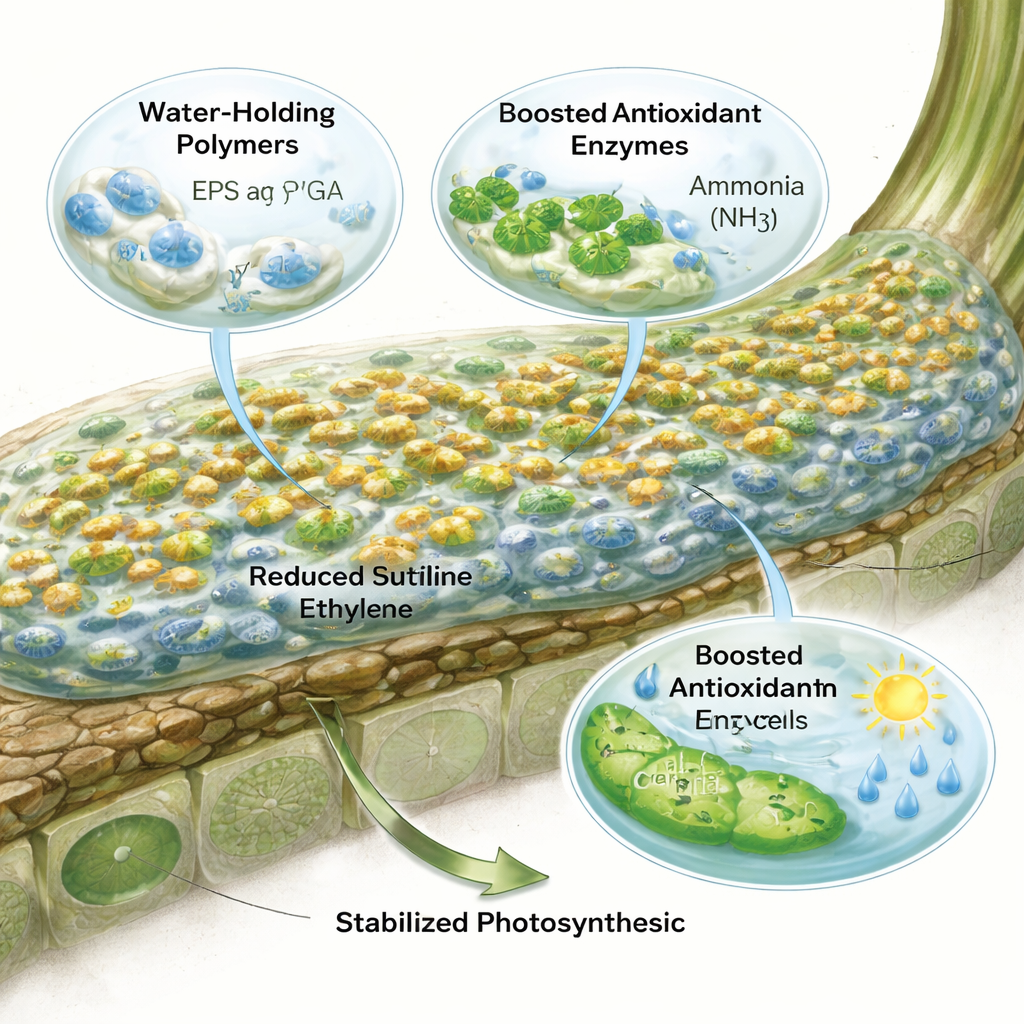
First, the team showed that strains 3A1 and WMA1 formed much thicker biofilms on plastic surfaces than strain 168 and attached far more densely to pak choi roots, seen using green fluorescent protein and microscopy. The biofilm-forming strains also grew on a medium containing ACC, a plant compound that turns into the stress hormone ethylene, revealing that they produce ACC deaminase, an enzyme known to dial down stress signals in plants. In contrast, the biofilm-poor strain 168 could not use ACC, suggesting it lacks this stress-relieving trait.
Bacterial coatings help during drought and floods
To test how this plays out for whole plants, pak choi seedlings were watered for two weeks with diluted bacterial culture broths or control solutions, then exposed either to six days without water followed by recovery, or to six days of flooding. Plants treated with 3A1 or WMA1 clearly outperformed all other groups. Under drought, they had much greater fresh and dry weight, taller shoots, thicker stems, longer roots, and higher survival than plants given water, nutrient broth, or the 168 strain. Similar advantages appeared under flooding: 3A1- and WMA1-treated plants grew larger and sturdier than controls. Measurements of leaf chlorophyll fluorescence, a sensitive indicator of damage to the photosynthetic machinery, showed that treated plants kept their photosystem II working more stably under both stresses, meaning their ability to capture light energy was better preserved.
How slime, enzymes, and recycled fruit peels help
The protective effect traced back to several linked mechanisms. Biofilm-forming strains 3A1 and WMA1 produced more sticky sugars (exopolysaccharides, or EPS) and a natural polymer called gamma-polyglutamic acid (γ-PGA), known for holding water and improving soil structure. These substances likely help keep moisture near the roots and stabilize the soil around them. In stressed plants, leaves treated with these strains also showed higher activity of two key antioxidant enzymes, catalase and superoxide dismutase, which detoxify harmful reactive oxygen molecules that build up during drought and flooding. The team further tested whether agricultural waste could boost this system by growing the bacteria in media enriched with fruit pomace—the pulpy leftovers from juice production. This simple addition increased EPS and γ-PGA production and led to even better plant growth and stress tolerance, especially for WMA1 under drought.
What this means for future farming
Put simply, the study shows that the right root-dwelling bacteria can wrap plant roots in a water-holding, protective film, calm the plant’s stress signals, and strengthen its internal defenses, allowing crops like pak choi to cope better with both drying and flooding soils. Using biofilm-forming B. subtilis strains as “biostimulants,” especially when grown on low-cost fruit waste, could offer farmers an eco-friendly tool to protect yields in a less predictable climate while also recycling agricultural by-products. Instead of relying only on irrigation or chemicals, growers might soon enlist microscopic helpers to keep their plants greener and more resilient when the weather turns extreme.
Citation: Chen, YH., Liu, JY., Hwang, SG. et al. Biofilms of Bacillus subtilis as biostimulants for plant resilience to drought and flooding. Sci Rep 16, 6113 (2026). https://doi.org/10.1038/s41598-026-36767-w
Keywords: plant stress, beneficial bacteria, biofilms, drought tolerance, sustainable agriculture