Clear Sky Science · en
Ononin suppresses tumor-induced platelet activation and invasion and enhances cell-cycle arrest and apoptosis in triple-negative breast cancer cells
Why this research matters for people
Triple-negative breast cancer is one of the most aggressive forms of breast cancer and is notoriously hard to treat because it lacks the usual molecular targets for therapy. This study explores whether a natural compound called ononin, found in certain medicinal plants, can interfere with how these cancer cells grow, spread, and interact with the blood platelets that help them travel through the body. Understanding this could open up new, safer ways to slow or prevent dangerous metastasis.
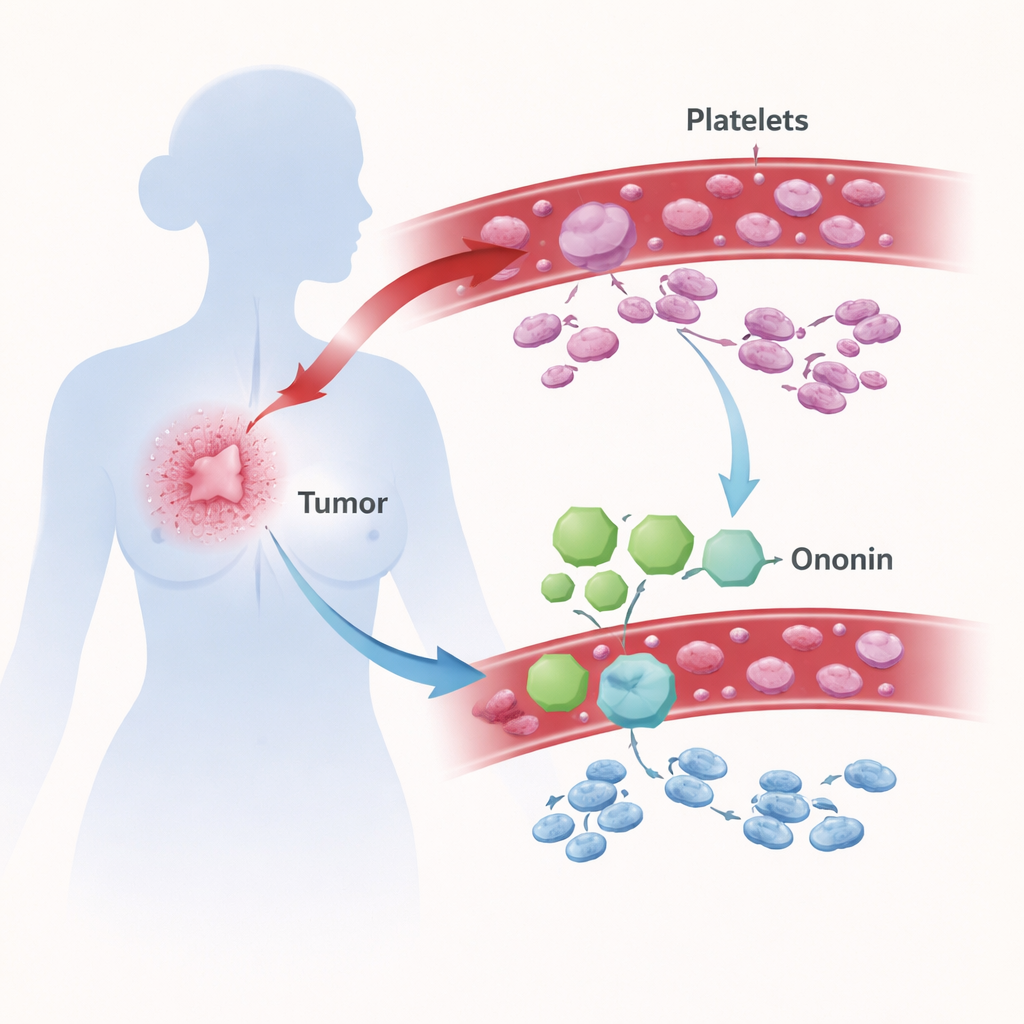
How blood platelets help cancer spread
Metastasis—the spread of cancer to distant organs—is the main reason cancer is so deadly. Cancer cells do not travel alone: they enlist the help of platelets, the tiny blood fragments that normally help stop bleeding. When tumor cells activate platelets, these platelets form protective clusters around the cancer cells, shield them from the immune system, release growth and invasion signals, and help them exit blood vessels into new tissues. Because of this close partnership, blocking cancer-driven platelet activation is seen as a promising, more tumor-focused way to limit metastasis without causing major bleeding problems.
An aggressive cancer and a plant compound
The researchers focused on a widely used laboratory model of triple-negative breast cancer called MDA-MB-231, known for its strong tendency to invade and metastasize. Earlier work suggested that ononin, a natural molecule from the Fabaceae (legume) family and a constituent of Astragali Radix, could weaken these cancer cells and make standard chemotherapy more effective. What was unknown was whether ononin could also disrupt the cancer–platelet partnership and directly curb the cells’ ability to invade, multiply, and survive. To answer this, the team tested ononin at two moderate doses, chosen to be below the level that simply kills cells outright.
Testing how well tumor cells trigger platelets and invade
To see whether ononin changed how cancer cells activate platelets, the scientists first treated the tumor cells with ononin and then exposed them to platelet-rich plasma from healthy donors. Using flow cytometry, a laser-based cell analysis technique, they measured how many platelets switched from a resting to an activated state. Cancer cells without ononin robustly activated platelets, but cells pretreated with ononin showed a clear drop in activated platelets—from about 80% to roughly 62–64%, at both doses. In a separate three-dimensional “spheroid” invasion test, the cancer cells were grown as tiny tumor-like clusters embedded in collagen gel. Over five days, untreated spheroids spread widely into the surrounding gel, whereas ononin-treated spheroids remained compact, with a dramatically smaller invasion area, indicating strongly reduced invasive behavior. 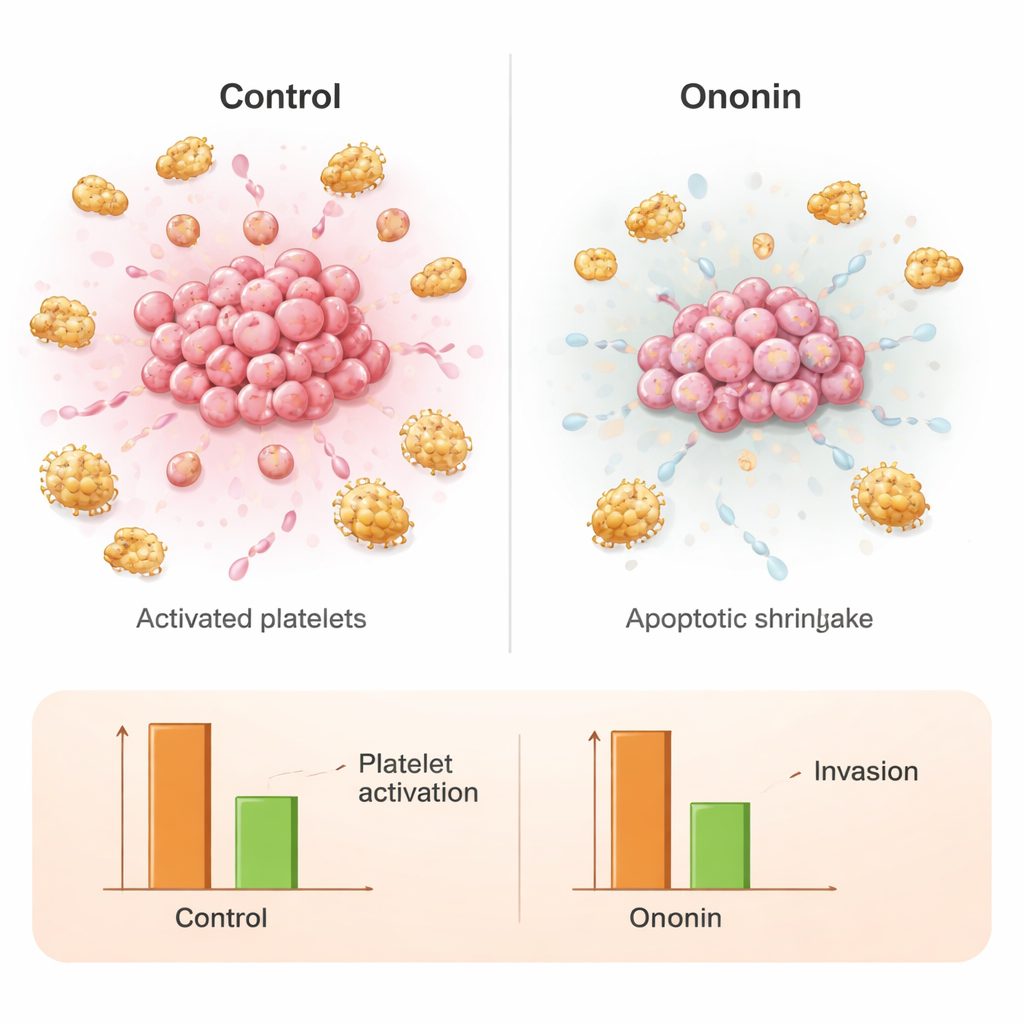
Slowing the cell cycle and triggering cell death
The team next examined how ononin affects the basic life cycle of cancer cells and their tendency to die. Using DNA staining and flow cytometry, they found that ononin caused more cells to pile up in the G1 phase—the stage before DNA is copied—while reducing the number in later phases. This G1 “traffic jam” means the cells are held back from dividing. At the higher dose, more than 85% of cells were stuck in G1, leaving almost none progressing to later stages. When the researchers measured apoptosis, the programmed self-destruction of damaged cells, they saw that ononin-treated cultures had fewer viable cells and more cells in both early and late stages of apoptosis, along with a modest rise in necrosis. These changes occurred at both doses, suggesting that ononin consistently pushes triple-negative breast cancer cells toward growth arrest and death.
What this could mean for future treatments
Taken together, the findings show that ononin attacks triple-negative breast cancer cells on several fronts at once: it reduces their ability to switch on platelets, limits their invasion into surrounding tissue, halts their cell cycle before division, and increases their likelihood of dying. For a layperson, this means ononin both weakens the cancer cells themselves and undercuts their “bodyguards” in the bloodstream. While this work was done in cells in the lab and only in one cancer cell line, it supports the idea that plant-derived compounds like ononin might one day complement existing treatments to slow the spread of aggressive breast cancers, provided future animal studies and clinical trials confirm that they are safe and effective in patients.
Citation: Al-Kabariti, A.Y., Abbas, M.A., Alsarayreh, N. et al. Ononin suppresses tumor-induced platelet activation and invasion and enhances cell-cycle arrest and apoptosis in triple-negative breast cancer cells. Sci Rep 16, 6803 (2026). https://doi.org/10.1038/s41598-026-36762-1
Keywords: triple-negative breast cancer, ononin, platelets, metastasis, apoptosis