Clear Sky Science · en
Enhancing sand production assessment through accurate determination of Young’s modulus and Poisson’s ratio
Why sand in oil wells is a big deal
When an oil or gas well starts producing sand along with fluids, the tiny grains can act like industrial‑strength sandpaper. They erode steel pipes, clog valves and separators, force unplanned shutdowns, and even create safety hazards. This article explores how better measurements of two basic rock properties—how stiff the rock is and how easily it deforms sideways—can dramatically improve our ability to predict when and where sand will break loose, helping the industry avoid costly surprises.
The hidden physics of crumbling rock
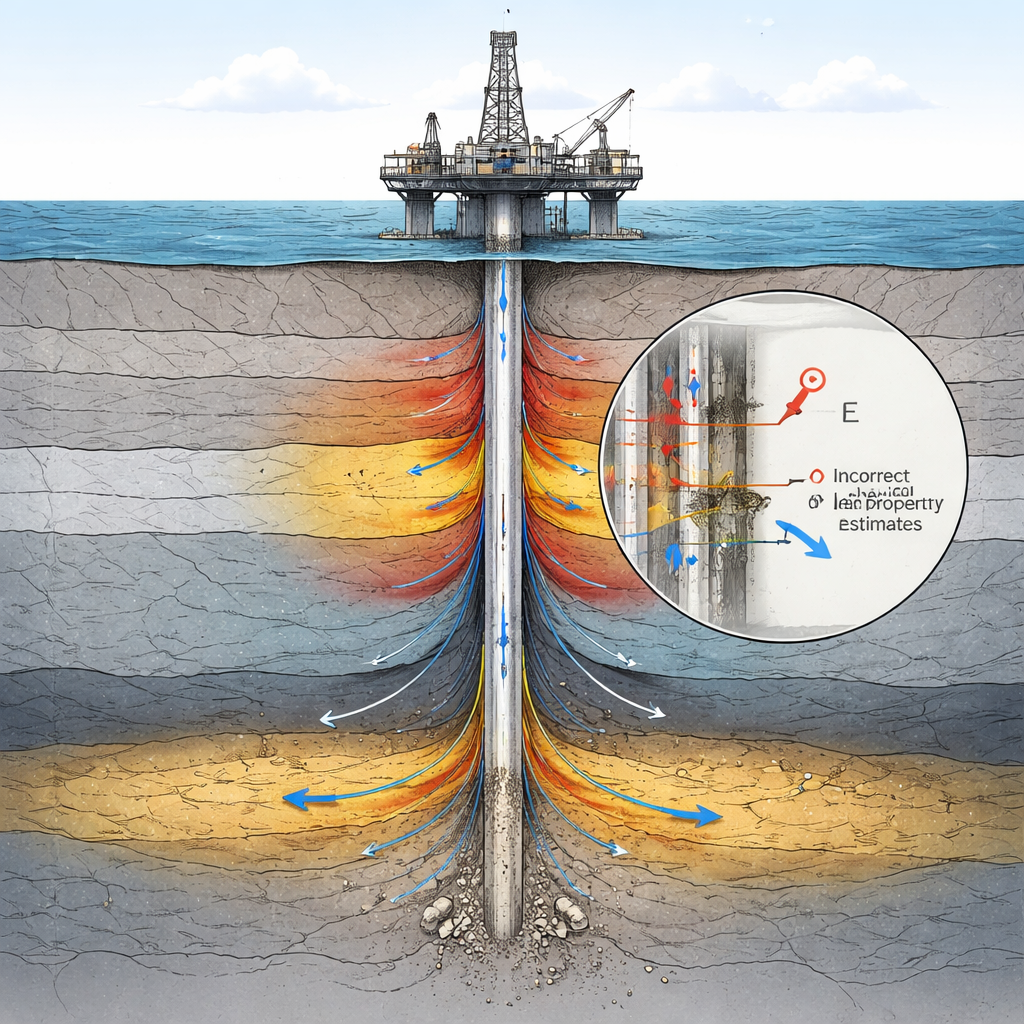
Deep underground, reservoir rocks are squeezed by the enormous weight of overlying layers, yet they must also withstand the drag of oil, gas, and water being pulled toward a well. Whether the rock holds together or sheds grains depends strongly on its stiffness (Young’s modulus) and how it bulges under stress (Poisson’s ratio). Engineers often estimate these properties indirectly from sound waves and density logs because full laboratory testing on rock cores is expensive and slow. However, these indirect estimates come in two flavors—dynamic and static—and sand prediction methods need the static versions to reflect real reservoir behavior. The question the authors ask is simple but crucial: which of the many published formulas and machine‑learning models for these static properties can actually be trusted in the field?
Putting popular prediction methods to the test
The researchers assembled a dataset of 100 sandstone samples for which static Young’s modulus and static Poisson’s ratio had been measured in the laboratory. They then used a wide range of existing empirical equations and machine‑learning models to re‑estimate these two properties from standard well‑log inputs, such as rock density and the travel time of compressional and shear sound waves. With these estimated properties, they fed the results into three widely used sand prediction tools: the Sand Production Index (B), a ratio of shear rigidity to overall compressibility (G/Cb), and the Schlumberger Sand Index (S/I). By comparing each tool’s sand/no‑sand verdict against the verdict obtained from measured lab data, the team could see how much error came not from the prediction method itself, but from the quality of the input rock properties.
One standout model among many
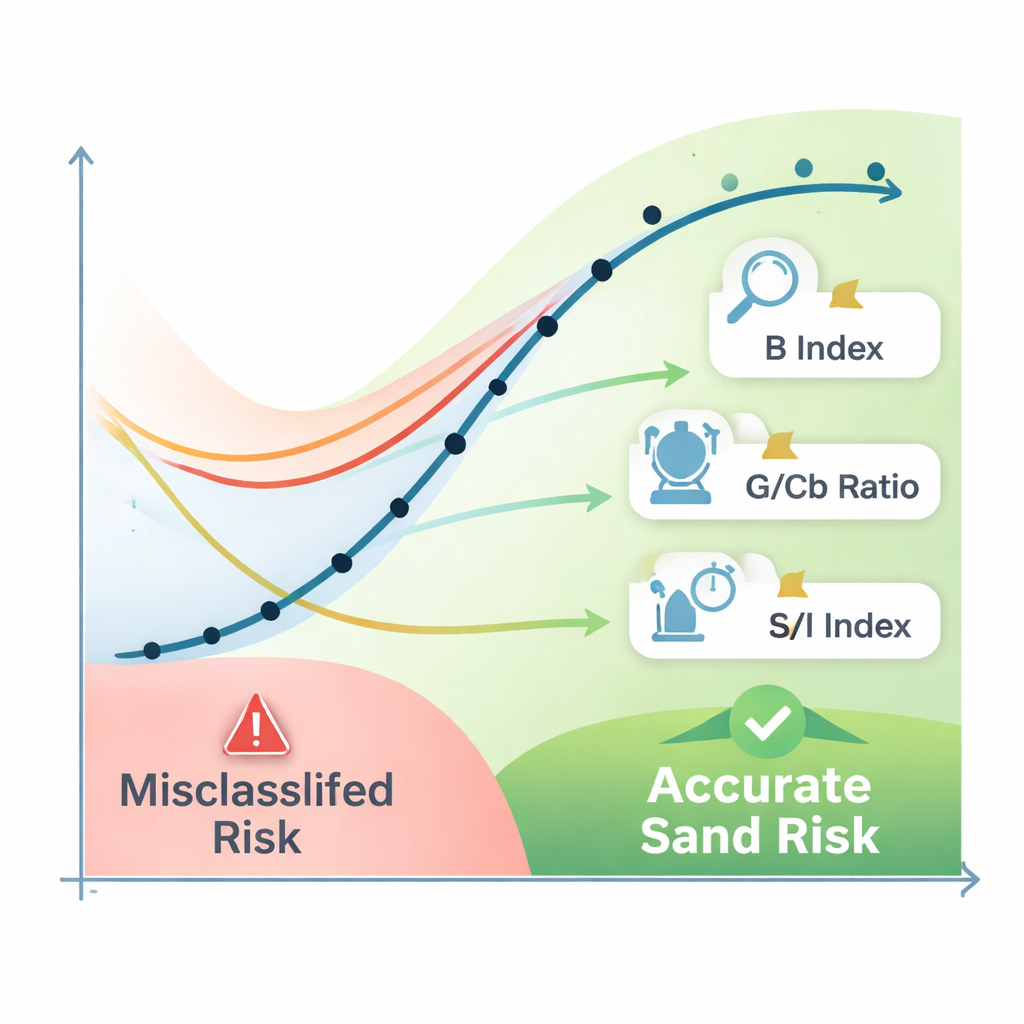
The head‑to‑head comparison revealed a stark pattern. Most traditional formulas for Young’s modulus and Poisson’s ratio produced values that either barely correlated with laboratory measurements or even trended in the wrong direction. When these poor estimates were fed into the three sand prediction methods, the outcome was inconsistent: some models flagged sand risks where none existed, while others missed clearly sand‑prone intervals. In sharp contrast, a Gaussian process regression model for Young’s modulus and a deep‑learning model (based on gated recurrent units) for Poisson’s ratio, both developed by the same research group in earlier work, tracked the measured data almost perfectly. Statistical tests showed a coefficient of determination close to 1 and vanishingly small errors. With these accurate inputs, all three sand prediction methods—B, G/Cb, and S/I—gave sand/no‑sand results that closely matched the laboratory‑based benchmarks.
Seeing rock types more clearly
Beyond predicting sand, engineers also classify reservoir rock as loose, weakly cemented, or well consolidated based on stiffness, and as soft, medium, or hard based on Poisson’s ratio. These categories guide choices such as whether to install gravel packs or more robust sand screens. The study showed that most legacy models mis‑assigned many samples to the wrong rock class, potentially leading to over‑designed or under‑designed sand control. The machine‑learning models again stood out, reproducing the same rock type classifications as those derived from measured properties for most samples. This means they can not only signal where sand is likely, but also give a more reliable picture of the overall mechanical character of the reservoir.
What this means for real‑world wells
For non‑specialists, the key message is that the quality of the “ingredients” going into sand prediction tools matters as much as the tools themselves. Using poorly calibrated formulas for rock stiffness and deformability can make a reservoir look either safer or riskier than it really is, driving expensive and sometimes unnecessary interventions. By rigorously benchmarking many models against real measurements, the authors show that a few carefully trained machine‑learning approaches can provide rock property estimates accurate enough to strongly improve forecasts of when sand will appear and what kind of rock is present. In practical terms, this offers operators a more dependable basis for designing wells, choosing sand control strategies, and reducing the chances that invisible grains will one day bring a multi‑million‑dollar project to a halt.
Citation: Alakbari, F.S., Mahmood, S.M., Abdelnaby, M.M. et al. Enhancing sand production assessment through accurate determination of Young’s modulus and Poisson’s ratio. Sci Rep 16, 6826 (2026). https://doi.org/10.1038/s41598-026-36761-2
Keywords: sand production, reservoir geomechanics, Young’s modulus, Poisson’s ratio, machine learning models