Clear Sky Science · en
Effect of high shear-dispersed nano-alumina on concrete strength, durability, and microstructure
Why Tiny Additives Matter for Big Structures
Concrete is the backbone of modern cities, but it can crack, crumble under harsh weather, and weaken when attacked by chemicals or fire. This study explores how adding an extremely fine powder called nano-alumina—particles thousands of times smaller than a grain of sand—and mixing it with a powerful high-speed stirrer can make everyday concrete stronger, longer-lasting, and more predictable in performance. The work aims to turn a laboratory idea into something that real construction sites can actually use at scale.
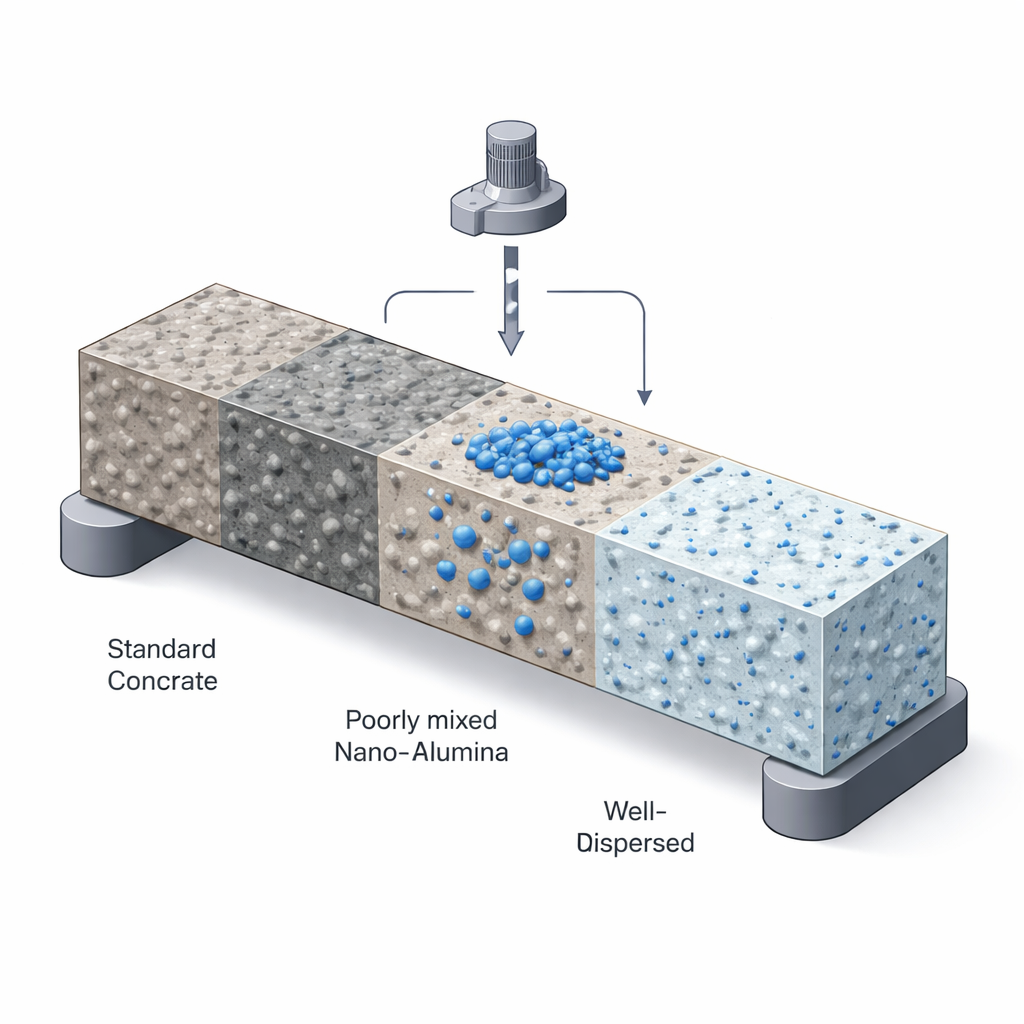
Making a Smarter Concrete Mix
The researchers worked with a common structural concrete (known as M40 grade) and added small amounts of nano-alumina equal to 0.5%, 1.0%, and 1.5% of the cement’s weight. Rather than just dumping the powder into the mixer, they first blended it into the mixing water using a high shear mixer that spins at about 3000 revolutions per minute. This intense stirring breaks up clumps and spreads the nano-sized particles evenly, shrinking them into the range of 10–30 billionths of a meter. The treated water–powder blend was then combined with sand, gravel, cement, and a standard chemical additive that helps the wet concrete flow.
Testing Strength from All Angles
To see how this modified concrete behaved, the team tested three key types of strength. Compressive strength measures how much squeezing force a concrete cube can withstand; split tensile strength captures how well it resists pulling apart; and flexural strength shows how it performs under bending, as in a beam or slab. Over periods up to 180 days, mixes with nano-alumina consistently outperformed the ordinary control mix. At 28 days, the mix with 1.5% nano-alumina showed nearly 27% higher compressive strength, about 38% higher tensile strength, and roughly 48% higher bending strength. With longer curing up to 180 days, compressive strength passed 74 megapascals—well into high-performance territory for structural concrete.
Standing Up to Harsh Conditions
Concrete in the real world must survive salt-laden environments, industrial chemicals, freezing winters, and occasional fire. The researchers exposed their samples to strong salt and acid solutions, repeated freeze–thaw cycles, and high temperatures up to 600 °C. In almost all of these tests, nano-alumina mixes held their strength better than the conventional mix, especially at the 1.5% dosage. They lost less strength after chemical attack and freeze–thaw cycling, and they performed noticeably better up to about 400 °C. At 600 °C all concretes weakened, but the nano-alumina versions still showed reduced damage compared with standard concrete. These gains are linked to a tighter internal structure that slows the entry of harmful substances and reduces the amount of water available to freeze or turn to steam.
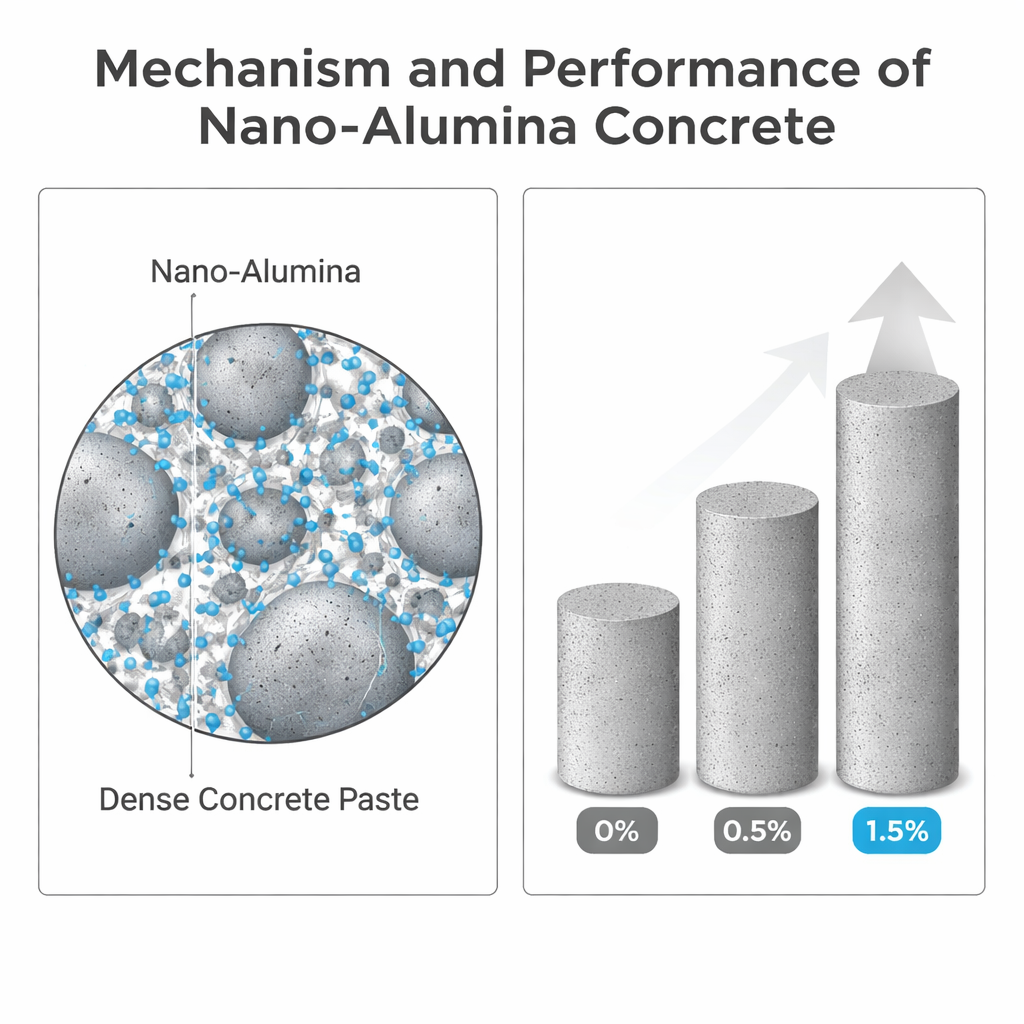
A Denser Inner World
Microscope images revealed what was happening inside. Ordinary concrete contains tiny gaps and weak zones around the stones and sand. With nano-alumina and high shear mixing, these gaps shrank dramatically—average void size dropped by about 65% in the best mix, and the transition zone around aggregates became thinner and more solid. The nano particles act like ultra-fine filler, plugging micro-voids, and they also take part in the chemical reactions that bind concrete, forming extra gel-like material that glues everything together. This denser, more continuous network explains the higher strength and better durability. Statistical models confirmed that not only did the concrete get stronger, its performance also became more consistent and predictable from sample to sample.
What This Means for Everyday Building
To a non-specialist, the message is straightforward: by using tiny, carefully dispersed particles and a high-speed mixer, it is possible to make ordinary concrete both tougher and more reliable without radically changing construction practices. The study shows that how nano materials are mixed is more important than simply how much is added. When dispersed properly, modest amounts of nano-alumina can help structures better withstand heavy loads, chemical attack, freeze–thaw damage, and moderate fire exposure. This points toward a future where bridges, buildings, and infrastructure last longer and require less repair, simply by refining what goes into each batch of concrete and how it is blended.
Citation: Rahman, I., Dev, N., Arif, M. et al. Effect of high shear-dispersed nano-alumina on concrete strength, durability, and microstructure. Sci Rep 16, 5346 (2026). https://doi.org/10.1038/s41598-026-36760-3
Keywords: nano-alumina concrete, high shear mixing, durable infrastructure, nanotechnology in construction, high performance concrete