Clear Sky Science · en
Evaluation of water resources carrying capacity in Ordos city based on the Game Theory-Topsis-Grey Prediction coupling model
Why water limits matter in a booming desert city
In the dry grasslands of Inner Mongolia, Ordos has become one of China’s biggest coal and energy hubs. Yet this fast-growing city sits in a region where rainfall is scarce, evaporation is intense, and ecosystems are fragile. The study behind this article asks a simple but crucial question: how much development can Ordos sustain with the water it has—and is getting from the Yellow River—without pushing its environment past a breaking point?
Balancing growth and survival in a dry land
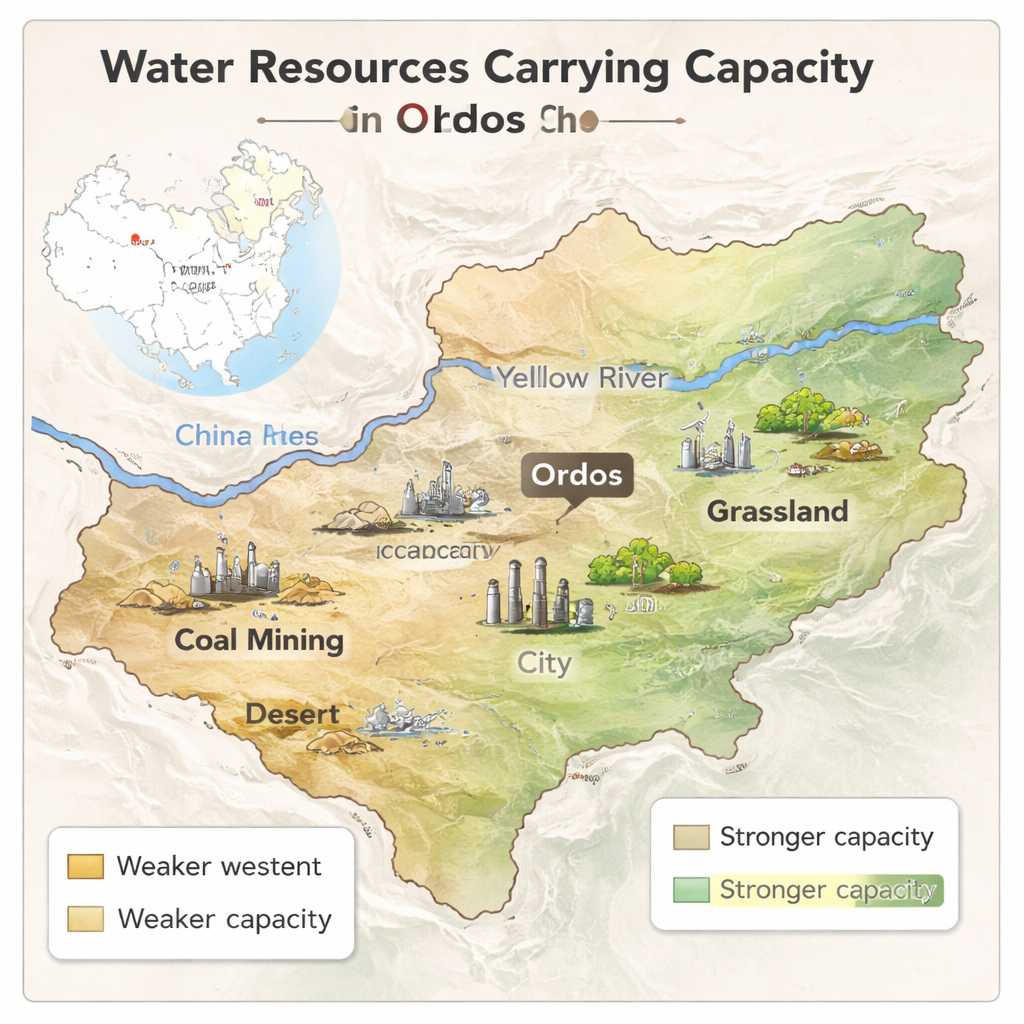
Ordos lies in the upper reaches of the Yellow River Basin, with annual rainfall of only 150–400 millimeters and evaporation several times higher. At the same time, it supplies about 17 percent of China’s raw coal and has an urbanization rate near 80 percent. These twin pressures—high water demand and a delicate environment—make Ordos a test case for how resource-based cities can grow without exhausting their limited water. The authors examine the city’s “water resources carrying capacity,” a measure of how well water supplies can support people, industry, and nature while staying within safe limits.
Turning many clues into a single health check
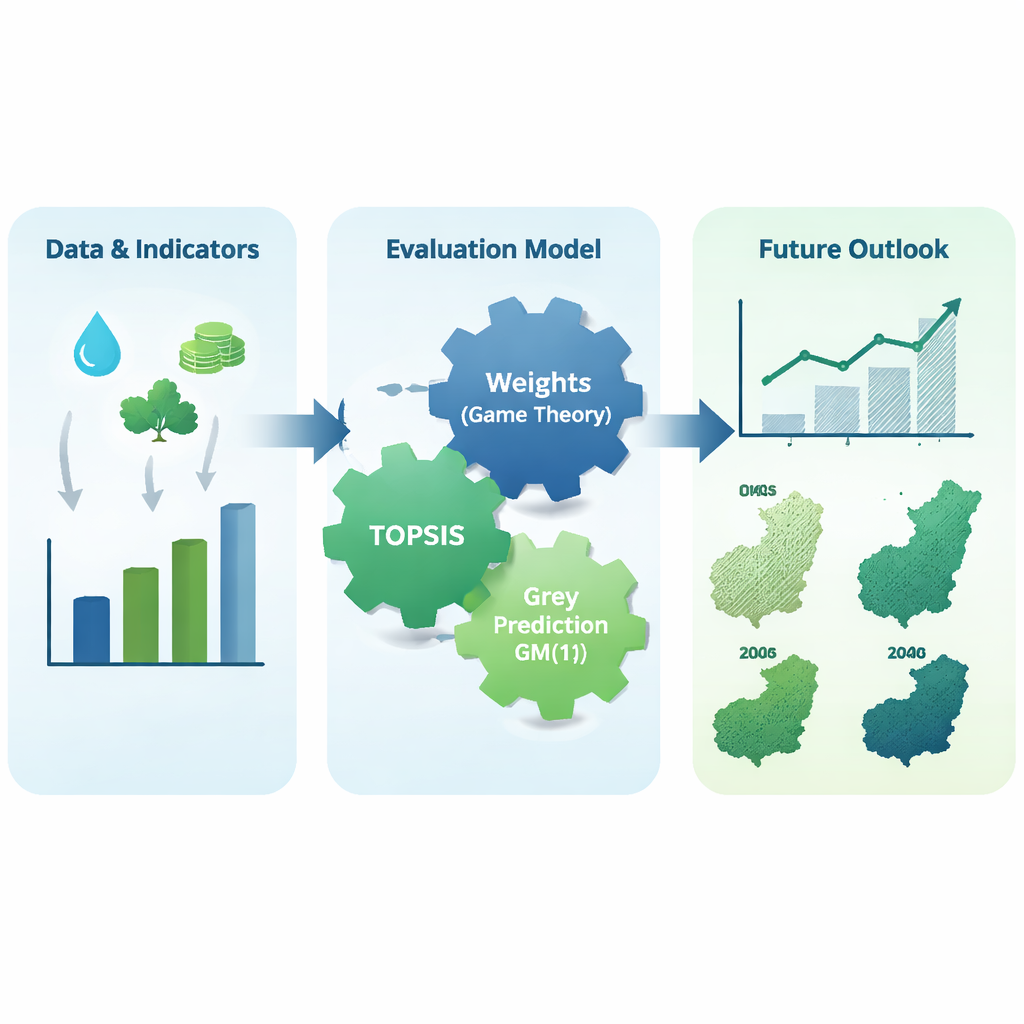
To judge Ordos’s water situation, the team built an index system with 20 indicators grouped into three themes: water resources (such as total water availability, use, and reclaimed water), social and economic activity (like population, gross domestic product, and coal output), and ecological conditions (including green space and river health). Because different indicators matter to different degrees, they must be weighted. Traditional methods either rely heavily on expert opinion or purely on statistical patterns, which can bias results. Here, the researchers treat weight setting as a kind of “negotiation game” between subjective expert judgment and several data-driven methods, using game theory to find a balanced compromise. This approach cut random swings in weights by about a third and avoided overvaluing flashy economic indicators while rescuing underappreciated but important ones such as reclaimed water use.
Tracking change across space and time
With these refined weights, the authors used a decision tool called TOPSIS to calculate a yearly water-carrying index for each county-level area of Ordos from 2000 to 2023. The index runs from 0 to 1, where higher values mean better capacity. Citywide, it rose from 0.33 to 0.64 over the study period, an average annual gain of 2.9 percent. Early years showed heavy overload, but conditions gradually improved to a “bearable” level. The pattern is uneven: eastern areas along the Yellow River, supported by diversion projects that add about 28 million cubic meters of water annually and by dense water works, moved sooner into safer territory. Western areas, dominated by desert and water-hungry agriculture, lagged behind, though they too shifted from chronic overload to at least “weak” sustainability by 2023.
Looking ahead with cautious optimism
To peer into the future, the team turned to a forecasting technique called a grey prediction model, well-suited for short data records and uncertain systems. Feeding in the past 24 years of index values, they projected Ordos’s overall water-carrying index to reach about 0.63 in 2025, 0.77 in 2030, and nearly 0.97 by 2040—firmly in the “strong carrying” range. Statistical checks suggest the model’s errors are generally small, although the authors acknowledge that extreme droughts or other shocks, which are hard to forecast, could still disrupt this trajectory. The results imply that continued investment in ecological restoration, reclaimed water, and smarter allocation can keep widening the city’s safety margin, even as its economy evolves.
What this means for people and policy
For non-specialists, the message is reassuring but not complacent. Ordos has moved from a water system under severe strain toward one that can reasonably support its people, industries, and ecosystems—if hard-won gains are protected. The study’s combined toolkit of weighted indicators, status evaluation, and future projection offers local and national planners a way to set realistic limits on population, industry, and land use that match what the water can actually bear. As other dry, resource-heavy regions grapple with climate change and carbon reduction goals, this kind of dynamic “water budget” could help ensure that economic prosperity does not come at the cost of long-term ecological collapse.
Citation: Zhao, Y., Yin, H., Zhang, W. et al. Evaluation of water resources carrying capacity in Ordos city based on the Game Theory-Topsis-Grey Prediction coupling model. Sci Rep 16, 5782 (2026). https://doi.org/10.1038/s41598-026-36754-1
Keywords: water resources carrying capacity, Yellow River Basin, Ordos City, sustainable water management, grey prediction model