Clear Sky Science · en
OCT biomarkers as predictors of treatment interval in neovascular age-related macular degeneration treated with intravitreal aflibercept using a treat-and-extend regimen
Why this matters for aging eyes
As people live longer, more of us face age-related problems with vision. One major culprit is neovascular age-related macular degeneration (nAMD), a disease that damages the central part of the retina and can steal sharp sight. Modern drugs injected into the eye can preserve vision, but they require repeated visits and shots. This study asks a practical question that matters deeply to patients and caregivers: at the very first scan, can doctors see signs that predict how often someone will need these injections over the coming year?
Balancing eyesight and treatment burden
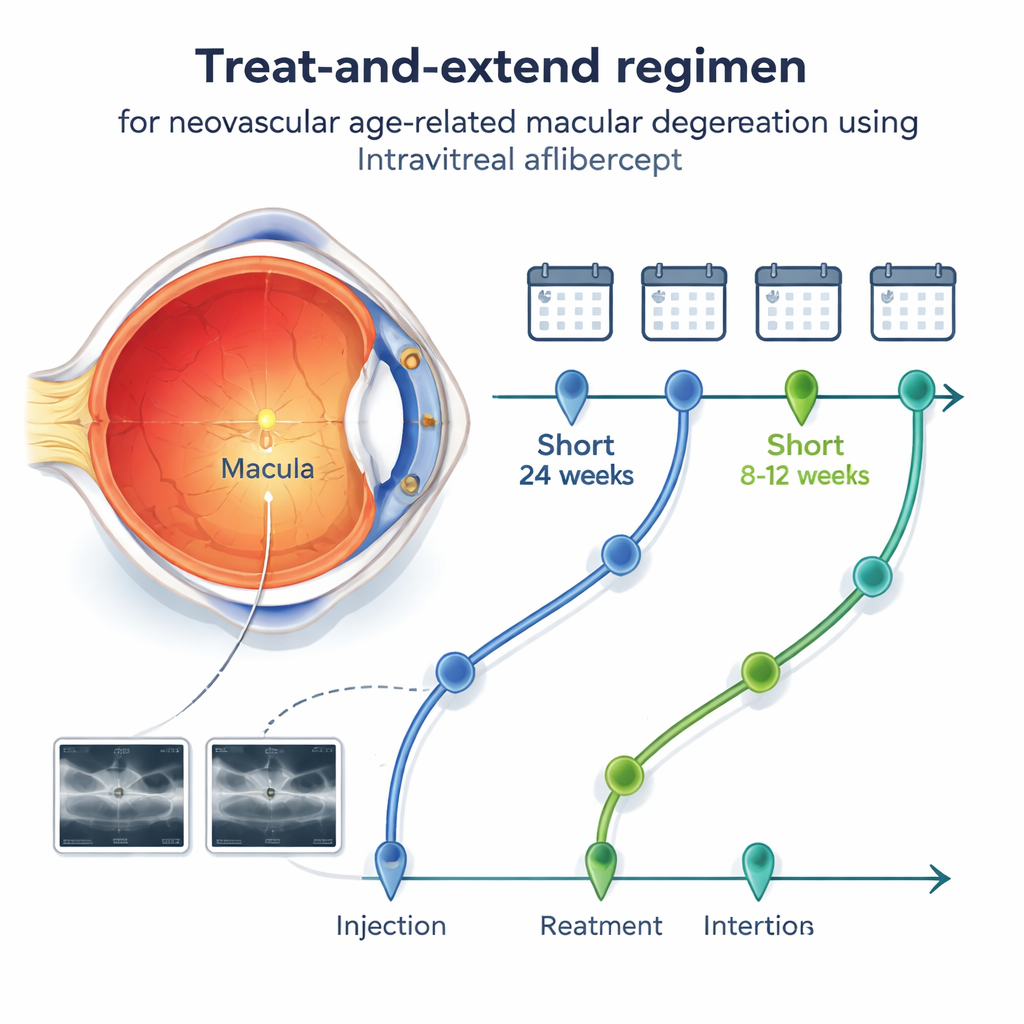
The standard drugs used for nAMD block a signal called VEGF that drives the growth of abnormal, leaky blood vessels under the retina. One common way to give these drugs is called “treat-and-extend.” After a few monthly doses to calm the disease, doctors gradually stretch the time between visits as long as the retina stays quiet on imaging, or shorten it again if the disease flares. This approach aims to keep vision stable while cutting down on clinic visits. Yet some patients can safely go several months between injections, while others need frequent treatment. Today, that difference is mostly discovered by trial and error over time.
Looking for early clues in retinal scans
The researchers reviewed real-world records from 174 eyes with newly diagnosed nAMD, all treated only with the drug aflibercept using a treat-and-extend schedule over at least one year. Before treatment began, every eye had a detailed optical coherence tomography (OCT) scan—a kind of “optical ultrasound” that shows the fine layers of the retina. The team examined many features on these scans, from overall retinal thickness and pockets of fluid to subtle changes in specific light-reflecting bands. To help with the more complex measurements, they used a deep learning computer program to automatically outline and quantify different types of fluid within the retina.
Who needed injections more often?
After one year, a little more than half of the eyes had managed to reach treatment intervals of 12 weeks or longer, while the rest still needed injections every 8–10 weeks or less. Surprisingly, the sheer amount of retinal fluid measured by the computer model did not reliably predict which group a patient would fall into. Instead, several more structural features stood out. Eyes with a form of the disease called retinal angiomatous proliferation tended to need more frequent injections. So did eyes in which two delicate layers in the light-sensing cells—the external limiting membrane and the ellipsoid zone—were more extensively broken up at the start.
Hidden damage in the light-sensing layer
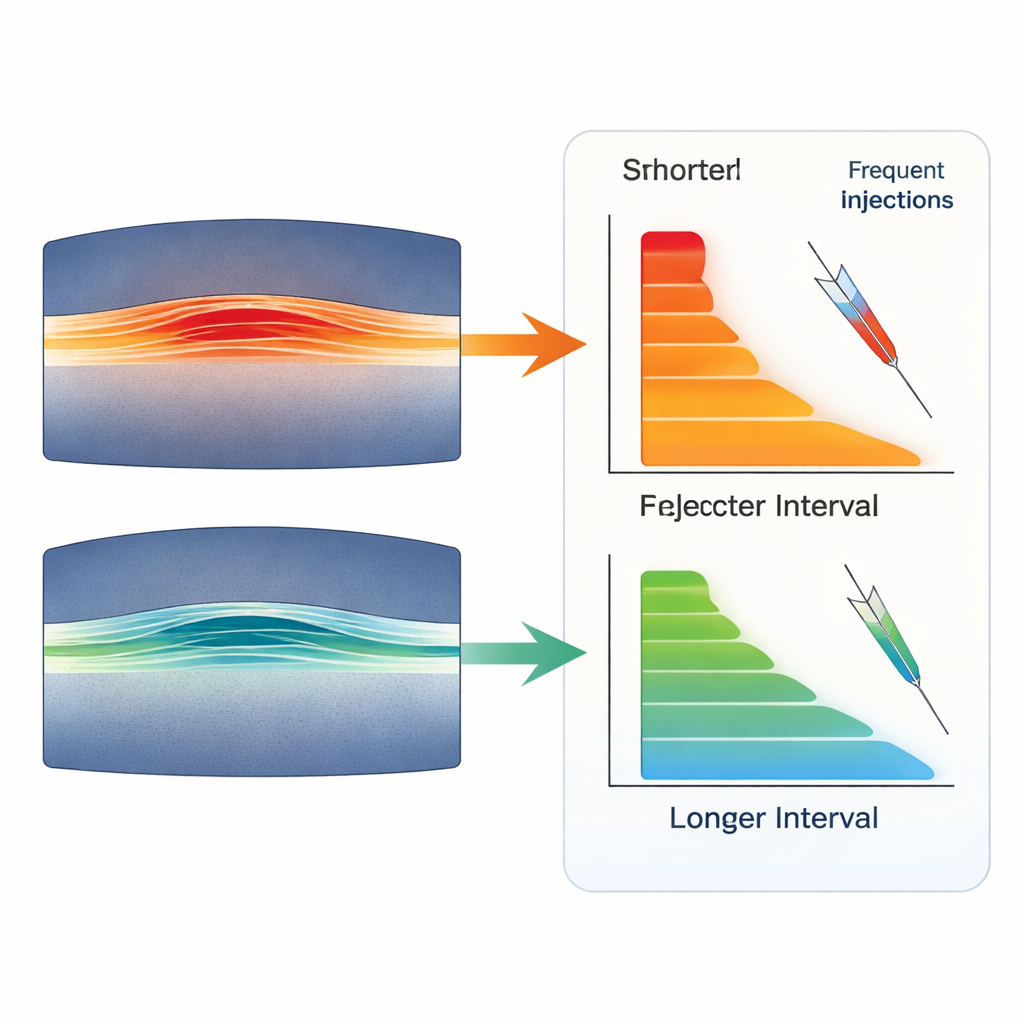
These two layers sit within the photoreceptors, the cells that turn light into electrical signals. When they appear continuous and clean on OCT, it usually signals healthier tissue and a better outlook for vision. In this study, longer stretches of missing or disrupted lines in these layers were strongly linked with a heavier treatment burden: eyes with greater damage were more likely to require injections at intervals shorter than 12 weeks throughout the year. Interestingly, the presence of bleeding inside or under the retina at the first visit was associated with a lower chance of needing very frequent injections later, a finding the authors suggest may reflect differences in how certain subtypes of the disease evolve after a bleed.
What this means for patients and doctors
For people newly facing nAMD, these findings suggest that their very first high-resolution retinal scan may already hold clues about how demanding their future treatment schedule will be. Rather than focusing only on how much fluid is present, doctors may gain more by carefully judging the integrity of the fine photoreceptor layers and recognizing specific disease patterns. While these signs cannot yet be used as strict rules, they move care a step closer to personalized planning—helping patients prepare for whether they are likely to need frequent visits or may eventually enjoy longer breaks between injections, all while keeping their central vision as stable as possible.
Citation: Lee, J., Lee, SY., Jang, B. et al. OCT biomarkers as predictors of treatment interval in neovascular age-related macular degeneration treated with intravitreal aflibercept using a treat-and-extend regimen. Sci Rep 16, 6504 (2026). https://doi.org/10.1038/s41598-026-36751-4
Keywords: age-related macular degeneration, ocular coherence tomography, retinal biomarkers, treat and extend regimen, intravitreal aflibercept