Clear Sky Science · en
Inter-neural co-regulation before and after an interactive perturbation in mother-infant dyads
How Babies and Parents Tune In to Each Other
Anyone who has cared for a baby knows that moments of perfect connection are often interrupted by fussing, distraction, or withdrawal. This study asks a striking question: when these little ruptures in interaction happen, do the brains of mothers and their 9‑month‑old infants fall out of sync, and then retune themselves? By measuring brain activity in both partners at the same time, the researchers show that everyday ups and downs in a baby’s mood are mirrored by subtle shifts in how parent and child’s brains coordinate.
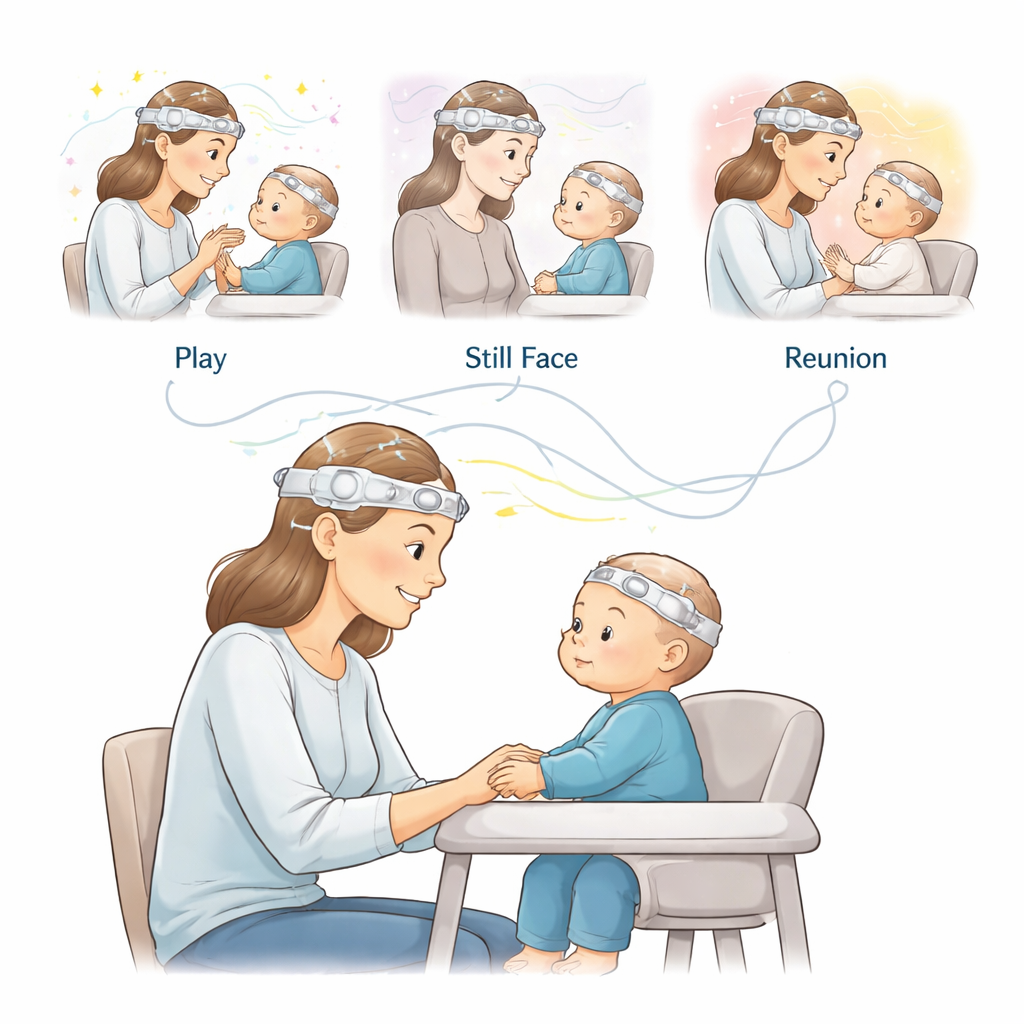
A Classic Stress Test for Baby–Parent Bonds
To explore this, the team used a well-known laboratory setup called the Face-to-Face Still-Face procedure. First, mothers and babies played together freely for a couple of minutes. Then, for a short period, the mother kept a neutral, still expression and stopped responding, while maintaining eye contact. Finally, she resumed normal playful interaction in a reunion phase. This brief “social freeze” is known to be stressful for many infants and reliably reveals how well a pair can move from connection to disruption and back again.
Watching Behavior and Brain Waves Together
Sixty-six healthy mother–infant pairs took part when the babies were about nine and a half months old. Both wore soft caps that recorded electrical activity from the scalp, allowing the researchers to look at ongoing brain rhythms. At the same time, videos of the interactions were carefully coded frame by frame: how often the baby smiled or cried, turned away or looked at the mother’s face, and how frequently mother and child shared eye contact or positive emotion at the same time. The scientists focused on two types of brain waves seen in both adults and infants—slower “theta” rhythms and slightly faster “alpha” rhythms—which have been linked to attention, emotion, and self‑control.
How Babies React When Mom Goes Still
The still-face episode worked as intended: compared with the play phase, babies showed more negative emotion and turned their gaze away more often, and these signs only partly settled during reunion. Mothers, in contrast, did not drastically change how much they looked at, talked to, or touched their babies between play and reunion. However, the quality of the shared moment did shift. During reunion, mother and child spent less time in mutual gaze and shared positive emotion than during the initial play period, suggesting that the earlier disruption left a lingering mark on the interaction even after the mother “came back.”
Shifting Patterns of Brain-to-Brain Connection
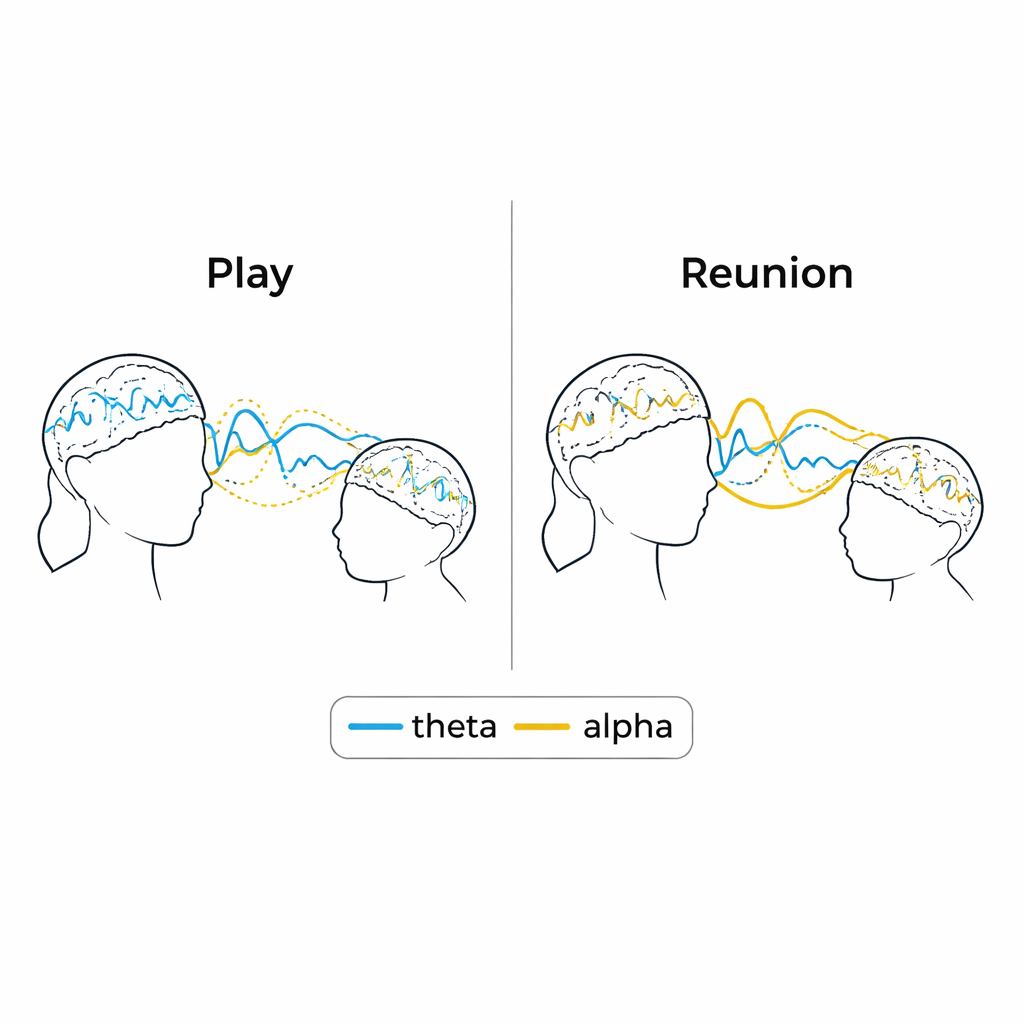
At the brain level, the researchers asked how tightly the mothers’ and infants’ rhythms lined up with each other, a measure sometimes called inter-neural synchrony. They found that, across the group, coordination in the alpha band was stronger during reunion than during play, hinting that the pair’s brains became more tightly coupled after the stressful interruption. In contrast, for girls but not boys, coupling in the theta band decreased from play to reunion, suggesting that not all forms of brain synchrony move in the same direction after a disruption. Before the still-face, higher theta synchrony was linked with more moments of mutual gaze, especially in regions toward the back of the head, but this relationship faded in the reunion period. In other words, when the interaction was smooth and undisturbed, looking at each other’s faces went hand in hand with a certain kind of brain alignment; after the break, that link loosened.
What This Means for Everyday Parenting
For non-specialists, the main lesson is reassuring: brief mismatches and upsets are not signs of failure, but part of a dance in which parent and child continually lose and regain coordination. This study suggests that as they do so, their brains reorganize as well, increasing some kinds of shared activity while letting others relax. These flexible changes in brain synchrony may be one way that everyday relationships help babies build resilience—learning that moments of disconnection can be tolerated and repaired. Over time, that repeated experience of "falling out of sync" and finding a new balance may support healthy emotional and social development.
Citation: Capelli, E., Provenzi, L., Pili, M.P. et al. Inter-neural co-regulation before and after an interactive perturbation in mother-infant dyads. Sci Rep 16, 4492 (2026). https://doi.org/10.1038/s41598-026-36750-5
Keywords: mother-infant interaction, brain synchrony, EEG hyperscanning, emotion regulation, still-face paradigm