Clear Sky Science · en
The relationship between natural hydrogen flow rates and production viability
Why Hidden Hydrogen Matters
As the world looks for clean fuels to replace oil and gas, some scientists and start‑ups are betting on “natural hydrogen” — hydrogen gas that forms underground on its own. If large, accessible pockets exist, they could offer low‑carbon energy without the need for big factories or massive solar farms. This study asks a simple but crucial question: do the natural hydrogen flows we see today come anywhere close to what would be needed to run real‑world energy projects?
Two Ways Earth Can Store Hydrogen
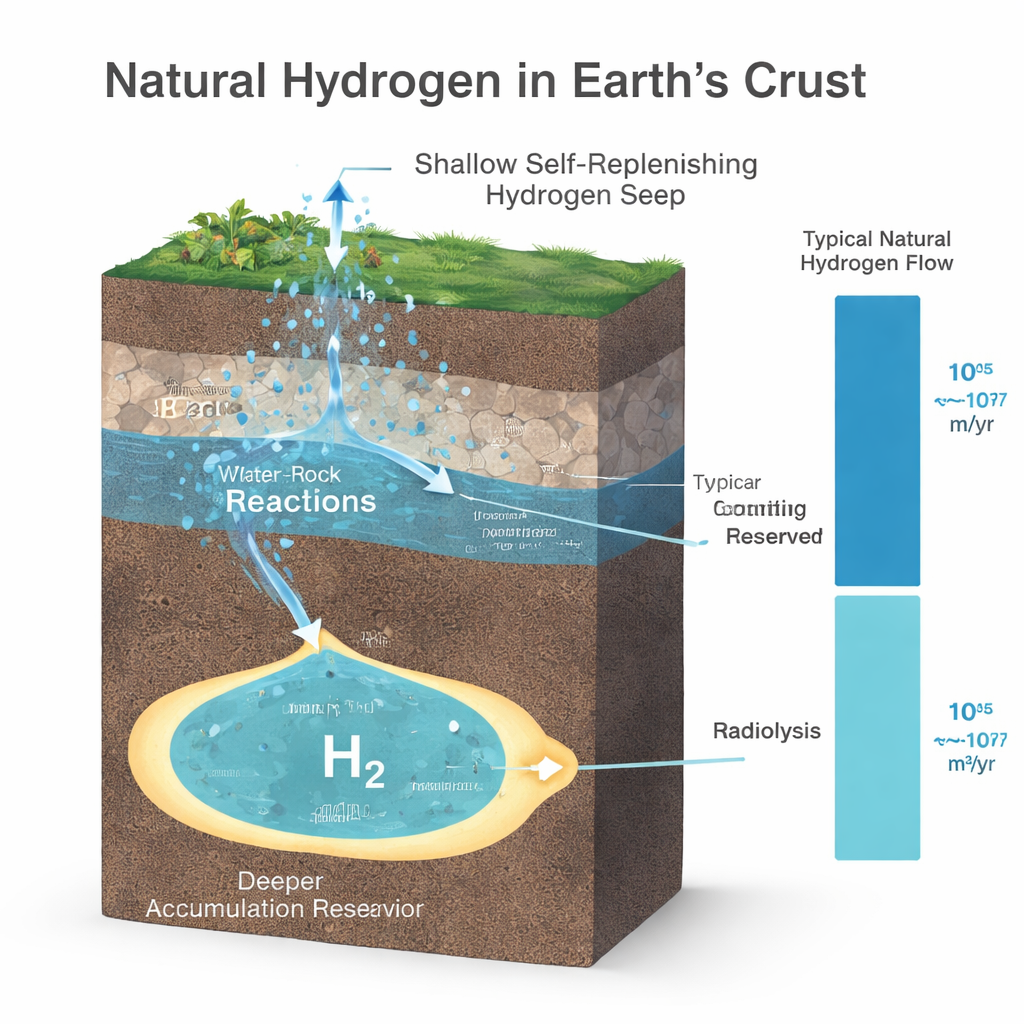
The authors describe two basic underground hydrogen scenarios. In a self‑replenishing system, rocks and water react quickly enough that newly formed hydrogen continuously replaces what seeps out or is pumped up — in theory behaving like a renewable resource. In an accumulation system, hydrogen trickles out of rocks over thousands of years and slowly builds up in underground traps, much like conventional gas fields. Both systems are fed mainly by reactions between water and iron‑rich rocks and by the slow splitting of water by natural radioactivity. The key unknown is whether any of these processes are fast and focused enough to sustain industrial‑scale production.
Measuring What Actually Comes Out of the Ground
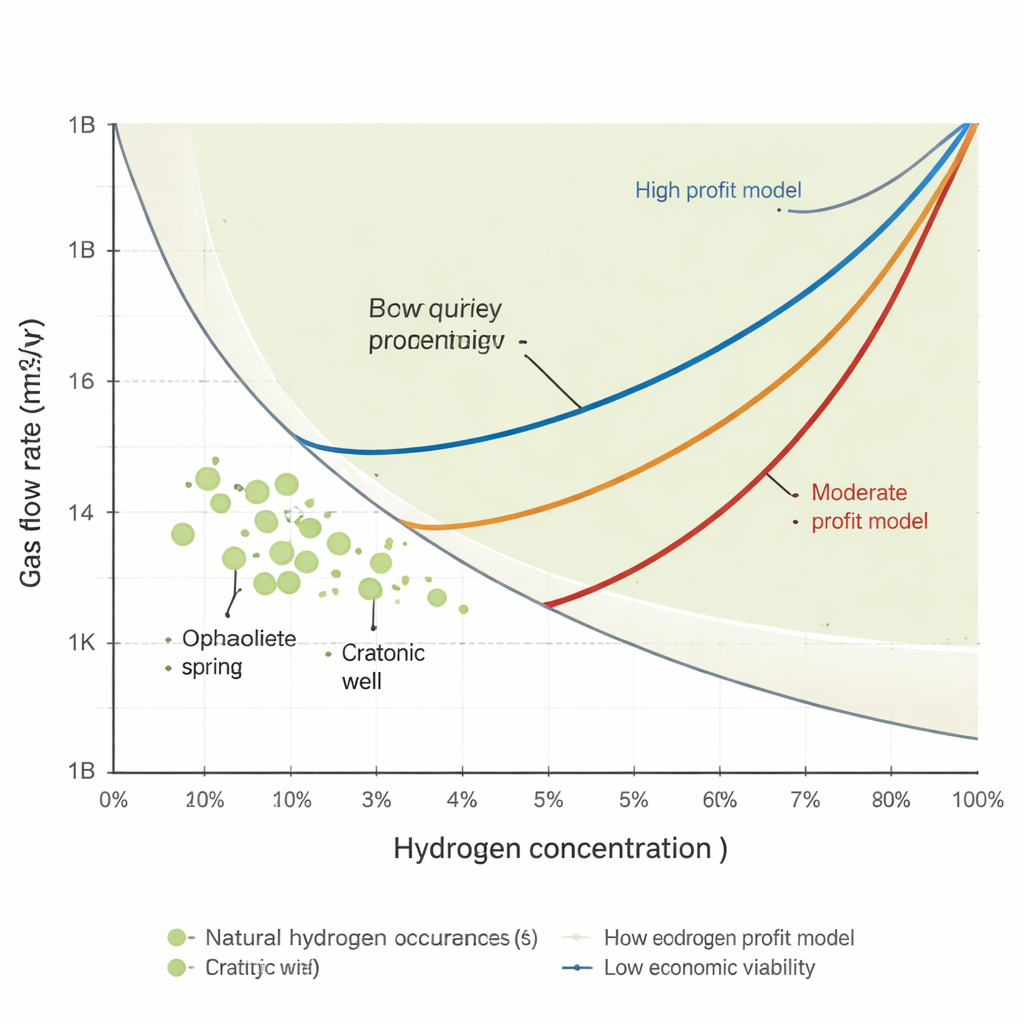
To ground the debate in numbers, the team assembled worldwide data on hydrogen escaping at seeps, springs, mines and wells. They distinguished between overall flow (how many cubic meters of gas come out per year) and flux (how intense the flow is per unit area). Where only flux was known, they converted it into an approximate total flow. Across different geological settings — from ancient continental cores (cratons) to slices of ocean crust pushed up on land (ophiolites) — most measured hydrogen flows fall between one hundred thousand and ten million cubic meters per year. Only a handful of locations, such as some ophiolite areas and a well in Mali, reach the upper end of that range, and even those often mix hydrogen with other gases.
Stacking Hydrogen Against Natural Gas Economics
Because there is almost no open data from dedicated hydrogen wells, the authors compare these natural flows to what is routine in the natural gas industry. A typical onshore gas well in the United States produces tens of millions of cubic meters of gas per year; giant fields can reach hundreds of millions of cubic meters per well annually, often over decades. Techno‑economic studies of future hydrogen projects suggest that, to be competitive, a hydrogen well would likely need to deliver on the order of ten to one hundred million cubic meters of hydrogen per year, at high purity, for twenty to thirty years. When the observed hydrogen flows from nature are plotted against their hydrogen content, almost all points fall well below these economic thresholds. High flows usually have low hydrogen percentages, and high‑purity hydrogen almost always comes with modest flow rates.
How Much Hydrogen Does the Planet Make?
The authors then zoom out from local seeps to the global picture. Recent estimates suggest that natural processes in the continental crust may generate a few billion cubic meters of hydrogen per year. But much of the total global hydrogen budget comes from places that are essentially unreachable, such as the deep ocean floor or underwater volcanoes, where any gas dissolves rapidly in seawater. After excluding these areas and discounting speculative sources like very deep “primordial” hydrogen from Earth’s mantle, the amount of hydrogen that might realistically accumulate on land becomes much smaller. Using analogies with oil and gas, where only a tiny fraction of generated hydrocarbons are ever trapped in usable deposits, the study estimates that only tens of millions of cubic meters of hydrogen per year may end up stored in onshore reservoirs worldwide.
Slowly Filling Small Underground Tanks
Putting these numbers together, the authors infer that economically attractive hydrogen deposits probably require long‑term buildup rather than rapid, self‑renewing flow. If rocks underground were generating around ten million cubic meters of hydrogen each year, and only a tiny fraction of that were successfully trapped under a tight seal, it could take on the order of ten thousand years to fill a reservoir large enough to support commercial production for a few decades. Even under very optimistic assumptions, the timescale is still centuries. That means viable deposits are more likely to be rare, long‑lived accumulations in specific geological settings — such as certain ophiolite belts, rift zones, or thick sediment‑covered ancient crust — rather than quickly refilling natural “wells.”
What This Means for a Hydrogen Future
For non‑specialists, the take‑home message is that natural hydrogen is real and sometimes abundant locally, but the flows we can currently measure fall far short of what is needed to power large‑scale energy projects in a self‑replenishing way. The study argues that truly renewable, continuously refilling underground hydrogen sources are unlikely to supply significant commercial energy. Instead, if natural hydrogen plays a role in future energy systems, it will probably resemble conventional gas: focused exploration for rare accumulations, careful assessment of long‑term well performance, and attention to supporting infrastructure and co‑products such as helium or geothermal heat.
Citation: Franke, D., Klitzke, P., Bagge, M. et al. The relationship between natural hydrogen flow rates and production viability. Sci Rep 16, 3036 (2026). https://doi.org/10.1038/s41598-026-36749-y
Keywords: natural hydrogen, geologic energy, underground gas reservoirs, hydrogen exploration, energy transition