Clear Sky Science · en
Randomized controlled trial of whole body vibration training on lower limb muscle strength in sub elite short track speed skaters
Shaking Your Way to Stronger Legs
Short-track speed skating is a sport of razor-thin margins, where stronger legs can mean the difference between winning and wiping out on the ice. This study asked a simple but intriguing question with broader appeal to athletes and fitness enthusiasts alike: can standing in a semi-squat on a vibrating platform—essentially “shaking” the body in a controlled way—make leg muscles stronger and more powerful in just a few weeks, and does the exact vibration setting matter?
What the Researchers Wanted to Know
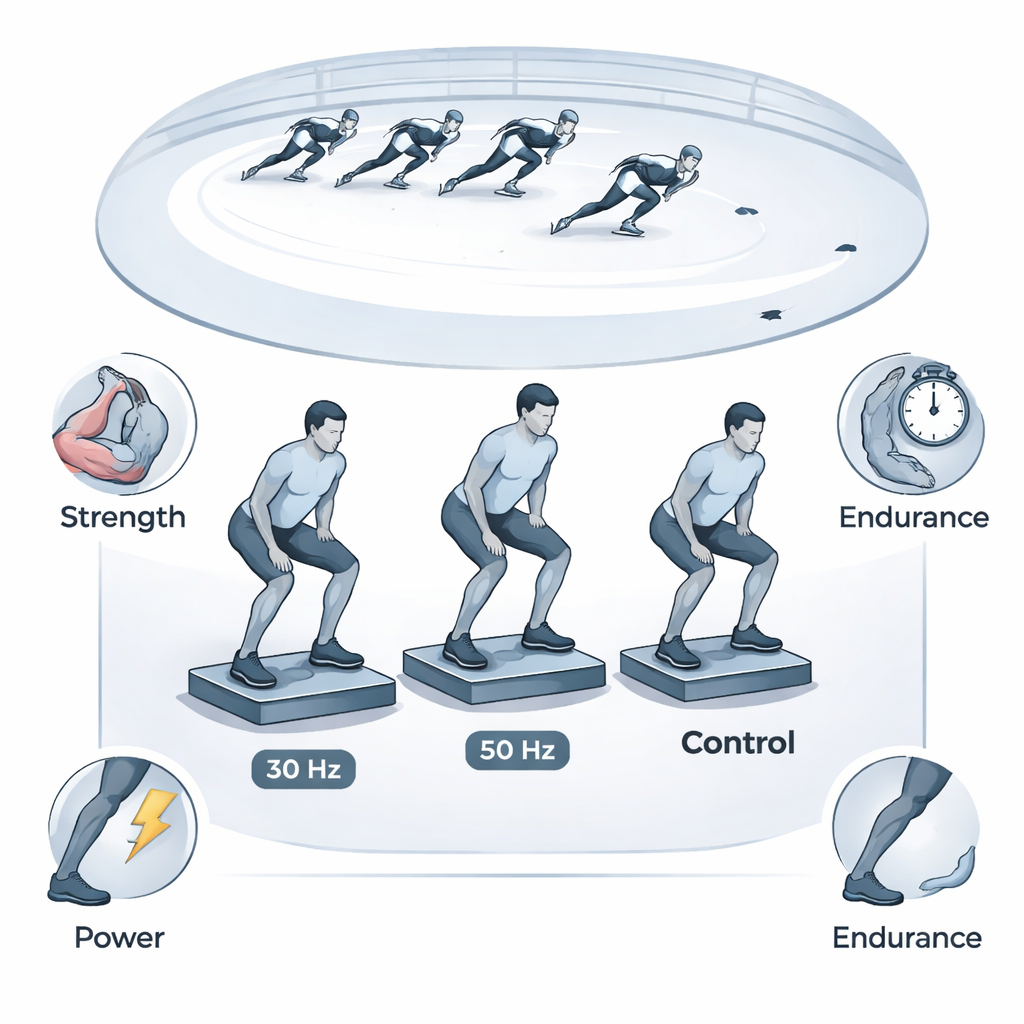
The team focused on whole-body vibration training, in which people stand on a platform that rapidly moves up and down. Earlier work suggested that such vibrations can make muscles contract reflexively, recruiting more muscle fibers without adding heavy weights. Yet scientists still debate which vibration settings are best. Here, the researchers investigated whether two commonly used vibration frequencies—30 times per second (30 Hz) and 50 times per second (50 Hz)—would have different effects on the leg strength of sub-elite male short-track speed skaters, athletes who already train 20–30 hours per week.
How the Study Was Set Up
Seventy-five experienced male skaters from a sports university in China were randomly assigned to one of three groups: a 30 Hz vibration group, a 50 Hz vibration group, or a control group that stood on the same platform without vibration. Twice a week for four weeks, all skaters held a semi-squat position—similar to their skating posture—for short 30-second bouts on the platform at a small 2-millimeter vibration amplitude. Before and after the four-week period, a specialized machine measured how strong and powerful their knee muscles were, and how much total work the muscles could perform, capturing maximum strength, explosive power, and muscular endurance in bending and straightening the knees.
What Happened to Leg Strength and Power
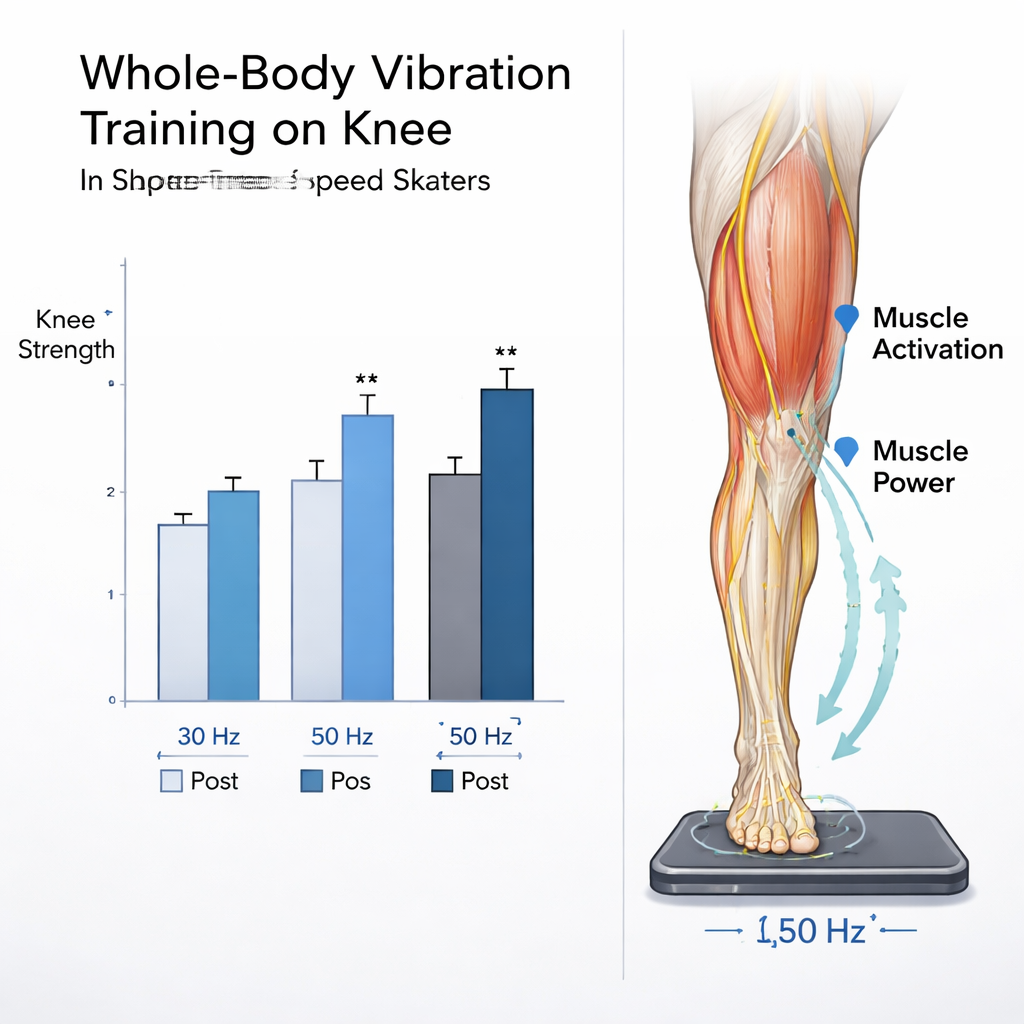
After just four weeks, both vibration groups showed clear gains. Their knee muscles could produce higher peak forces and greater peak power compared with their own starting values, while the control group changed little. The improvements were not just statistically significant; many came with large effect sizes, meaning the changes were meaningful in practice, not just on paper. When the researchers compared the three groups head-to-head, the 50 Hz group usually came out on top. These skaters improved maximal and explosive strength of the muscles that bend the knees on both legs more than those in the 30 Hz group, and often outperformed the control group in the muscles that straighten the knee as well. In contrast, the control skaters, who simply held the same posture without vibration, gained little despite continuing their usual demanding training schedules.
Endurance Gains and Possible Explanations
The story for muscular endurance—the ability to keep working under fatigue—was a bit different. Both vibration settings increased the total work the knee muscles could perform over repeated contractions, suggesting better strength endurance, but there was no consistent advantage of 50 Hz over 30 Hz. The authors suggest that endurance may simply require more than four weeks to show frequency-specific differences, or that it is less sensitive to vibration setting than pure strength and power. They point to proposed mechanisms in which vibration stimulates reflexes in the muscles and nervous system, leading to quicker and stronger recruitment of muscle fibers, particularly those suited for fast, explosive movements. However, these mechanisms were not directly measured in this trial, and changes on the ice—such as faster lap times or sharper turns—were not tested.
What This Means for Skaters and the Rest of Us
In everyday terms, this study found that a short, twice-weekly routine of standing in a skating-like squat on a vibrating platform can measurably boost leg strength, power, and endurance in already well-trained male skaters. Using a higher vibration frequency of 50 Hz gave the best results for maximum strength and quick force production, while both 30 Hz and 50 Hz helped muscles last longer under effort. The work suggests that coaches might use vibration platforms as a compact add-on to training plans, especially in pre-season phases when boosting strength and power is a priority. For recreational athletes and gym-goers, the findings add to growing evidence that, when used sensibly, whole-body vibration can be more than a gimmick—though the exact gains will likely depend on training experience, health status, and how consistently the method is applied.
Citation: Qi, Q., Fu, Y. & Gao, Y. Randomized controlled trial of whole body vibration training on lower limb muscle strength in sub elite short track speed skaters. Sci Rep 16, 6302 (2026). https://doi.org/10.1038/s41598-026-36748-z
Keywords: whole-body vibration, short-track speed skating, leg strength, muscle power, sports training