Clear Sky Science · en
Structural resilience of skylights with perforated panels in healthcare facilities: a case study
Why skylights matter in healing spaces
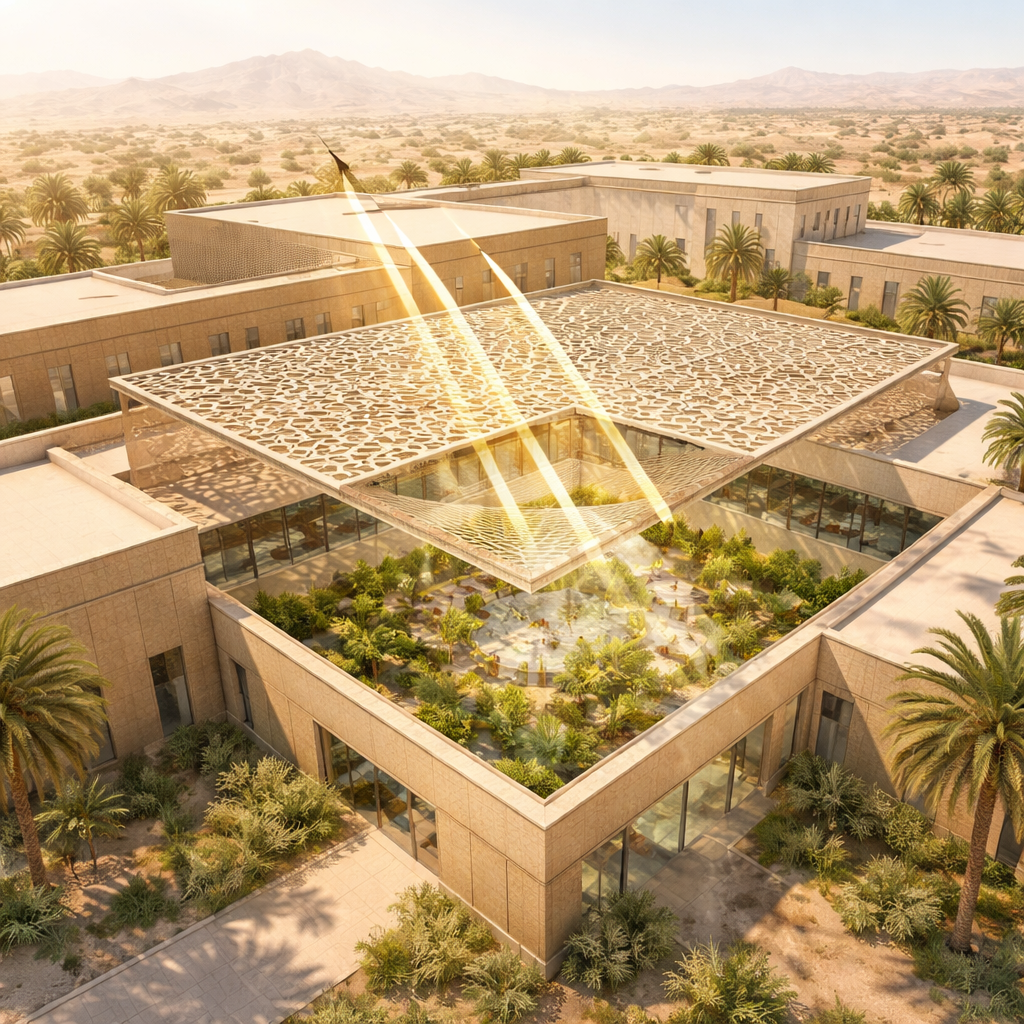
Walk into a hospital filled with soft daylight and you can feel the difference. Bright, open spaces tend to calm people, lift moods, and even support better sleep and recovery. But in hot, windy regions, simply cutting a hole in the roof and adding glass is risky: strong desert winds and extreme temperatures can damage skylights or make interiors uncomfortably hot. This article explores how a real hospital in an arid climate uses a modern twist on a traditional Middle Eastern screen—perforated aluminum Mashrabiya panels—to create skylights that are both soothing and structurally safe.
Bringing desert light indoors, safely
Skylights have been used since ancient Roman times to bring daylight deep into buildings, reduce the need for electric lighting, and create a sense of openness. In healthcare settings, these qualities become especially important: studies link natural light to better patient mood, more regular sleep–wake cycles, and higher staff productivity. Yet in arid regions such as the Middle East and North Africa, rooftops are exposed to intense sun, high temperatures, and powerful winds. Conventional skylights often focus on light and heat control but pay less attention to how the whole system behaves structurally when the wind really picks up. The hospital studied here installs large, flat skylights over interior courtyards, then adds a second layer of perforated panels above them to filter sun and help tame the wind.
A modern role for a traditional screen
Mashrabiya screens—ornate lattices that once shaded windows and balconies—have long been used to provide privacy, reduce glare, and promote natural ventilation. In this project, the designers use aluminum Mashrabiya panels not just as decoration but as an active part of the structural system. Their many openings break up the wind, spreading forces more evenly and reducing the suction that can try to lift a skylight off the roof. The researchers built a detailed computer model of the hospital skylight, including glass, aluminum framing, steel supports, and the perforated panels. They based the model on the actual installed geometry and local building standards, then applied conservative wind loads higher than the minimum required by code to see how the real structure would respond.
Testing strength, stiffness, and safety margins
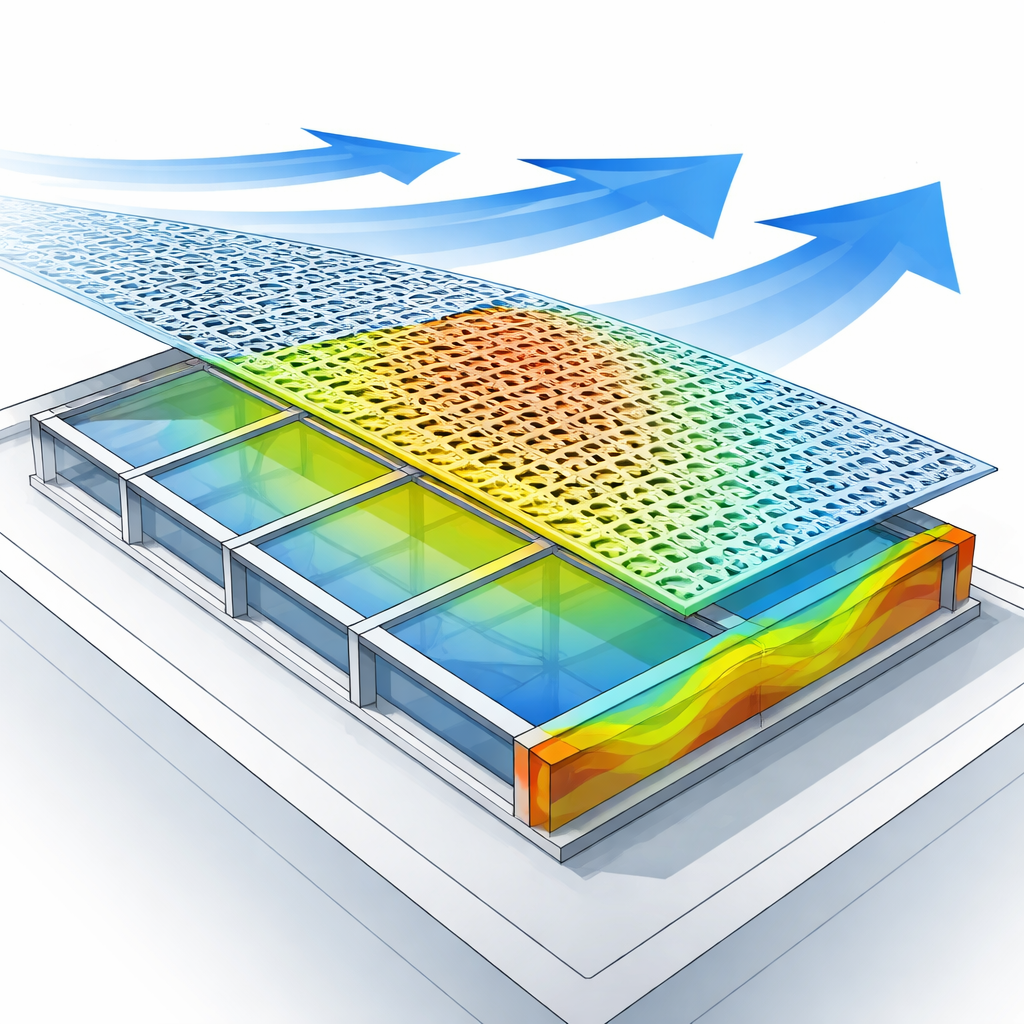
Using engineering software, the team examined how the skylight bends and deflects under combinations of its own weight, people loads, temperature swings, and a design wind pressure of 1.2 kilopascals. They carefully refined the digital “mesh” that breaks the structure into small elements, checking that results stayed stable as the mesh became finer. This ensured that the predicted stresses and deflections were trustworthy without wasting computing time. For the main aluminum frame members, the highest calculated stress under the most demanding load case was about 49 megapascals—well below the allowable 160 megapascals. The glass and supporting steel members also stayed within strict limits, and the maximum mid‑span deflection of 7.7 millimeters was far less than the permitted values, indicating that the skylight would not sag noticeably or cause problems with drainage.
How the perforated panels share the load
The researchers then focused on the Mashrabiya panels themselves. Perforated sheets tend to concentrate stress around their openings, so the team used both stress‑concentration formulas and fine‑mesh simulations to capture these peaks. Even after accounting for these localized effects, the maximum stress in the aluminum panels reached only about 41 megapascals, again far below the 160‑megapascal limit. Deflections in the panels also remained within acceptable serviceability limits. Because the overall system proved quite conservative—with a demand‑to‑capacity ratio of only 0.46—the authors explored ways to trim material. By modestly reducing panel thickness in simulations, they showed that significant weight savings (up to about 28 percent) could be achieved while still keeping stresses and deflections within safe bounds, hinting at future designs that are lighter, cheaper, and more sustainable.
From digital model to better hospitals
To connect their virtual findings with reality, the team reviewed on‑site measurements, sealing details, and thermal performance estimates. Field sensors confirmed that actual deflections were close to those predicted, and calculations of heat transfer showed that the skylight system can contribute to energy savings by limiting unwanted heat gain. The authors argue that their workflow—from surveying a real hospital roof to building and refining a numerical model, then checking strength, stiffness, and thermal behavior—offers a practical template for future projects.
What this means for future buildings
For non‑specialists, the takeaway is straightforward: it is possible to enjoy generous natural light in hospitals located in harsh, windy climates without sacrificing safety or comfort. By treating decorative perforated panels as active structural partners rather than mere ornament, designers can soften daylight, cut energy use, and help roofs stand up to extreme winds. The study shows that the examined skylight system has a large safety margin and that its materials can likely be used more efficiently. With further testing in wind tunnels and full‑scale prototypes, this approach could guide the next generation of hospital roofs and other public buildings, where architecture, engineering, and patient well‑being all work together.
Citation: Naqash, M.T., Ali, M., Asteris, P.G. et al. Structural resilience of skylights with perforated panels in healthcare facilities: a case study. Sci Rep 16, 5804 (2026). https://doi.org/10.1038/s41598-026-36744-3
Keywords: skylights, healthcare buildings, perforated panels, wind-resistant design, natural daylight