Clear Sky Science · en
Kinetic, equilibrium, and thermodynamic study of Methylene Blue adsorption on orange peel biochar prepared by microwave-assisted pyrolysis
Turning Fruit Waste into Water Helpers
Every glass of brightly dyed fabric or paper we use leaves a hidden legacy in our rivers: stubborn dyes that resist breaking down and can harm aquatic life and human health. This study explores a surprisingly simple idea to tackle that problem—using discarded orange peels, converted into a charcoal-like material, to pull a common blue dye out of water. By refining how this material is made and how it is used, the researchers show that fruit waste can become an effective tool for cleaning up industrial wastewater.
Why Blue Dyes Are Hard to Remove
The textile and related industries release hundreds of thousands of tons of synthetic dyes into water each year, often with little or no treatment. Methylene Blue, a vivid blue dye used in fabrics, paper, and even medicine, is especially persistent. Even tiny amounts can turn water an intense color, blocking sunlight, lowering oxygen, and stressing aquatic ecosystems. Because the dye’s molecular structure is stable and resists natural breakdown, traditional treatments such as chemical oxidation or biological processes can be expensive, inefficient, or produce unwanted by-products. This has driven the search for cheaper, cleaner materials that can soak up dyes before they reach rivers and lakes.
From Orange Peels to Cleaning Charcoal
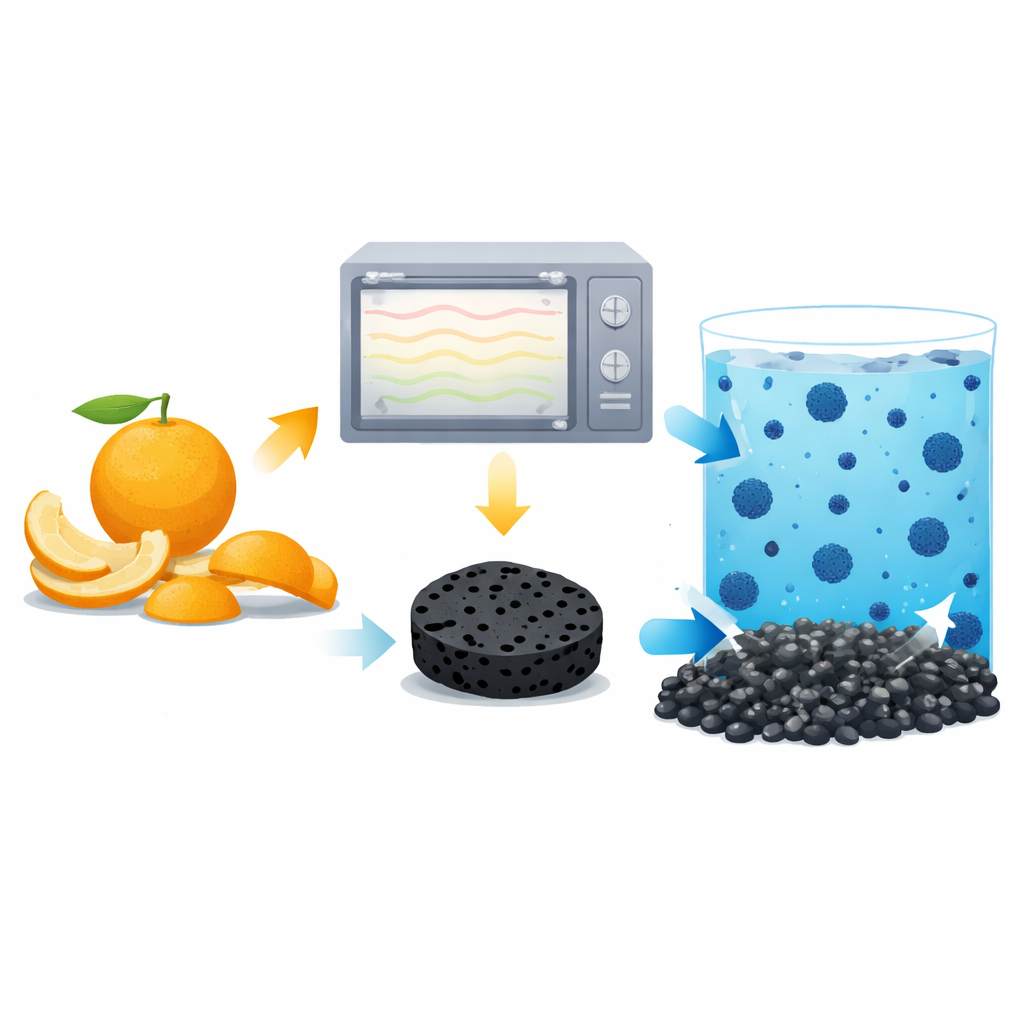
Orange juice factories around the world generate millions of tons of peel waste each year, much of which is simply discarded. The team turned this waste into biochar—a porous, carbon-rich solid—using microwave-assisted pyrolysis, a process that rapidly heats the peels in the near absence of oxygen. In just 15 minutes at controlled microwave power, the peels were transformed into a dark, stable material with a high carbon content and an alkaline surface. Detailed tests showed that the resulting biochar retained oxygen-containing chemical groups, had large pores compared with the size of the dye molecules, and carried mineral-rich ash that made its surface strongly basic. All of these traits are promising for attracting and holding positively charged contaminants from water.
How Water Acidity Changes Performance
A central question in this work was how the acidity or basicity of the water—its pH—affects dye removal. The researchers compared two scenarios: one in which the pH was carefully kept constant and another in which it was allowed to drift naturally. They found that a mildly acidic condition, around pH 4, produced the best results, removing about 83% of the blue dye. Under these controlled conditions, the maximum amount of dye the biochar could hold was about 20.6 milligrams per gram of material, roughly 83% higher than in the unregulated pH case. This improvement came even though the biochar’s own surface tends to be alkaline, a situation that might normally discourage attraction between the positively charged dye and the material. The results show that adjusting and holding the right pH is as important as the choice of sorbent itself.
What Happens on the Surface
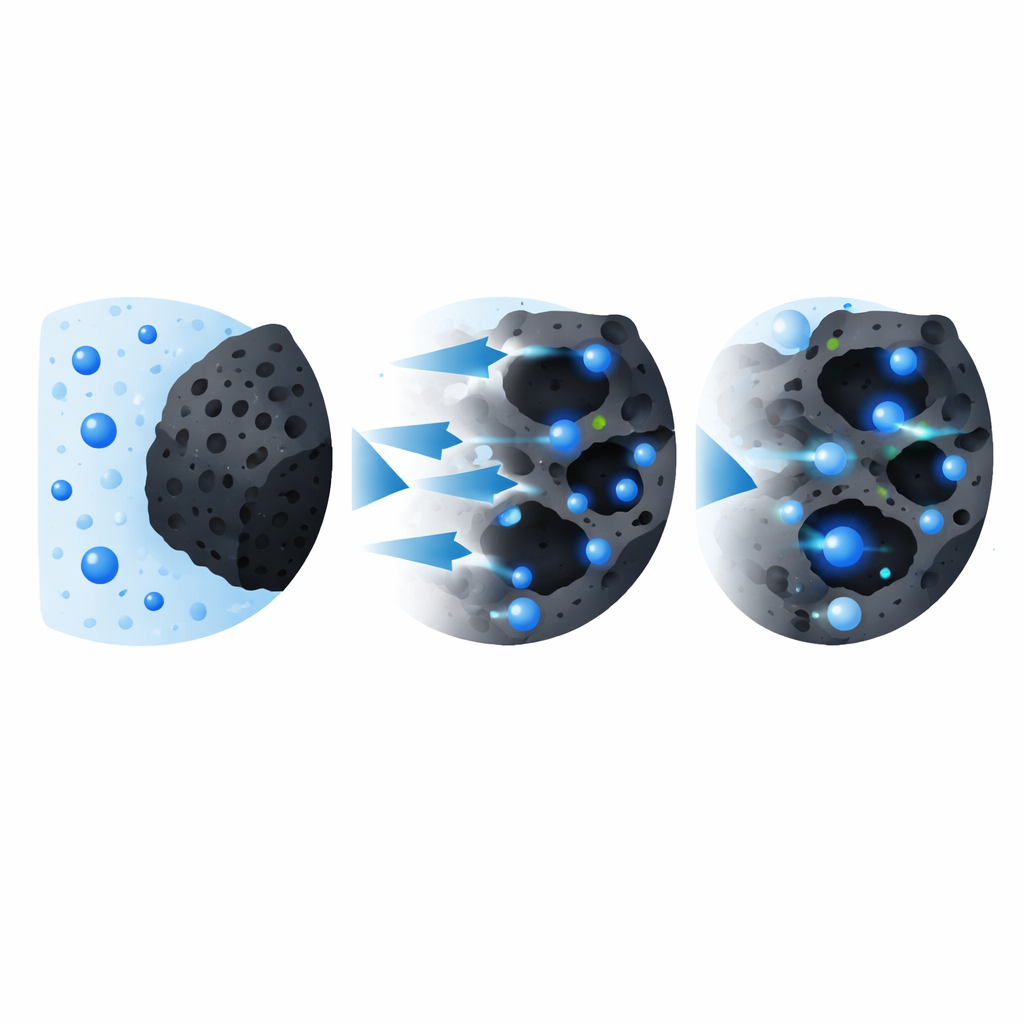
To understand how the dye sticks to the biochar, the team combined microscopic images, infrared spectroscopy, and mathematical models of how fast and how strongly the dye is taken up. The time-dependent data matched best with a model that assumes the surface has many different types of sites, each with its own energy barrier, suggesting a heterogeneous landscape for adsorption. Equilibrium tests—measuring how much dye remains in solution after contact—fit well with a model in which a fixed number of sites form a single layer of attached molecules. Thermodynamic calculations showed that the process is spontaneous and slightly heat-absorbing, and that the energies involved are small enough to rule out strong chemical bonding. Instead, the dominant forces appear to be gentle physical ones, such as hydrogen bonds and stacking of the dye’s ring-shaped structures against similar regions in the carbon matrix.
A Simple Path Toward Cleaner Water
In practical terms, this study shows that non-activated, microwave-made biochar from orange peels can act as a robust, low-cost filter material for removing Methylene Blue from water, provided the pH is properly controlled. The material is derived from abundant agricultural waste, produced quickly with relatively low energy input, and does not require extra chemical activation steps. While other specially treated carbons can hold even more dye, this orange-peel biochar offers a cleaner and more sustainable option. By clarifying how pH and gentle physical interactions control performance, the work points toward scalable, circular-economy strategies in which common food waste helps capture industrial pollutants before they reach the environment.
Citation: Correa-Abril, J., Cabrera, E.V., Robles, N. et al. Kinetic, equilibrium, and thermodynamic study of Methylene Blue adsorption on orange peel biochar prepared by microwave-assisted pyrolysis. Sci Rep 16, 8310 (2026). https://doi.org/10.1038/s41598-026-36741-6
Keywords: wastewater treatment, biochar, orange peel, methylene blue, microwave pyrolysis