Clear Sky Science · en
Recurrent neural network long short term memory model to detect the pile toe using raw data of pile integrity test
Smarter checks for hidden foundations
Many buildings and bridges rest on long underground concrete columns called piles. Because these piles are buried, engineers cannot simply look at them to see whether they were built correctly or how deep they go. This study shows how an artificial‑intelligence model can read subtle vibration signals from a simple hammer test and automatically pinpoint the pile’s toe—the point where it ends in the ground—making these hidden checks faster, more reliable, and less dependent on individual expert judgment.
How engineers listen to buried columns
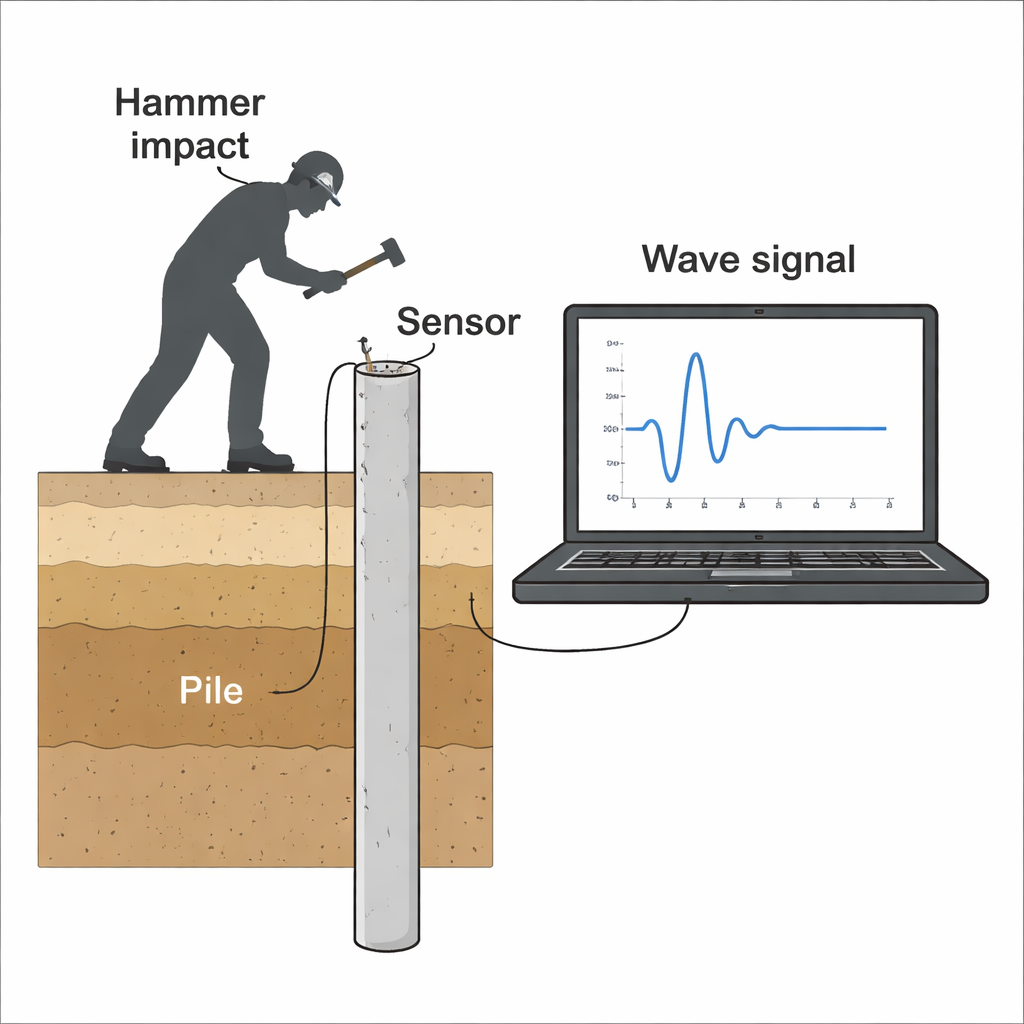
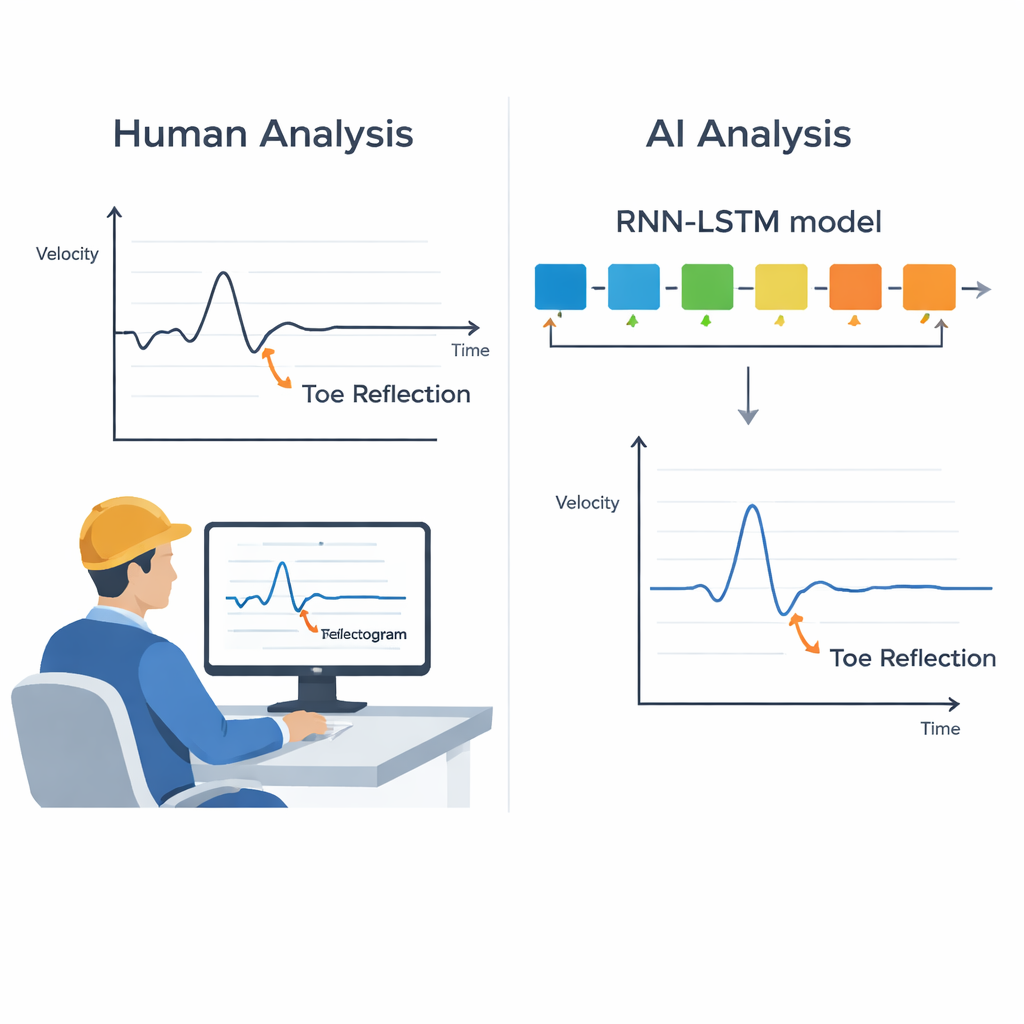
To examine a pile without digging it up, engineers use a low‑strain integrity test. A worker taps the top of the pile with a small hammer while a sensor records how the pile vibrates. The impact sends a stress wave down the pile; when the wave meets a change—such as the pile toe or a defect—it reflects back. A portable device turns these vibrations into a trace called a reflectogram, which shows how the signal changes with time or depth. Experienced engineers study this trace, along with site information and standards such as ASTM D5882 and Eurocode‑based rules, to judge whether the pile is intact and where its toe lies. But this interpretation can be subjective, time‑consuming, and sensitive to noise and soil conditions.
Why bring deep learning into the picture
In recent years, researchers have tried many artificial‑intelligence approaches to make sense of pile test data, from classical neural networks to image‑based methods and signal classifiers. These approaches often require manually extracting features from the recorded signals or converting them into images, and they may struggle to capture how waves evolve over time along the pile. The authors of this paper instead focus on models designed specifically for sequences: recurrent neural networks with long short‑term memory, or RNN‑LSTM. These networks are built to “remember” what came before in a time series, making them well suited to follow a hammer‑induced wave as it travels, reflects, and fades inside the pile.
Turning raw hammer hits into clean data
The team assembled a database of 500 low‑strain test records from Egyptian construction projects involving bored concrete piles 12 to 30 meters long in layered soils. For each pile, they had raw acceleration measurements over time and a corresponding reflectogram that had originally been drawn and interpreted by humans. They carefully digitized these charts, converted depth to time using known wave speeds, and normalized the vertical scale so that signals from different piles could be compared. On the raw sensor side, they smoothed away high‑frequency noise, standardized signals using a robust statistical scale, and used clever padding and small random variations so that the neural network could handle sequences of different lengths without distorting their patterns.
Designing and testing the neural network
Several network layouts were tried, varying how many layers and virtual “neurons” the model used. The researchers looked for a balance: strong prediction accuracy without an explosion in computational cost or a tendency to memorize the training data. They found that a six‑layer LSTM model with 32 units in each layer achieved this compromise. To help the model track important parts of the signal, they added shortcuts between layers and an attention mechanism that lets the network focus on key time intervals. Trained on 400 piles and validated on 100 unseen cases, the final model reproduced human‑generated velocity traces with high statistical accuracy, showing strong agreement between predicted and digitized signals.
From numbers to practical pile decisions
Beyond statistics, the main practical question is whether the model can correctly mark the pile toe. The researchers visually inspected each predicted reflectogram and compared the toe location with the digitized reference. If the match was within 5 percent, it was rated “Good”; up to 10 percent, “Fair”; beyond that, “Bad.” For the training set, about 90 percent of piles were “Good” and only 4 percent “Bad.” On the validation set, 84 percent were “Good” and 6 percent “Bad.” These results suggest that the AI system can mimic expert interpretation closely enough to be useful in everyday testing, at least within the ranges of pile sizes, concrete strengths, and test types it was trained on.
What this means for safer structures
In simple terms, the study shows that a well‑designed deep learning model can take the raw vibration record from a hammer tap on a pile and automatically draw the same kind of curve that a specialist would use to find the pile toe. This reduces the number of manual steps and the room for human error, while keeping the final judgment about pile quality transparent and grounded in familiar plots. For now, the model applies only to a specific type of sensor and to piles similar to those in the study, but it points toward a future where routine checks on hidden foundations become faster, more consistent, and easier to apply on busy construction sites.
Citation: Samaan, R.M., Saafan, M.S.A., Mokhtar, A.A. et al. Recurrent neural network long short term memory model to detect the pile toe using raw data of pile integrity test. Sci Rep 16, 6348 (2026). https://doi.org/10.1038/s41598-026-36732-7
Keywords: pile integrity testing, deep learning, recurrent neural network, non-destructive testing, civil engineering