Clear Sky Science · en
Mechanical properties of thermoformed and direct-printed aligner materials after immersion in 37 °C water: a 14-day in vitro study
Why your clear aligners don’t all feel the same
More and more adults are straightening their teeth with nearly invisible plastic aligners instead of metal braces. But not all aligners are made from the same kind of plastic, and that can change how they feel and how they move teeth. This study asked a simple but important question: when these different plastics sit in warm water for two weeks—much like they do in your mouth—do their strength and flexibility change in ways that matter for comfort and tooth movement?
Two ways to make a clear aligner
Today’s aligners are made in two main ways. The traditional method heats a flat plastic sheet and sucks it down over a 3D model of your teeth, a process called thermoforming. Newer “direct-printed” aligners are built layer by layer in a 3D printer from liquid resin that hardens under light. This study compared three such printer resins (TC-85, TR-07, and TA-28) with two popular thermoformed plastics (Zendura A and Zendura FLX). The goal was to see how each behaved under conditions that mimic the mouth: soaked in water at body temperature for up to 14 days—the typical time a patient wears one aligner.
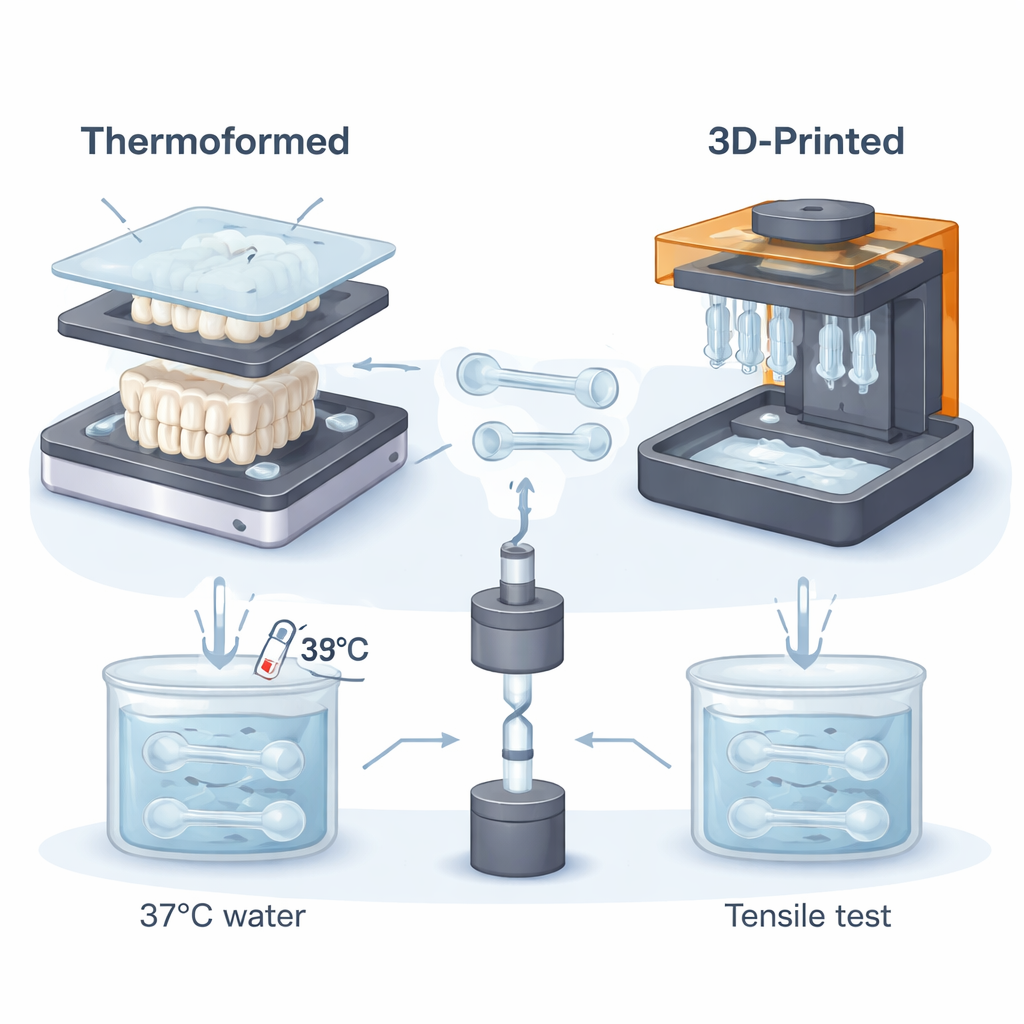
Soaking, stretching, and measuring
Instead of testing full aligners, the researchers made small, flat “dog-bone” strips from each material, similar in thickness to real aligners. These strips were stored in 37 °C water for times ranging from a few minutes to two weeks. Right after soaking, each strip was pulled in a testing machine, which measured how much force it produced when gently stretched, how stiff it was, how far it could stretch before breaking, and how strong it was at its breaking point. The stretching was kept within the tiny deformations that aligners actually experience on teeth, so the forces could be compared with the gentle pressures considered healthy for tooth movement.
Stiff plastics versus smart plastics
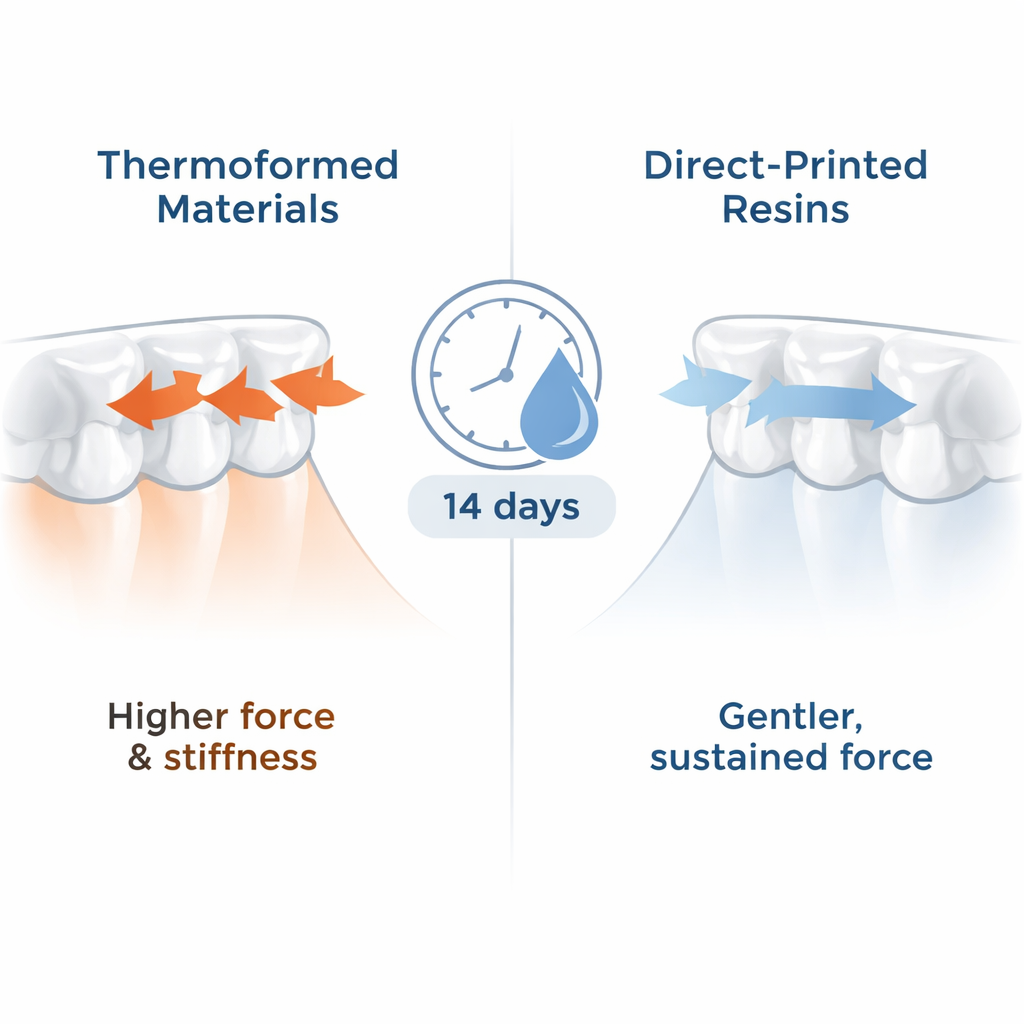
The thermoformed plastics, especially Zendura A, behaved like sturdy springs. They stayed relatively stiff and continued to deliver high forces even after two weeks in warm water. Zendura A generated the largest forces and had the highest resistance to breaking, suggesting it is very durable but can push teeth quite firmly. Zendura FLX, a layered material designed to be more flexible, still stayed in a higher-force zone than the printed resins. In contrast, the 3D-printed resins softened noticeably in warm water. Within about an hour, their stiffness and force dropped and then stabilized. Over 14 days, they continued to show lower forces and became more stretchable without breaking. One resin, TA-28, showed the greatest drop in force, while TR-07 changed the least, reflecting its design as a more retainer-like material.
What this means for comfort and tooth movement
The lower forces produced by the printed resins are not a sign that they are weak or failing. Instead, they reflect their “smart” temperature-responsive behavior: they relax at body temperature and deliver gentler, more constant pressure. That gentle range is closer to what orthodontists consider biologically comfortable for moving teeth. Thermoformed materials maintain higher forces and stiffness, which may be useful for certain movements but could feel tighter or harsher to some patients. All of the tested plastics remained strong enough not to tear easily, even after two weeks in warm water, so from a safety standpoint they all performed adequately under these lab conditions.
Takeaway for patients and clinicians
For someone considering clear aligner treatment, this study suggests that how an aligner is made—thermoformed sheet versus direct 3D printing—matters for how it behaves in the mouth over time. Traditional thermoformed aligners tend to stay stiffer and push harder, while 3D-printed aligners made from these new resins become more flexible and deliver softer, steadier forces as they warm up. Rather than being a drawback, that softer force profile may be an intentional feature, designed to keep tooth movement within a more comfortable and biologically friendly range. As direct-printing technology matures, being able to digitally tune aligner thickness and material choice could let orthodontists tailor both comfort and effectiveness to each patient in a more precise way.
Citation: Oyonarte, R., Lagos, I.M., Vidaurre L., F. et al. Mechanical properties of thermoformed and direct-printed aligner materials after immersion in 37 °C water: a 14-day in vitro study. Sci Rep 16, 5864 (2026). https://doi.org/10.1038/s41598-026-36723-8
Keywords: clear aligners, 3D printed aligners, thermoformed plastics, orthodontic forces, dental materials