Clear Sky Science · en
The impact of state and trait general and social anxiety on theory of mind
Why worry about worry?
Most of us have had the experience of feeling so anxious that it is hard to think straight around other people. Psychologists have long wondered whether anxiety actually makes us worse at reading minds – that is, figuring out what other people know, think, and intend. This study asked a focused version of that question: do different kinds of anxiety, both momentary and long‑term, really interfere with our ability to take someone else’s perspective?
Understanding how we read other minds
Being able to guess what others are thinking – often called "theory of mind" – helps us navigate everyday life, from chatting with friends to working with colleagues. One classic way to test this skill is through "false belief" stories, where a character acts on outdated or mistaken information. Adults are usually very good at these stories, but they can still be subtly biased by what they themselves know. When we cannot set aside our own knowledge, we fall prey to a "curse of knowledge" and become more self‑centered in our judgments. Earlier research suggested that anxiety might strengthen this egocentric pull, making it harder to see the world from someone else’s point of view.
Different flavors of anxiety
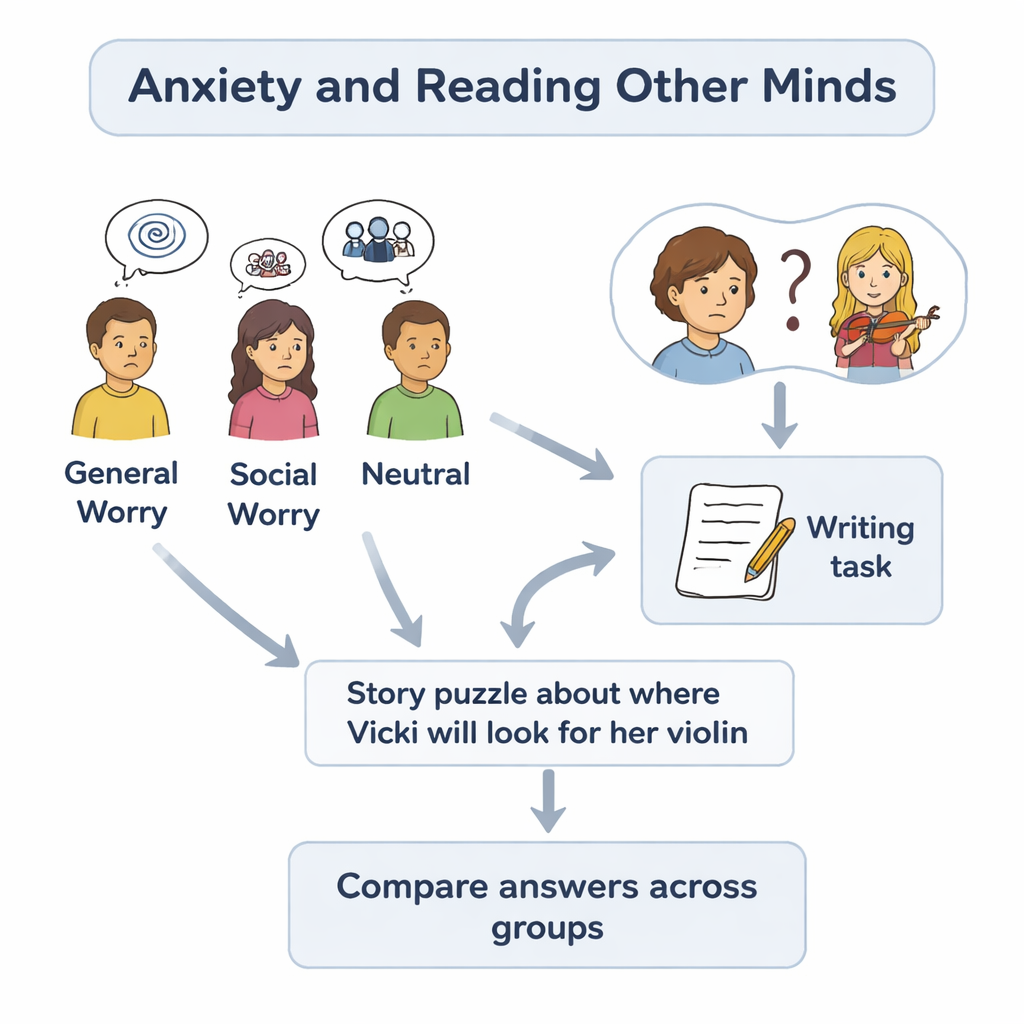
Anxiety is not a single, simple feeling. It can flare up in the moment (state anxiety) or be a long‑standing tendency to worry (trait anxiety). It can also be more general – about everyday problems and future events – or specifically social, focused on being judged by others. Previous studies often mixed these forms together, and used many different tests of social thinking, making their results hard to compare. This study set out to separate these pieces: general versus social anxiety, short‑term versus long‑term, all examined with one well‑established measure of theory of mind.
Putting anxiety to the test
The researchers recruited 168 young adults and first measured their usual levels of general and social anxiety with standard questionnaires. Then each participant was randomly assigned to one of three writing tasks designed to shift their mood: recalling a stressful exam (general anxiety), recalling a nerve‑racking social situation and expecting to speak about it (social anxiety), or simply listing recent grocery purchases (neutral). A brief mood check showed that both anxiety tasks successfully made people feel more anxious than the neutral task, and to a similar degree.
A musical mind‑reading puzzle
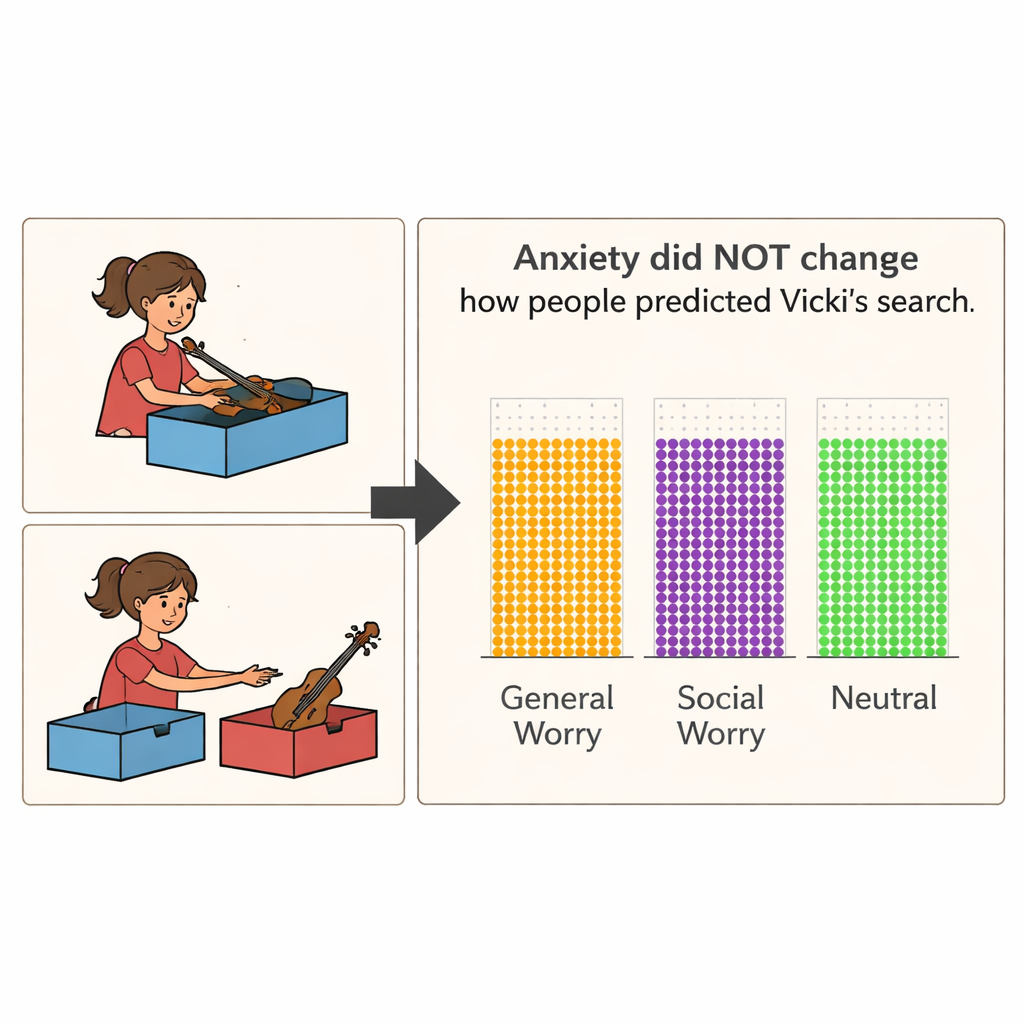
Next, everyone completed "Vicki’s violin" – a story‑based false belief task adapted for adults. Participants learned that Vicki put her violin in a blue box and then left the room. While she was away, her sister came in. In one version, the sister moved the violin to a red box (giving participants special knowledge Vicki did not have). In the other version, she simply rearranged the boxes without revealing where the violin ended up, so participants knew no more than Vicki herself. People then estimated, in percentages, how likely Vicki was to search each box first. If knowing about the move made people overestimate the chance that Vicki would check the red box, that would show an egocentric bias – they would be letting their own knowledge leak into their guess about Vicki’s belief.
What the results really showed
Despite the successful mood shift, anxiety did not change how people solved the violin puzzle. Those in the general anxiety, social anxiety, and neutral groups gave very similar estimates of where Vicki would search, whether or not they had privileged information about the violin’s true location. Statistical tests found no meaningful differences between mood groups, no effect of knowledge condition, and no interaction between them. Looking at long‑term tendencies to worry told the same story: people with higher trait general or social anxiety did not perform better or worse on the task than those with lower anxiety. The only clear link was that people who tended to have high general anxiety were also more likely to have high social anxiety.
What this means in everyday life
For lay readers, the key message is reassuring: feeling anxious – even in a way that mirrors general worry or social nerves – did not, in this study, blunt people’s basic ability to understand what someone else knows in a simple story. Anxiety may make social situations feel harder, but it does not automatically strip away our capacity to separate our own knowledge from another person’s. The authors argue that future work should continue to tease apart different kinds of anxiety and different aspects of social thinking, but their findings suggest that, at least for this kind of mind‑reading task, our perspective‑taking skills are more robust to worry than we might fear.
Citation: Foulds, C., Khudiakova, V. & Surtees, A.D.R. The impact of state and trait general and social anxiety on theory of mind. Sci Rep 16, 8232 (2026). https://doi.org/10.1038/s41598-026-36718-5
Keywords: anxiety, theory of mind, social cognition, perspective taking, false belief task