Clear Sky Science · en
General risk preference comes up short when predicting risk-taking frequency
Why everyday risk-taking matters to you
From speeding on the highway to skipping a doctor’s visit or trying a new investment, we all face choices that can help or harm us. This study asks a deceptively simple question: what really drives how often people take these real-world risks? The authors show that it is not our broad, self-proclaimed attitude toward risk that matters most, but a handful of specific traits and preferences that quietly steer our daily decisions.
Looking beyond a single “risk-loving” trait
For years, many scientists have treated risk-taking as if it stemmed from a single underlying taste for risk: some people are "risk-takers," others "risk-averse." That idea is usually tested with questionnaires asking how comfortable people feel with uncertainty in general, or in specific areas like money, health, or recreation. Yet people’s lives are messy. Someone might avoid gambling but drive aggressively, or never touch drugs yet frequently ignore medical advice. The authors suspected that a simple, one-size-fits-all risk preference would not fully explain who actually takes more risks in everyday life.
Tracking real-life risky behavior
To probe this question, the researchers surveyed 760 adults, most living in Sweden. Instead of relying only on abstract questions, they asked how often participants engaged in 19 concrete behaviors, such as smoking, heavy drinking, extreme sports, gambling, breaking traffic rules, procrastinating on important tasks, and skipping needed medical care. These answers were combined into an index of how frequently each person took risks across many parts of life. Participants also completed standard scales measuring general and domain-specific risk attitudes, as well as a set of psychological and demographic factors that earlier studies have linked to risk-taking, including impulsivity, sensation seeking, anxiety, personality traits, age, gender, education, and income.
What stood out: impulsivity, thrill-seeking, and social context
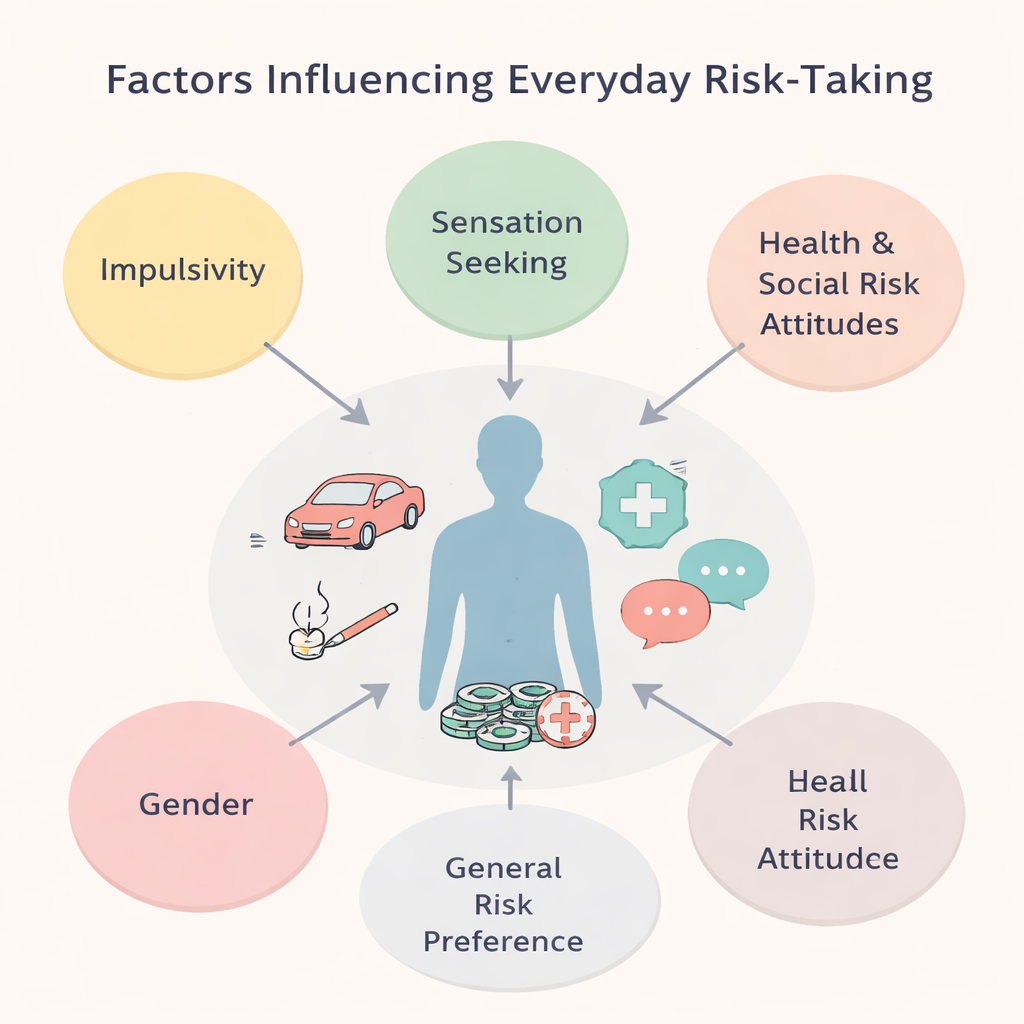
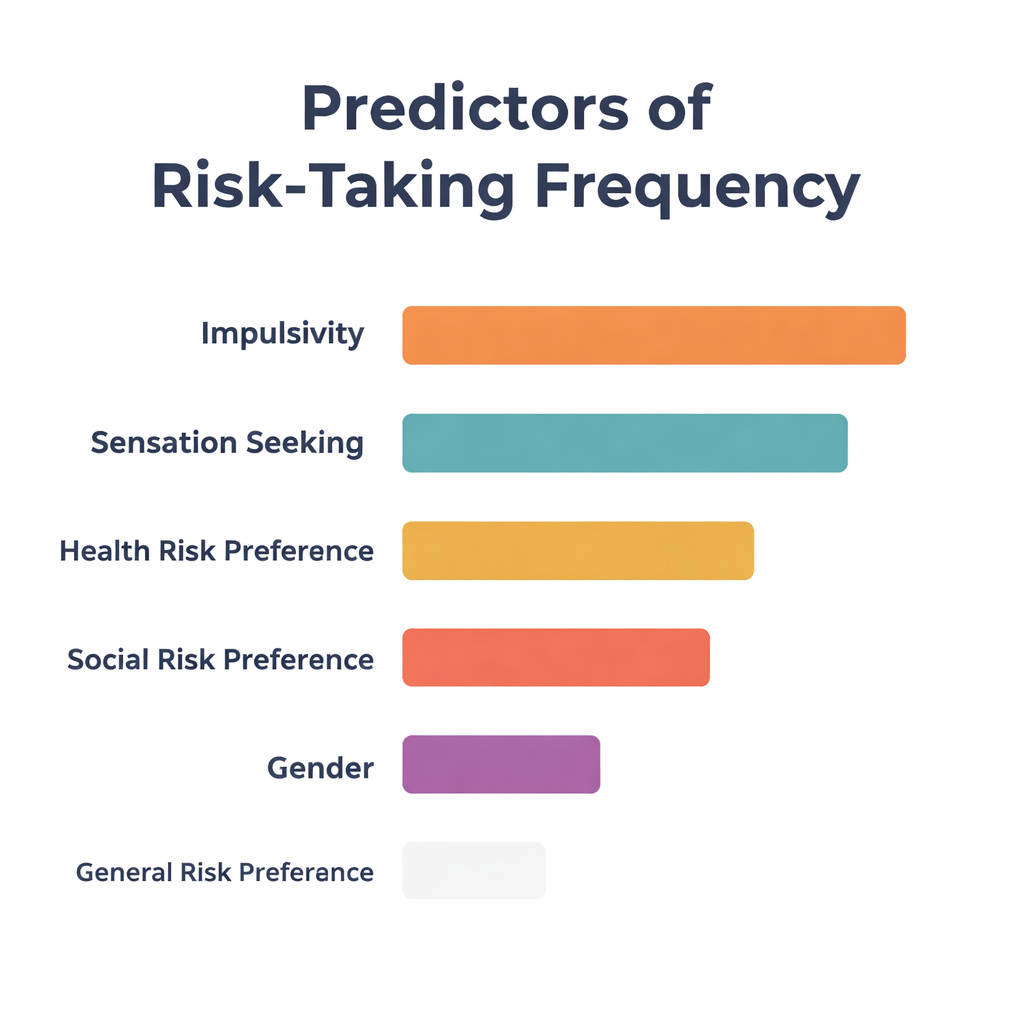
Using a statistical approach called Bayesian model averaging, which compares tens of thousands of possible models at once, the team asked which combination of factors best predicted how often people reported taking risks. Five variables consistently rose to the top. The strongest predictor was impulsivity—the tendency to act quickly without much forethought—followed by sensation seeking, a taste for excitement and intense experiences. In addition, people’s stated comfort with health-related and social risks, and whether they identified as male or not, all contributed meaningfully to explaining risk-taking frequency. These effects held up even when the authors zoomed in on narrower categories of risky behavior, such as health, safety, or economic risks.
When general risk attitude falls short
Strikingly, a broad, catch-all measure of general risk preference—how attracted someone feels to risks overall—lost most of its predictive power once impulsivity, sensation seeking, and specific risk attitudes were considered. Several other popular candidates, including anxiety, education, income, and overall personality style, also turned out to be weak or unreliable predictors when everything was examined together. This suggests that the apparent influence of some factors in earlier work may have been overstated because they were not tested alongside a richer set of psychological traits.
What this means for real life and future research
For lay readers, the key takeaway is that how often people take risks in daily life is less about a vague love of risk and more about being impulsive, craving thrills, and feeling comfortable with health and social risks—especially among men. This has practical implications. Efforts to reduce harmful risk-taking, or to encourage beneficial risks such as seeking medical care or pursuing new opportunities, may be more effective if they focus on managing impulsivity and sensation seeking rather than trying to change a person’s overall attitude toward risk. The study also urges scientists and clinicians to rethink theories that place general risk preference at center stage, and instead to pay closer attention to the specific traits and domains that truly drive risky behavior.
Citation: Asp, M., Abed, M. & Millroth, P. General risk preference comes up short when predicting risk-taking frequency. Sci Rep 16, 3049 (2026). https://doi.org/10.1038/s41598-026-36713-w
Keywords: risk-taking, impulsivity, sensation seeking, health behavior, decision making