Clear Sky Science · en
Urine volatile organic compounds (VOCs) combined with machine learning algorithm in the diagnosis of gallstones with cholecystitis
Why a urine test could spare you a scan
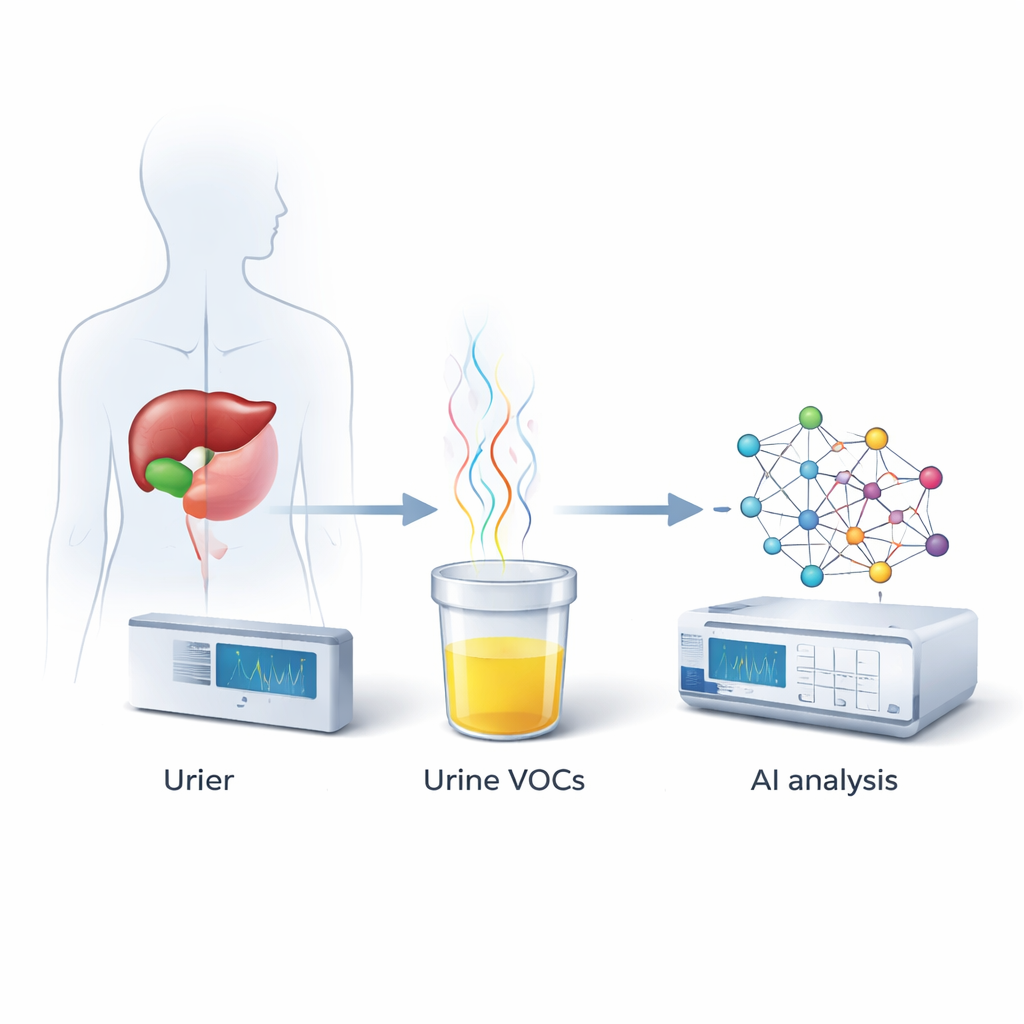
Gallstones and inflamed gallbladders are common, painful problems that often send people to the emergency room. Today, doctors usually rely on ultrasound or CT and MRI scans to diagnose them, but these tests can be expensive, operator‑dependent, or expose patients to radiation. This study explores a simple alternative: using the invisible chemical vapors in urine, read by a sensitive detector and interpreted by artificial intelligence, to spot gallstones with gallbladder inflammation early and without any needles or scanners.
The hidden chemistry of disease
Our bodies constantly release tiny airborne chemicals, called volatile organic compounds (VOCs), into breath, sweat, and urine. These molecules change when something in the body goes wrong, reflecting shifts in inflammation, metabolism, and even gut microbes. The researchers focused on VOCs in urine from people with gallstones and gallbladder inflammation (cholecystitis) compared with healthy volunteers. Because urine is easy and painless to collect, it is an attractive material for developing comfortable screening tests that patients can repeat as needed.
Turning urine into a chemical fingerprint
To read these chemical signals, the team used a technology called gas chromatography–ion mobility spectrometry (GC‑IMS). In simple terms, this device first separates the different vapors in each urine sample, then measures how fast their charged forms drift through an electric field. The result is a two‑dimensional “fingerprint map” for each person, capturing dozens of distinct chemical peaks. From 200 participants—100 patients and 100 healthy controls—the researchers collected frozen midstream urine, processed it under strictly standardized conditions, and extracted 60 reliably measured VOC peaks, 49 of which could be chemically identified.
Letting machines learn the disease pattern
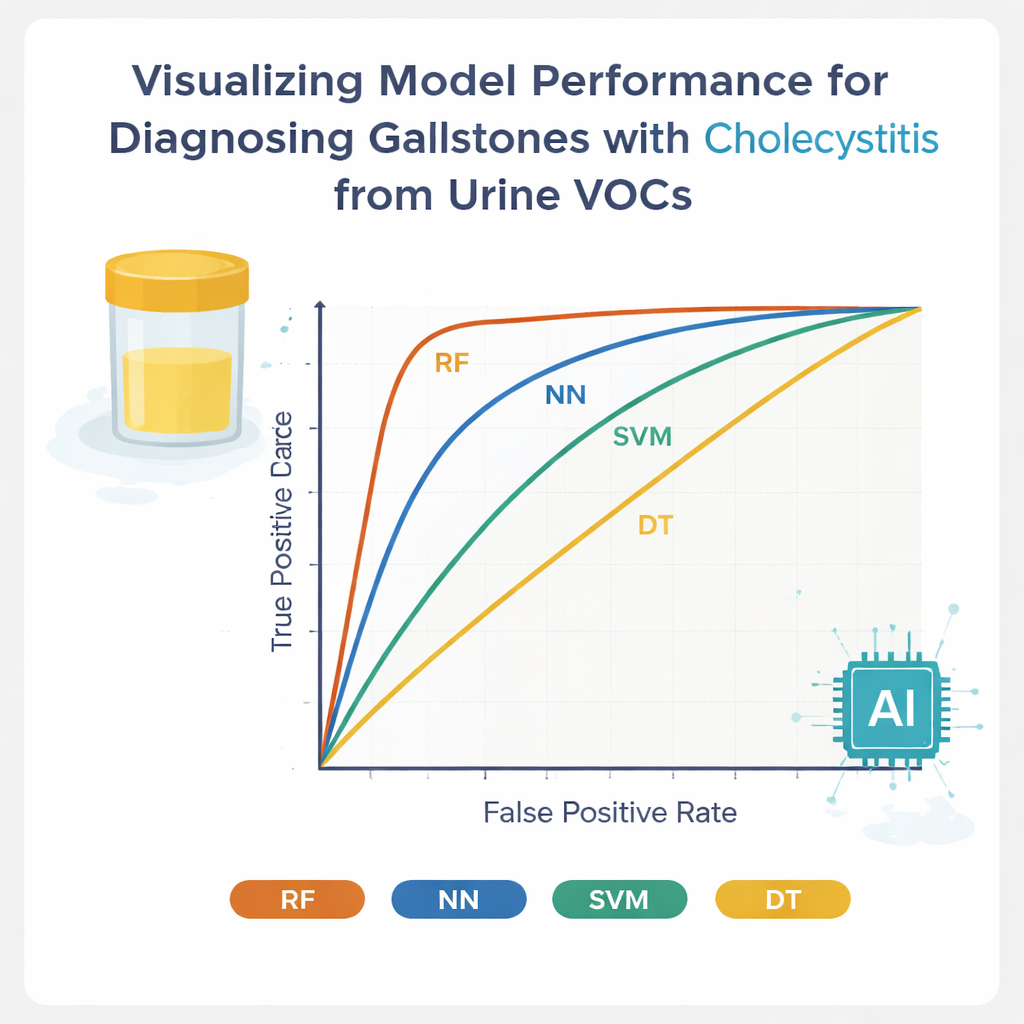
These chemical fingerprints are far too complex for a human eye to interpret, so the team turned to machine learning—computer programs that find patterns in large datasets. They trained four types of models on 70% of the samples and tested them on the remaining 30%. Three of the models—neural networks, random forests, and support vector machines—performed strongly, each correctly separating most patients from healthy people. Their scores on a standard accuracy measure called the area under the ROC curve ranged from about 0.82 to 0.86, meaning they achieved good balance between catching true cases and avoiding false alarms, while a simpler decision‑tree model lagged behind.
A handful of key scent clues
The researchers then asked a practical question: could a smaller, more manageable set of VOCs still carry enough information to be useful? Using feature‑importance tools and a game‑theory‑based explainer called SHAP, they highlighted five star chemicals—Linalool, Propyl‑propenyl disulphide, Methylthiobutyrate‑M, Butylamine, and Methyl pentanoate‑M. Models built using just four of these achieved areas under the curve around 0.76–0.81, not far from the full‑data models. Some of these compounds are linked to inflammation, fat metabolism, and immune responses, hinting that the same processes driving gallstones and gallbladder inflammation also reshape the chemical signature of urine.
What this could mean for patients
To a layperson, the bottom line is that a quick urine test, analyzed by a compact instrument and smart software, could one day help flag gallstones with gallbladder inflammation early—before symptoms become severe or repeated scans are needed. This approach is noninvasive, does not rely on operator skill, and could be relatively low‑cost, making it attractive for routine screening or for hospitals with limited imaging resources. While the study was done at a single center and will need confirmation in larger, multi‑center trials, it offers a promising glimpse of a future where doctors can read the body’s “chemical breath” from urine to guide faster, safer decisions about gallbladder disease.
Citation: Zhao, X., Li, X., Zhang, R. et al. Urine volatile organic compounds (VOCs) combined with machine learning algorithm in the diagnosis of gallstones with cholecystitis. Sci Rep 16, 6424 (2026). https://doi.org/10.1038/s41598-026-36709-6
Keywords: gallstones, cholecystitis, urine biomarkers, volatile organic compounds, machine learning diagnosis