Clear Sky Science · en
Impact assessment of the transported load mass on the lateral dynamics of a light delivery vehicles
Why delivery vans can be surprisingly risky
Most people think of big tractor‑trailers when they hear about dangerous cargo on the road. But in cities and suburbs, it is light delivery vans that shuttle groceries, parcels and pallets past homes, schools and shops. This study asks a simple but important question: how hard do these smaller vehicles actually push on their loads when they race through curves and roundabouts—and could they safely replace expensive lab machines used to test how well cargo is secured?
Real‑world testing on city streets
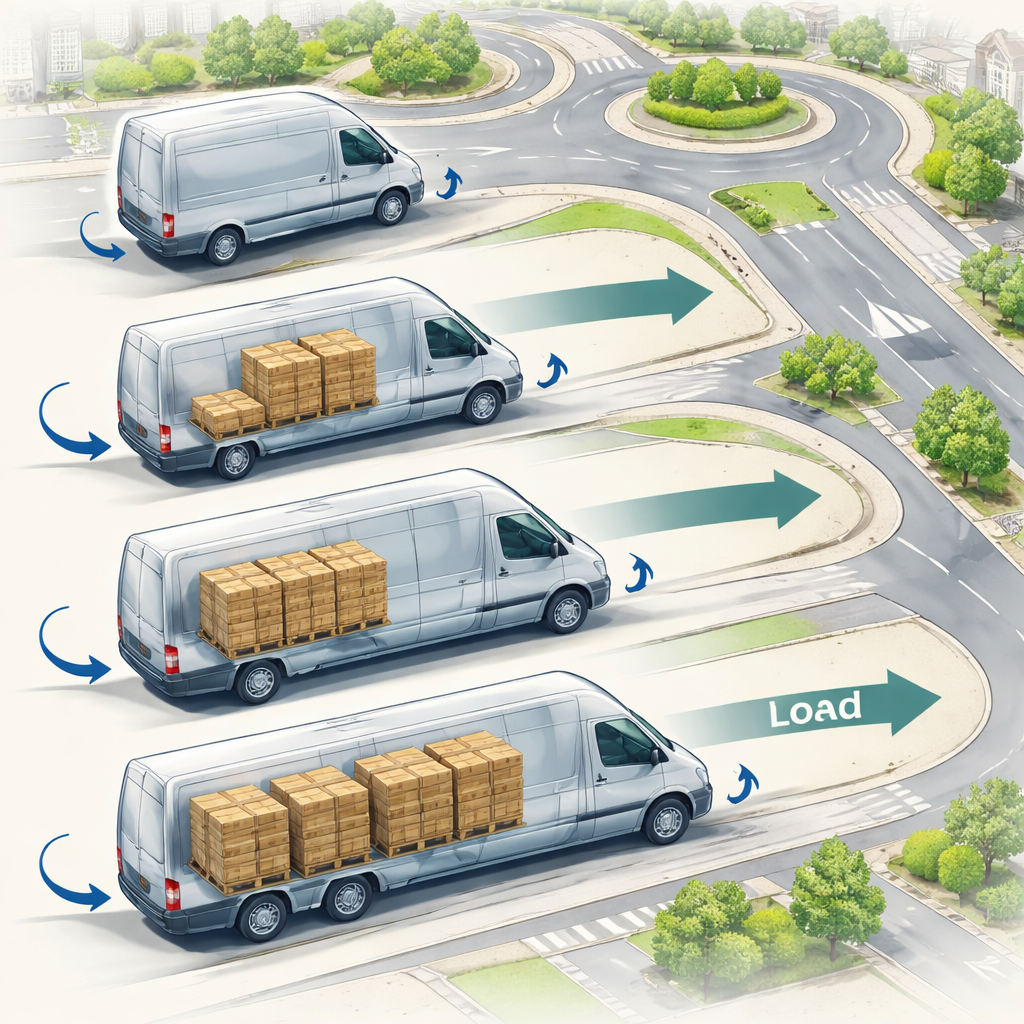
To find out, the researchers took an ordinary panel van and drove it repeatedly around a fixed 17‑kilometre loop near a city, mostly at night to avoid traffic. The route was chosen because it contained many tight roundabouts, sweeping curves and U‑turns—exactly the places where side forces on cargo are highest. The same driver ran the route four times under each of four loading conditions: fully loaded with heavy steel pallets, two lighter versions, and completely empty. The load was packed low and centred, so any differences in how the van behaved could be traced mainly to how heavy it was, not to where the weight sat along the floor.
Measuring forces where the cargo sits
The team equipped the van with two motion sensors. One sat high on the roof; the other was mounted lower, close to the van’s natural balance point and near the middle of the cargo space. Both sensors recorded side‑to‑side accelerations—how strongly the van and its load were pushed sideways—over thousands of one‑second intervals as the vehicle cornered. By comparing data from different trips and different loads, the researchers could see not only how strong these side forces became, but also how they varied with height inside the cargo area. They also tested two ways of picking out the "interesting" parts of the data: careful manual marking of the main peaks in each curve, and an automatic computer method that flagged every event above a small threshold.
Light vans, heavy forces
The measurements showed that even an everyday delivery van can experience surprisingly high side forces in normal urban driving. In the sharpest roundabouts, the sideways push reached up to about 0.8 times the force of gravity—well above the levels often assumed when designing straps, pallets and packaging. All four loading conditions exceeded commonly used design thresholds; even at modest speeds around 30 km/h, the van could impose long‑lasting, harsh side loads on the pallets. Interestingly, the lighter the van, the stronger these forces tended to be: compared with the heaviest configuration, the empty and lightly loaded van showed roughly 10–25% higher average and peak accelerations. That means small or partial loads, which are very common in real operations, may actually be exposed to rougher treatment than heavy, tightly packed shipments.
Higher up means harder hits
By comparing the roof‑mounted sensor with the one near the middle of the body, the study also revealed how forces grow with height. The upper sensor regularly recorded 5–8% higher accelerations than the lower one, because the van’s body rolls slightly in corners. That rolling motion swings the roof further out than the floor, like the top of a tree swaying more than the trunk. For tall stacks of boxes, this matters: their upper layers feel stronger side forces than the pallets under them. Because the automatic event‑detection method closely matched the manually checked results, the authors conclude that long, realistic road tests can be processed efficiently without losing accuracy.
When does a van risk tipping over?
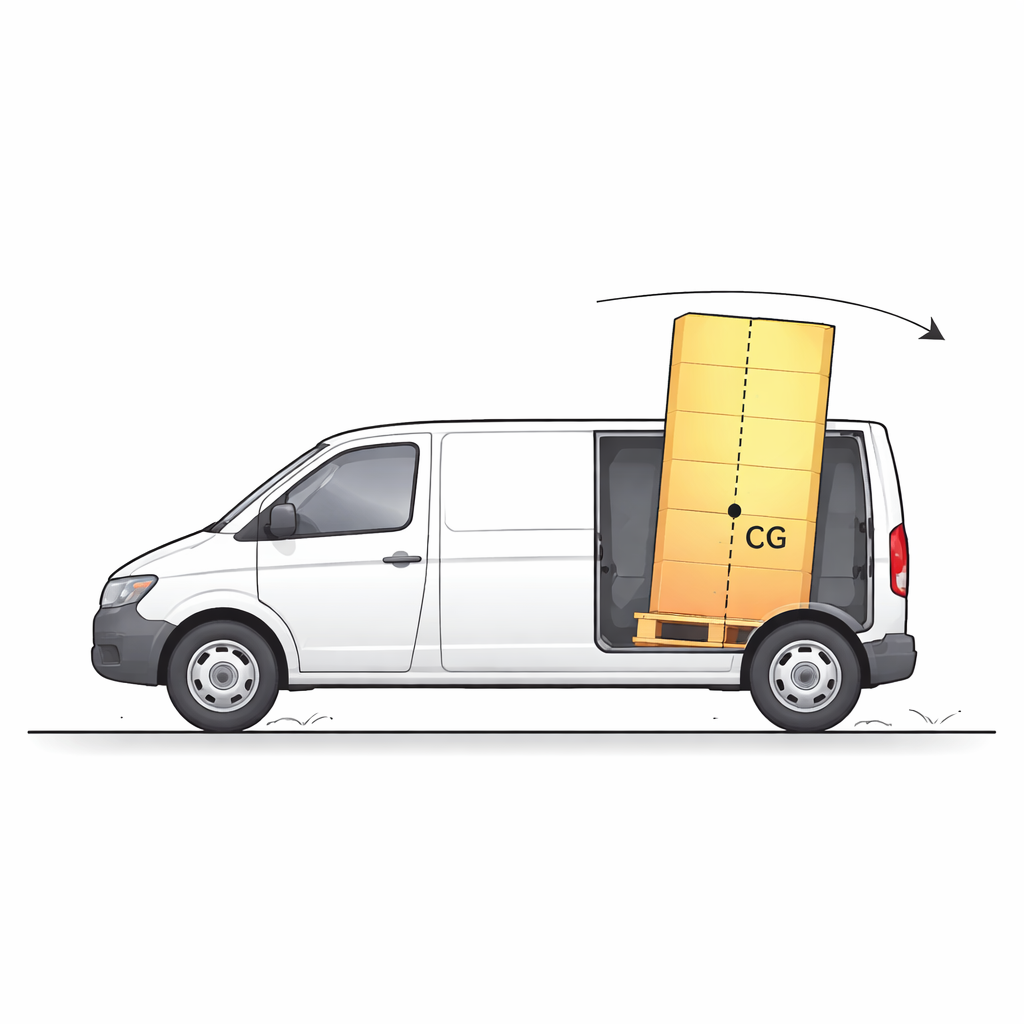
To translate these measurements into a simple safety rule, the authors built a basic physics model of a van in a steady curve. Ignoring suspension flex and road slope, they calculated how high the overall centre of gravity—van plus cargo—can be before the inner wheels start to lift. For a vehicle like the test van on grippy dry pavement, they found that rollover becomes a real concern once this height reaches roughly 1.1 metres. They then used the same model to estimate how tall pallet stacks of different weights can safely be. Light loads can be piled close to the roof, but heavier ones must be kept lower to avoid raising the van’s balance point too much.
What this means for everyday freight
In plain terms, the study shows that city delivery vans can subject their cargo to stronger sideways forces than many packaging and securing rules assume, and that lightly loaded vans can be rougher on goods than heavily loaded ones. It also offers a simple height limit for how high the overall weight can sit before rollover risk becomes critical. Together, these findings suggest that carefully designed road tests with real vans can stand in for expensive laboratory platforms when checking how well pallets and straps hold up—provided that testers respect the safe limits on load height and mass.
Citation: Jagelčák, J., Kubáňová, J., Zdanowicz, P. et al. Impact assessment of the transported load mass on the lateral dynamics of a light delivery vehicles. Sci Rep 16, 6653 (2026). https://doi.org/10.1038/s41598-026-36708-7
Keywords: delivery vans, cargo securing, lateral acceleration, vehicle rollover, pallet stability