Clear Sky Science · en
Computational framework and machine learning approach to fractional order soil helminth infections disease model for control mechanism
Why worms in the soil still matter
Hidden in ordinary dirt, microscopic worm eggs quietly infect more than a billion people, mostly children in poorer regions. These soil-transmitted helminths rob youngsters of iron, energy, and learning ability, and they are stubbornly hard to wipe out. This paper asks a deceptively simple question with modern tools: if we model how these worms spread using a more realistic kind of mathematics and combine it with machine learning, can we predict outbreaks better and design smarter ways to control them?
From dirty ground to human gut
Soil-transmitted helminths spread through a familiar but dangerous loop. Infected people shed parasite eggs in their feces, which contaminate soil where toilets and waste systems are poor. Children playing outside, or adults working in fields, accidentally swallow the eggs on unwashed hands or food. Inside the body, the worms move through stages: people start off susceptible, then become exposed after contact with contaminated soil, then infected, and finally either recover or adopt better hygiene that protects them for a time. The authors build a "compartment" model that follows all these groups of people plus the parasite population in the environment, capturing how individuals move from one stage to another and how worms build up or die off in soil. 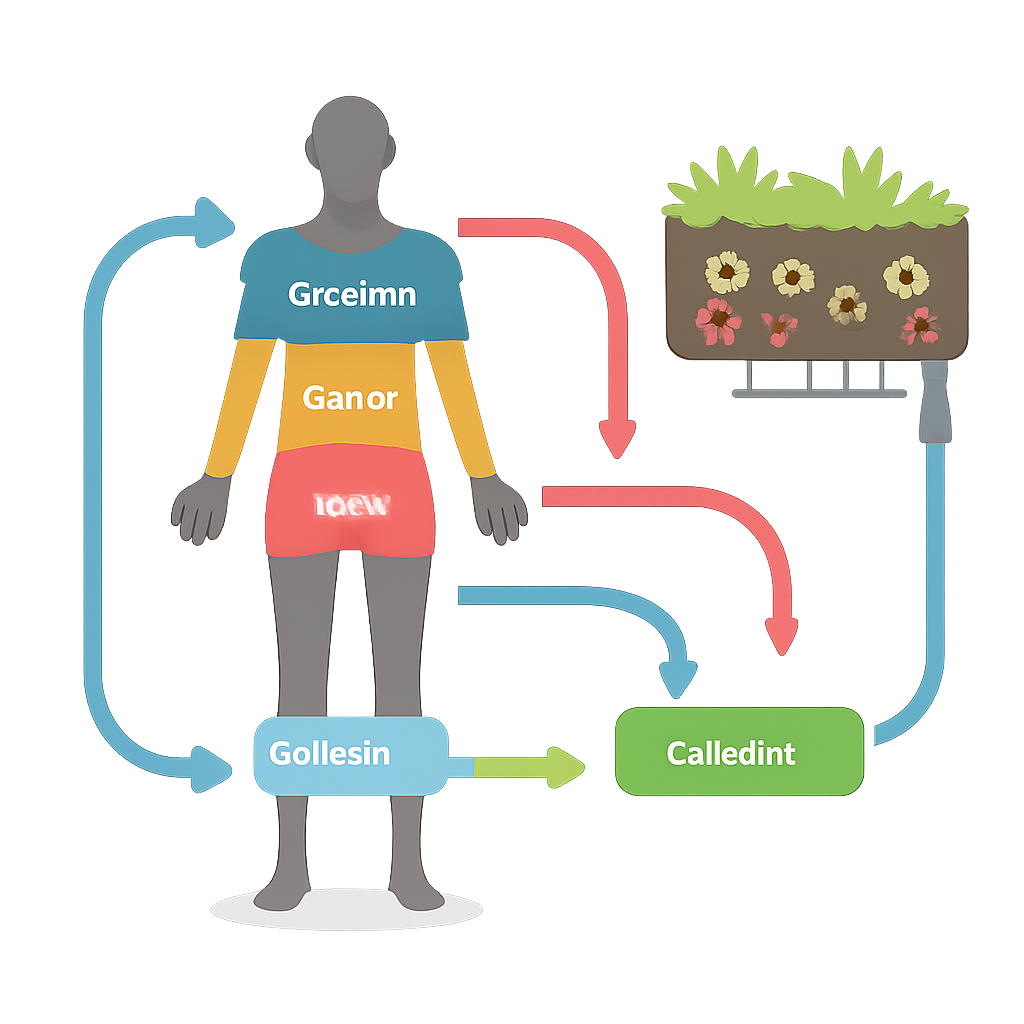
Adding memory to disease dynamics
Most traditional disease models assume that what happens next depends only on what is happening right now. In reality, infections like helminths carry memory: past exposure, slow immune responses, and changing hygiene habits all shape present risk. To capture this, the researchers use "fractional" calculus, a mathematical framework that naturally encodes history. In their model, the rate at which people change compartments and parasites accumulate does not just depend on the moment but on a weighted record of previous states. They prove that this history-based system behaves sensibly: solutions stay non-negative, remain within realistic bounds, and have clearly defined steady states where infection either dies out or persists.
Finding the tipping point for control
With this framework, the team calculates the basic reproduction number, a threshold that marks whether infection spreads or fades. If this number is below one, each existing worm leads to less than one new worm, and the disease can eventually disappear; above one, transmission continues. By systematically probing the model, they show which factors push this tipping point. The transmission rate between people and soil, the rate at which new people enter the population, and how many parasites the environment can sustain all have strong effects. So do parasite death in soil and hygiene-related behavior. In contrast, some clinical details of disease progression matter less. This kind of sensitivity analysis points policy makers toward which levers—sanitation, deworming coverage, or behavior change—are likely to make the biggest difference.
Teaching machines to track worm risk
Because the fractional equations are hard to solve directly, the authors train artificial neural networks to mimic their solutions over time. Using a specialized learning algorithm, the networks achieve extremely low errors when reproducing the model’s outputs, effectively serving as fast surrogates for complicated math. They then generate synthetic data from the model and feed it to two popular classification methods, Random Forests and Support Vector Machines. These algorithms learn to distinguish different infection states—such as low versus high infection levels—based on patterns in human and parasite populations. The classifiers reach accuracies around 99–100%, suggesting that similar tools, when coupled with real surveillance data, could support real-time dashboards that flag communities at rising risk. 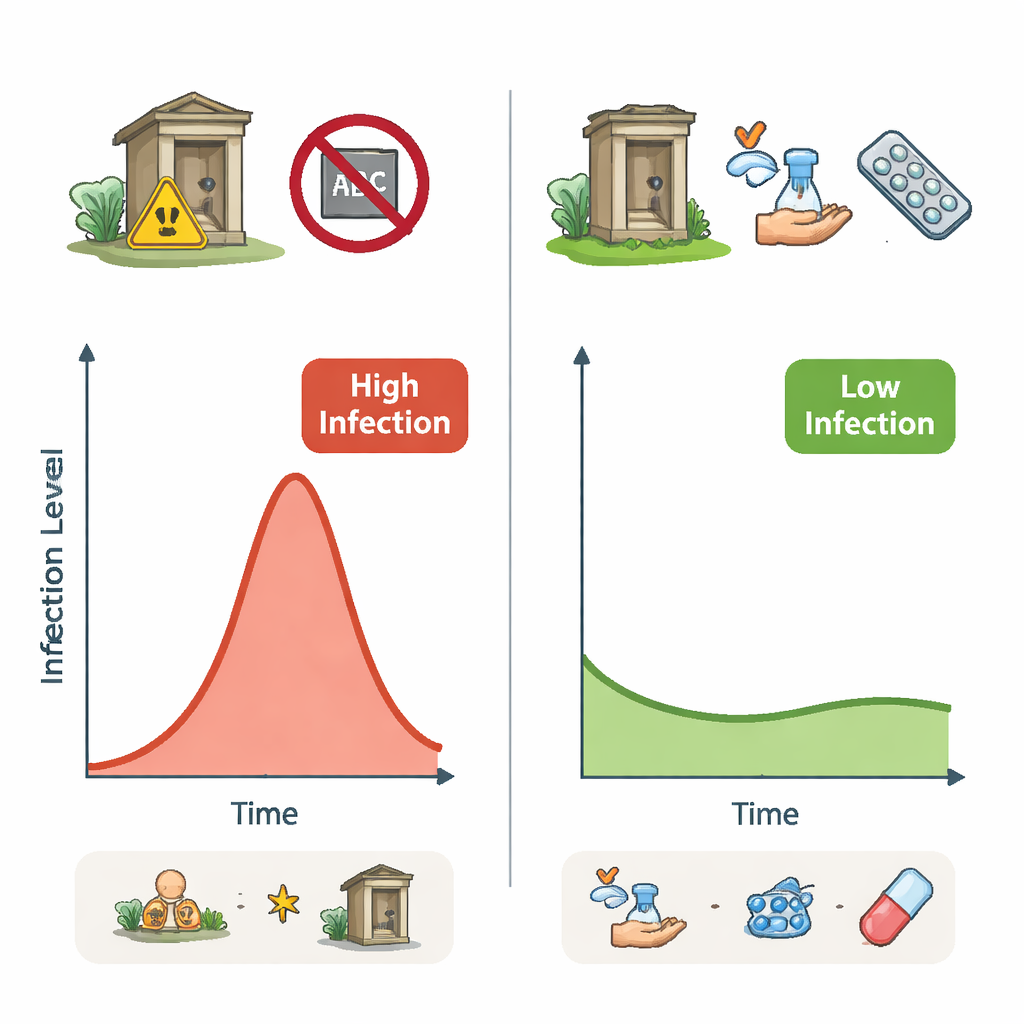
What this means for everyday health
For non-specialists, the punchline is that this work gives public health planners a sharper, more realistic lens for viewing worm infections. By blending a memory-aware mathematical model with powerful machine learning, the study shows how long-term habits, environmental contamination, and treatment programs interact to shape risk. The findings reinforce practical messages: improving sanitation, promoting handwashing and hygiene awareness, and sustaining deworming campaigns can collectively push the system past the tipping point where infections begin to fade. With further validation on real-world data, such models could help target limited resources to the places and time periods where children stand to benefit most.
Citation: Nisar, K.S., Farman, M., Waseem, M. et al. Computational framework and machine learning approach to fractional order soil helminth infections disease model for control mechanism. Sci Rep 16, 6671 (2026). https://doi.org/10.1038/s41598-026-36701-0
Keywords: soil-transmitted helminths, infectious disease modeling, fractional calculus, machine learning, public health control