Clear Sky Science · en
Multidimensional determinants of generative AI acceptance in foreign language education
Why this matters for language learners
Generative AI tools like chatbots and writing assistants are rapidly entering classrooms, especially for learning English and other foreign languages. But shiny technology alone does not guarantee better learning. This study asks a simple, practical question: what really makes university students willing to use these tools, and what actually drives them to keep using them in their day‑to‑day language studies?
Looking beyond “does it work?”
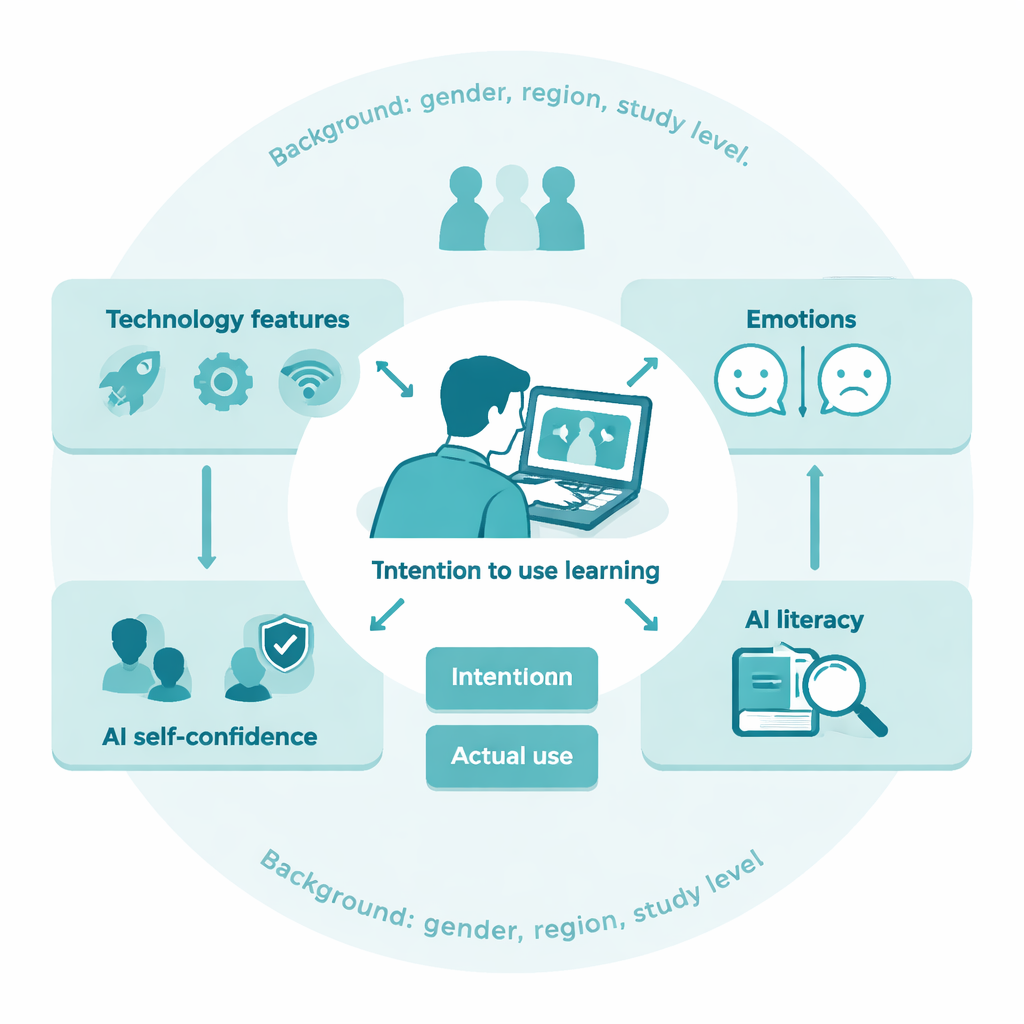
Most research on generative AI in language education has focused on test scores and performance: do students write better essays or speak more fluently with AI help? The authors argue that this view is too narrow. Even the most powerful tool is useless if students do not feel comfortable with it, do not see its value, or lack the skills to use it well. To tackle this, they build on a well‑known framework from technology research called the Unified Theory of Acceptance and Use of Technology. In simple terms, this framework links what people expect from a technology, how easy they think it is to use, what people around them think, and how much support they have, to their intention to use it and their real‑world usage.
What the researchers set out to test
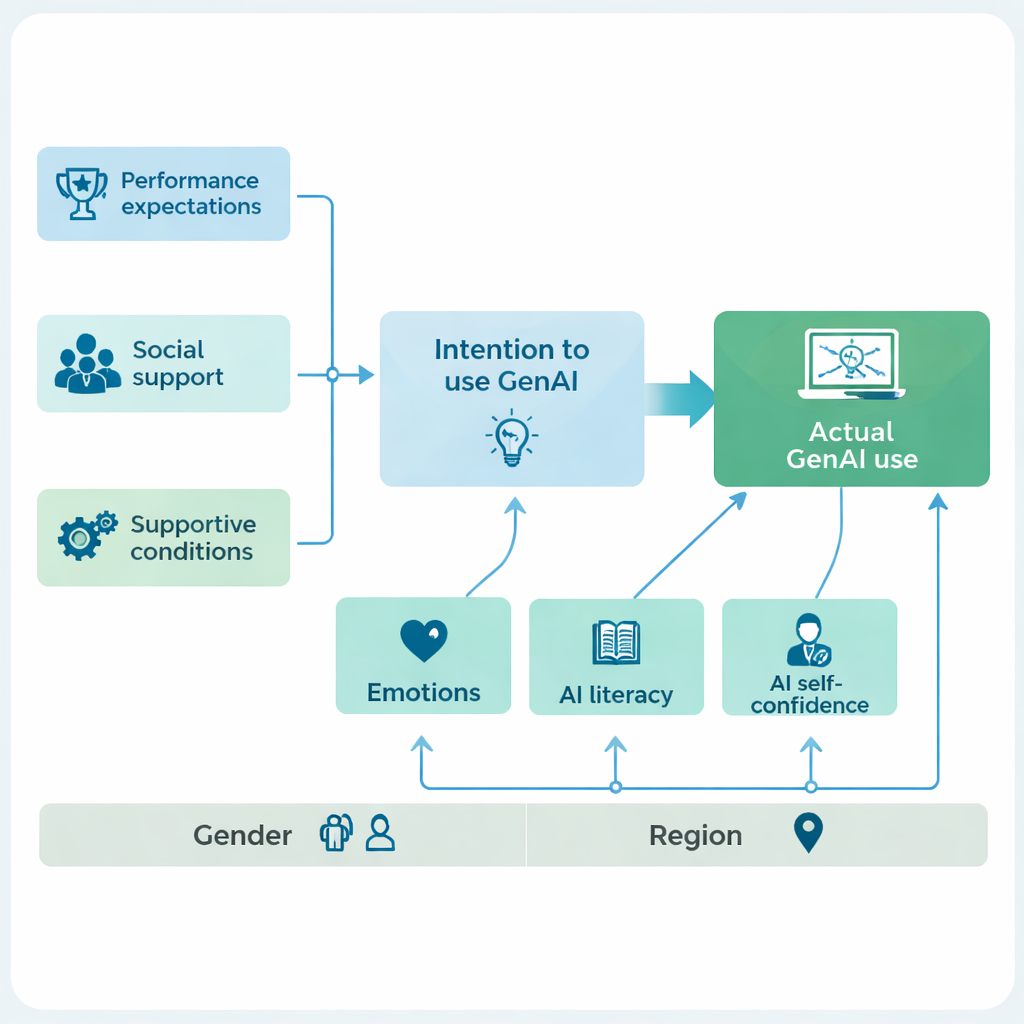
The study focused on 409 Chinese university students majoring in foreign languages such as English, French, German, and Japanese. All were studying at undergraduate or postgraduate level. The researchers used a detailed online questionnaire, adapted and translated carefully into Chinese, to measure several ingredients of AI acceptance. These included how useful students believed generative AI would be for their learning, how easy it felt to use, whether important people around them encouraged its use, and whether the technical and institutional support was in place. On top of this, they added three personal dimensions that are often overlooked: students’ emotions toward using AI (such as excitement or anxiety), their level of AI literacy (how well they understand and can evaluate AI tools), and their AI self‑efficacy (confidence in their own ability to work with AI).
What really drives students’ AI use
The analysis showed that two beliefs matter most for students’ intention to use generative AI: the expectation that it will genuinely improve their academic performance, and the sense that people they respect—teachers, supervisors, and peers—support its use. In contrast, perceived ease of use did not significantly change students’ intentions, likely because many modern AI tools are already intuitive. When it came to actual usage, several forces combined. Students were more likely to use generative AI when they already intended to, when their universities and systems made it easy and supported, when they felt more positive than negative emotions about AI, when they had stronger AI literacy, and when they felt confident in their own AI abilities. In other words, both the environment and the learner’s mindset play key roles in turning curiosity into regular practice.
How background factors shape the picture
The researchers also checked whether basic background characteristics changed how these factors interacted. They looked at gender, level of study, prestige of the university, region of China, and the language being learned. Most of these did not strongly alter the relationships in the model. Two stood out. First, gender mattered for the link between AI literacy and actual use: for male students, higher AI literacy translated more strongly into heavier use than for female students. Second, region mattered for how strongly beliefs about performance benefits fed into intention to use, with students in eastern China showing the strongest link. These findings hint that access, culture, and prior exposure to technology can subtly shape how students respond to the same tools.
What this means for classrooms and campuses
For educators and universities, the results send a clear message: promoting generative AI in language learning is not just about handing out tools. It requires showing students concrete learning benefits, building supportive norms in classes and departments, and offering training that raises both AI literacy and confidence. Structured activities that create low‑pressure opportunities to experiment with AI, honest discussions about its limits and ethics, and user‑friendly designs can all help students feel both capable and in control. The study concludes that when students expect real gains, feel encouraged by others, understand how AI works, and trust their own ability to use it, they are far more likely to adopt generative AI as a meaningful partner in learning a new language.
Citation: Xu, T., Xiong, Y. Multidimensional determinants of generative AI acceptance in foreign language education. Sci Rep 16, 5698 (2026). https://doi.org/10.1038/s41598-026-36700-1
Keywords: generative AI, language learning, technology acceptance, AI literacy, student emotions