Clear Sky Science · en
Experimental study on the failure risk of existing metro station under unilateral large-scale excavation
Why digging near subways can be risky
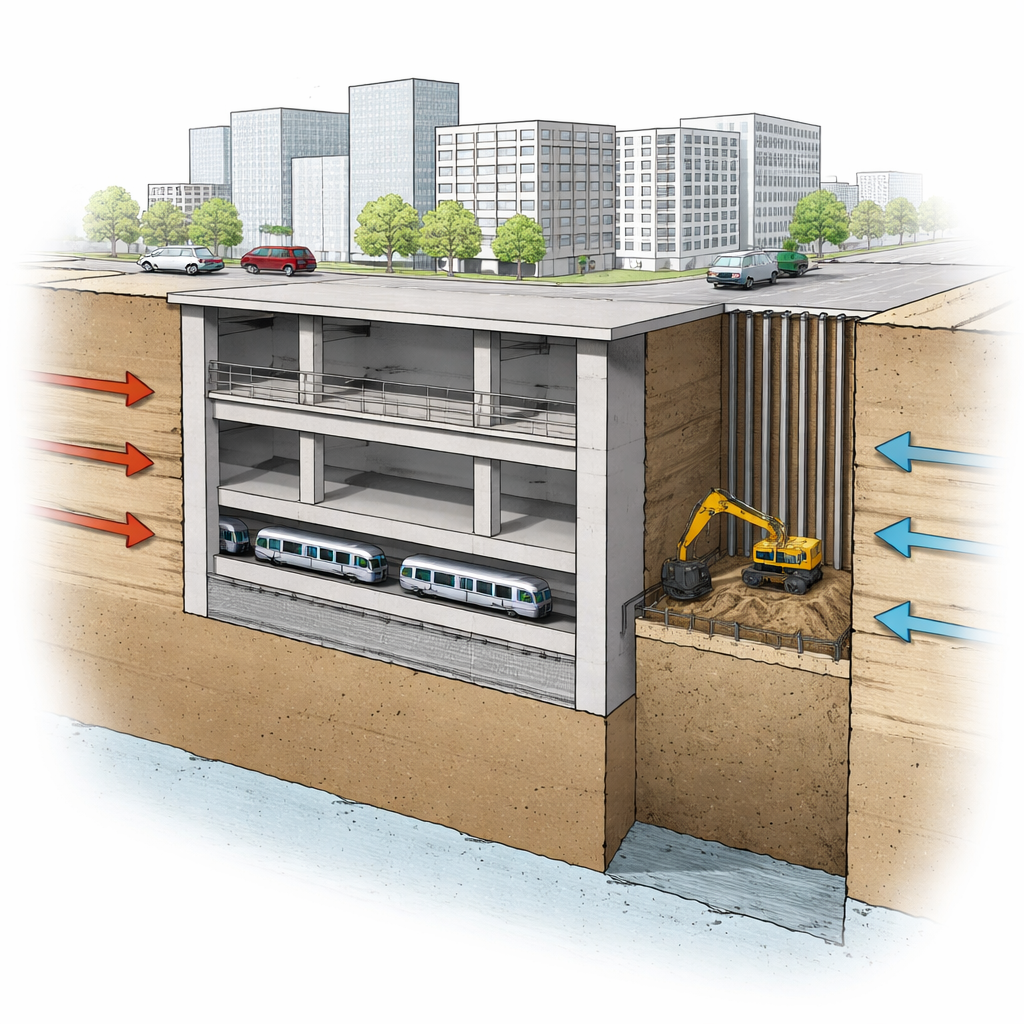
As cities add new subway lines and underground shopping centers, builders often must dig huge pits right next to stations that are already in service. At first glance, those stations look like solid underground fortresses. But when soil is removed on only one side of them, the hidden balance of pressures in the ground changes. This study asks a practical question with big safety implications: how wide and how deep can engineers dig on one side of an operating metro station before the station tilts, nearby streets crack, or buildings start to fail?
A real station inspires a lab experiment
The research is based on Jincheng Plaza Station in Chengdu, China, a busy underground hub where three metro lines meet. One line is already built, while the others require a massive new excavation right next to the finished station, exposing one of its long side walls. To explore the risks before full construction, the authors built a detailed scale model of the station and surrounding soft rock and soil. Using a 1:100 scale, they placed a transparent box of soil in the lab, embedded a miniature station made from stiff plastic, and then “dug” one side of the soil in carefully controlled steps.
Watching a tiny station move and strain
The model was instrumented like a real project site. Displacement meters tracked how the roof of the station moved vertically and sideways. Pressure cells behind the wall measured how the soil push changed, and strain gauges on the wall recorded how much the station’s structure stretched or compressed. The team ran 28 different excavation scenarios, combining four depths and seven widths of unilateral digging, from modest pits to removing soil across the full length of the station. After each small step of excavation, they waited for the soil to settle and then recorded the new deformations, pressures, and strains.
What happens when one side is over-dug
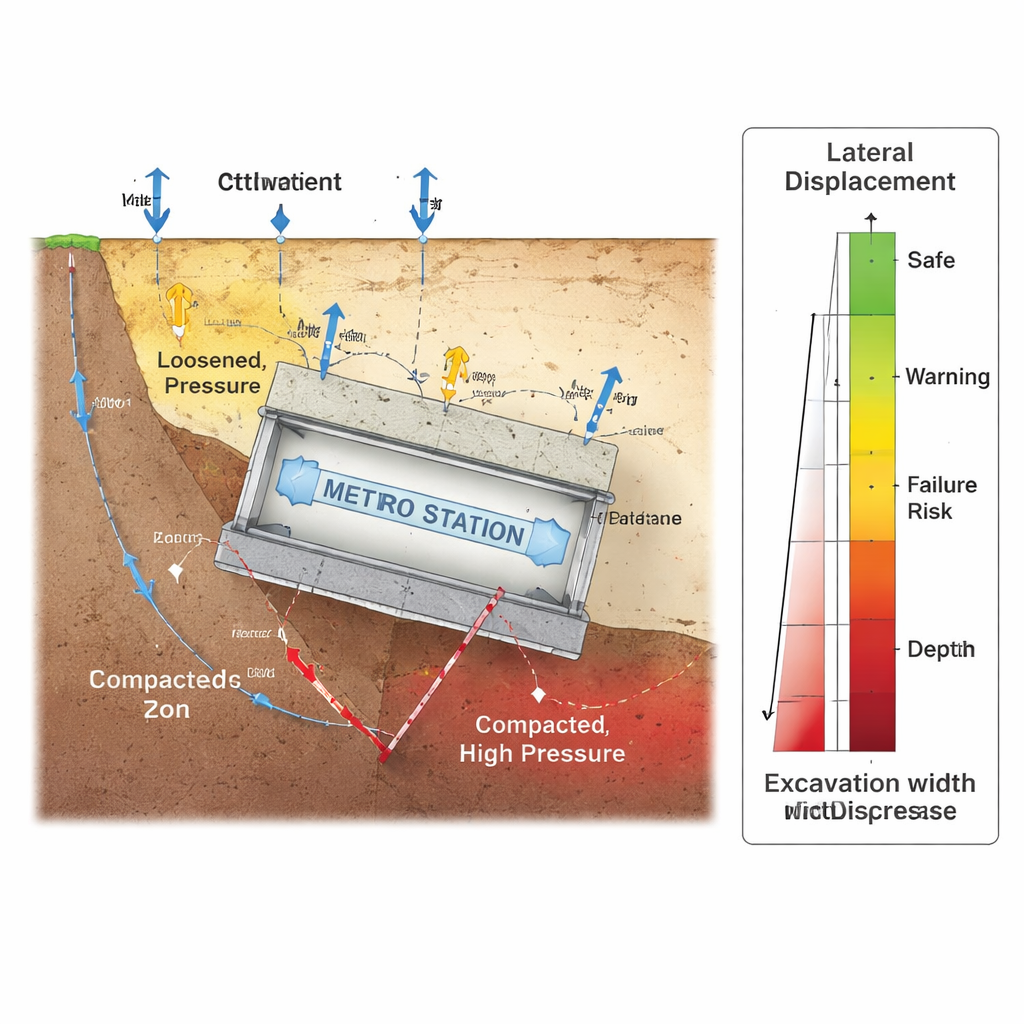
The experiments revealed that vertical settlement of the station roof remained small and within safety limits for all tested cases; the station hardly sank. The real danger came from sideways movement. As the unilateral excavation became deeper and wider, the station steadily leaned toward the pit. When the excavation depth exceeded about two-thirds of the station’s height, the tilt became obvious. For excavation widths around half to equal the station width, sideways movement reached warning levels; at even larger widths (100 meters and beyond in the real project), lateral deformation exceeded the code-based safety threshold, meaning normal train operations could no longer be guaranteed.
Soil loosens above, squeezes below
The soil itself also behaved in a revealing way. As the station tilted, the shallow soil just behind the excavated wall lost contact with the structure and became looser, so the earth pressure there dropped sharply—by up to about 98 percent in the most extreme case. At the same time, deeper soil near the base of the wall was squeezed harder, increasing pressure in a compacted zone. This combination means the ground near the surface can no longer safely support pavements or building foundations, raising the risk of road collapse or leaning high‑rises, even though the station’s concrete shell still has enough strength and does not crack.
A practical warning map for builders
Because sideways tilting turned out to be the most sensitive indicator of trouble, the authors used their data to build a simple risk-zoning chart. It divides combinations of excavation depth and width into four color-coded levels: A (no risk) where construction can proceed normally, B (general risk) requiring closer monitoring, C (high risk) where work should pause for safety assessment, and D (major risk) where immediate emergency measures are needed. Applied back to the Jincheng Plaza project, the method correctly predicted a high-risk C zone at a planned excavation of 22 meters deep and 80 meters wide; after extra support was added, the actual station movement dropped by about two-thirds. For city planners and engineers, this study turns complex underground mechanics into a practical, easily used tool to keep metro stations and nearby buildings safe during ambitious new digs.
Citation: Zhou, F., Zhou, P., Cao, K. et al. Experimental study on the failure risk of existing metro station under unilateral large-scale excavation. Sci Rep 16, 5701 (2026). https://doi.org/10.1038/s41598-026-36698-6
Keywords: metro station safety, deep excavation, ground deformation, urban tunneling, risk assessment