Clear Sky Science · en
Structural equation modeling of safety integration and production pressure effects on safety performance in cement manufacturing
Why Speed and Safety Collide in Cement Plants
The cement that holds our buildings, bridges, and roads together is made in huge factories that run almost nonstop to meet global demand. Inside these plants, workers face heat, dust, heavy machinery, and tight deadlines. This study asks a simple but vital question: when management pushes harder for output, what happens to safety—and can strong safety practices protect workers from that pressure?
How Safety Becomes Part of Everyday Work
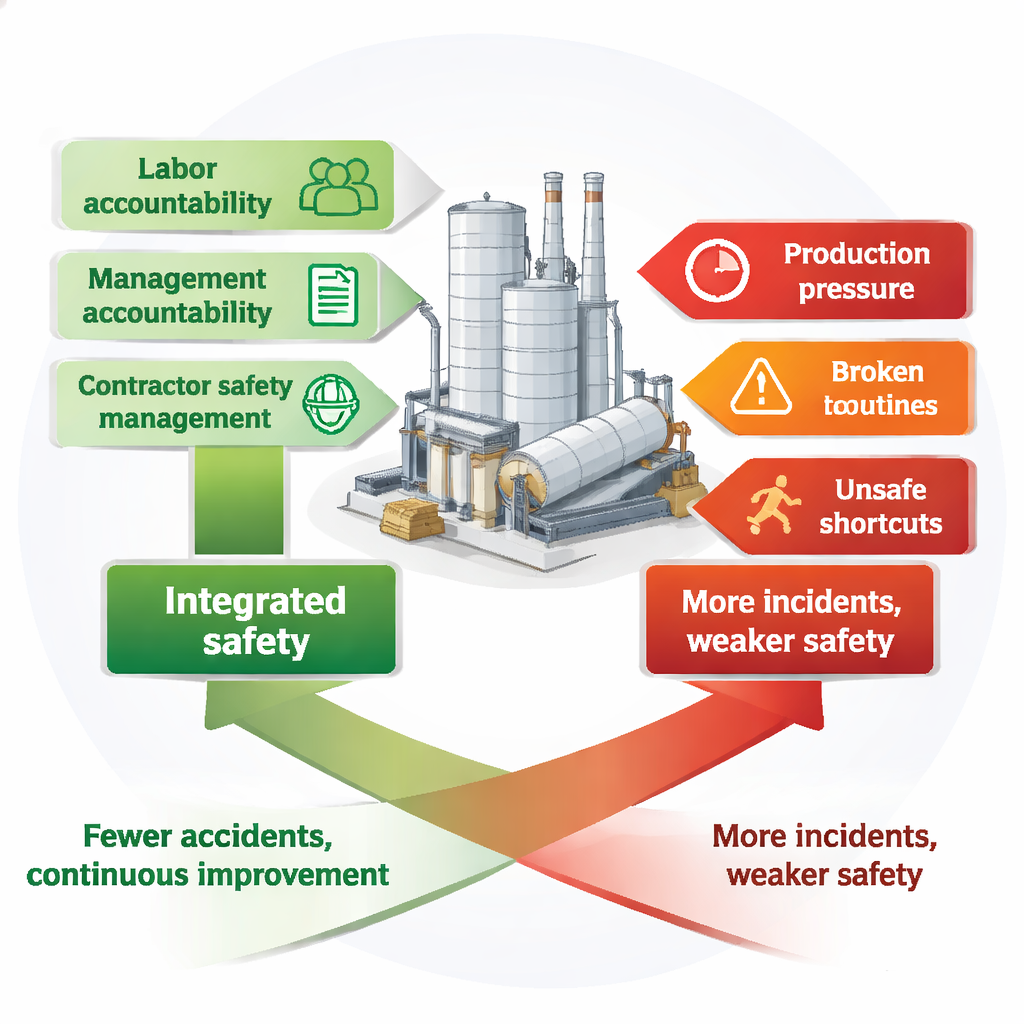
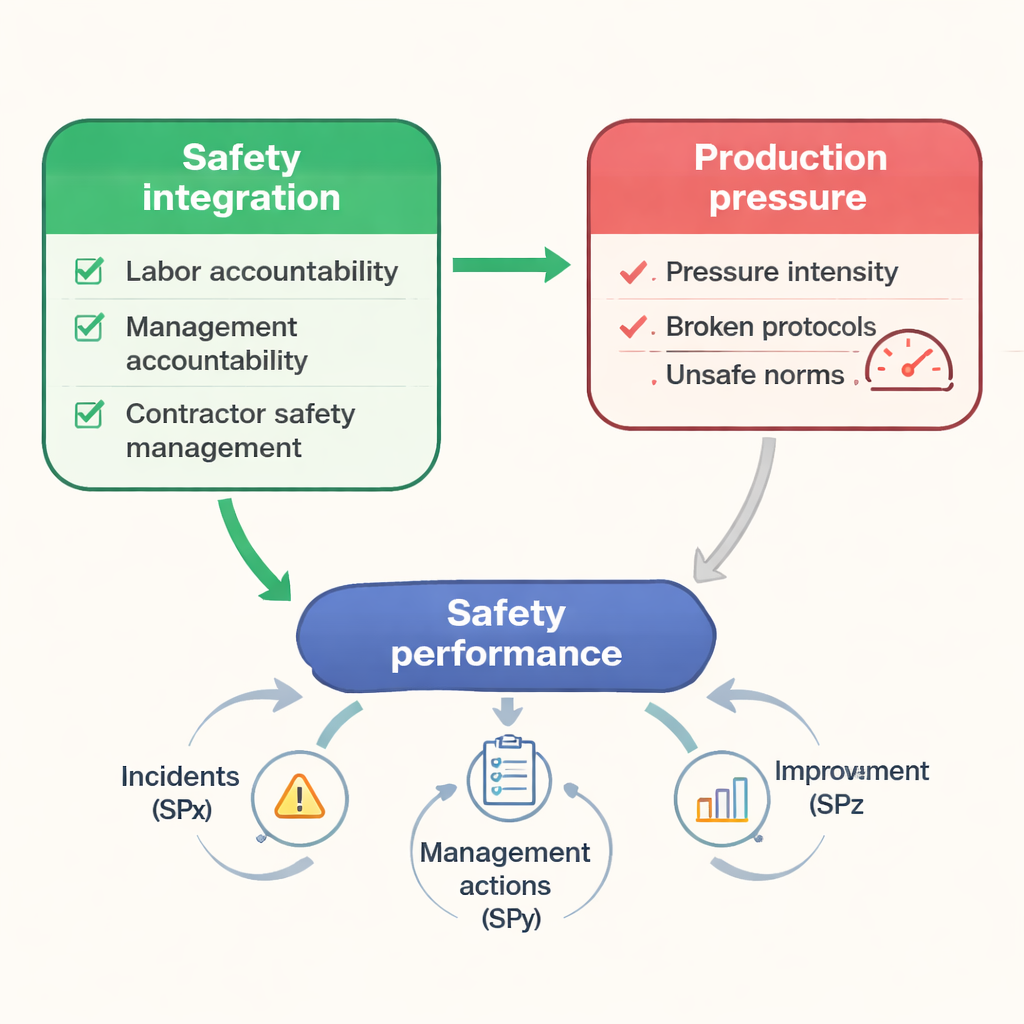
The researchers focus on “safety integration,” meaning how deeply safety is woven into day-to-day tasks rather than treated as an occasional add‑on. In a large cement plant in Uganda, they looked at three main ingredients: how clearly workers are held responsible for safe behavior (labor accountability), how seriously managers take their own safety duties (management accountability), and how well outside contractors are brought under the same safety rules as full‑time staff. When these pieces line up, safety meetings, training, supervision, and rewards become routine—not emergency responses after something goes wrong.
When Output Targets Undercut Good Intentions
At the same time, the plant operates under intense production pressure: strict deadlines, high output goals, staffing gaps, and equipment that is expected to run with minimal downtime. The study breaks this pressure into three parts. First is pressure intensity—workers being pushed to “get it done” despite limited time and resources. Second are disruptions of safety protocols, where rules are bent or skipped to keep the line moving. Third is the gradual normalization of unsafe practices, when shortcuts become so common that they start to feel normal. Together, these forces can quietly push safety down the priority list, even in companies that talk a lot about protecting workers.
What the Numbers Reveal About Risks and Protection
Using survey data from nearly 300 employees and advanced statistical modeling, the authors mapped how these factors interact. They grouped safety performance into three areas: actual incidents and near‑misses (SPx), management actions such as funding, training, and inspections (SPy), and continuous improvement efforts like learning from past incidents and tracking safety data (SPz). Across all three, labor safety accountability stood out as the strongest positive influence: when workers clearly understand and own their safety responsibilities, accidents fall and learning improves. Contractor safety management and management accountability also mattered, especially for preventing incidents and driving long‑term improvements. Production pressure told a different story. High pressure intensity and frequent disruptions of safety protocols were linked with poorer safety results, particularly more incidents and weaker management follow‑through. The normalization of unsafe practices showed a smaller direct effect, but the authors warn that it signals early erosion of a healthy safety culture—bad habits that may not cause an accident today but raise the odds over time.
Balancing Workload, Leadership, and Real‑Time Insight
The study goes beyond measuring problems to suggest practical solutions. It highlights the importance of visible, hands‑on leadership that treats safety as non‑negotiable, even when orders are piling up. It recommends embedding safety expectations into labor contracts, performance reviews, and contractor agreements so that everyone—from temporary workers to managers—is held to the same standard. The authors also point to new tools such as real‑time monitoring, predictive analytics, and behavior‑based safety programs that can spot patterns of fatigue, repeated rule‑bending, or near‑misses before they lead to serious harm. Adjusting shift patterns, reducing excessive overtime, and ensuring enough staff on critical tasks are presented as simple but powerful ways to reduce pressure at its source.
What This Means for Workers and the Wider Industry
In plain terms, the study concludes that strong safety integration can significantly improve safety performance in cement manufacturing, but relentless production pressure pulls in the opposite direction. When workers and managers share clear accountability, and contractors are fully included, plants see fewer incidents and more continuous learning. When output demands overwhelm people and systems, safety rules are quietly sidelined and risk rises. The message for cement producers—and other high‑demand industries—is blunt: real productivity gains do not come from squeezing more work out of tired people in unsafe conditions. Instead, long‑term success depends on designing operations where safety and production support each other, protecting both workers’ lives and the reliability of the plants they keep running.
Citation: Ssemuddu, J.B., Kajjoba, D., Olupot, P.W. et al. Structural equation modeling of safety integration and production pressure effects on safety performance in cement manufacturing. Sci Rep 16, 5801 (2026). https://doi.org/10.1038/s41598-026-36696-8
Keywords: cement industry safety, production pressure, worker accountability, contractor safety, occupational risk management