Clear Sky Science · en
Numerical simulation of reverse cyclic loading in precast column and pocket foundation connection
Why this matters for earthquake safety
Many modern buildings are assembled like giant Lego sets, using factory-made concrete parts that are quickly put together on site. This saves time and money, but it raises a crucial question: will these joints between pieces hold up when an earthquake hits? This article tackles that question for one of the most critical joints—the point where a building’s vertical column meets its foundation—by testing a type of precast “pocket” connection and comparing it with a traditional solid cast-in-place connection.
How building pieces are joined
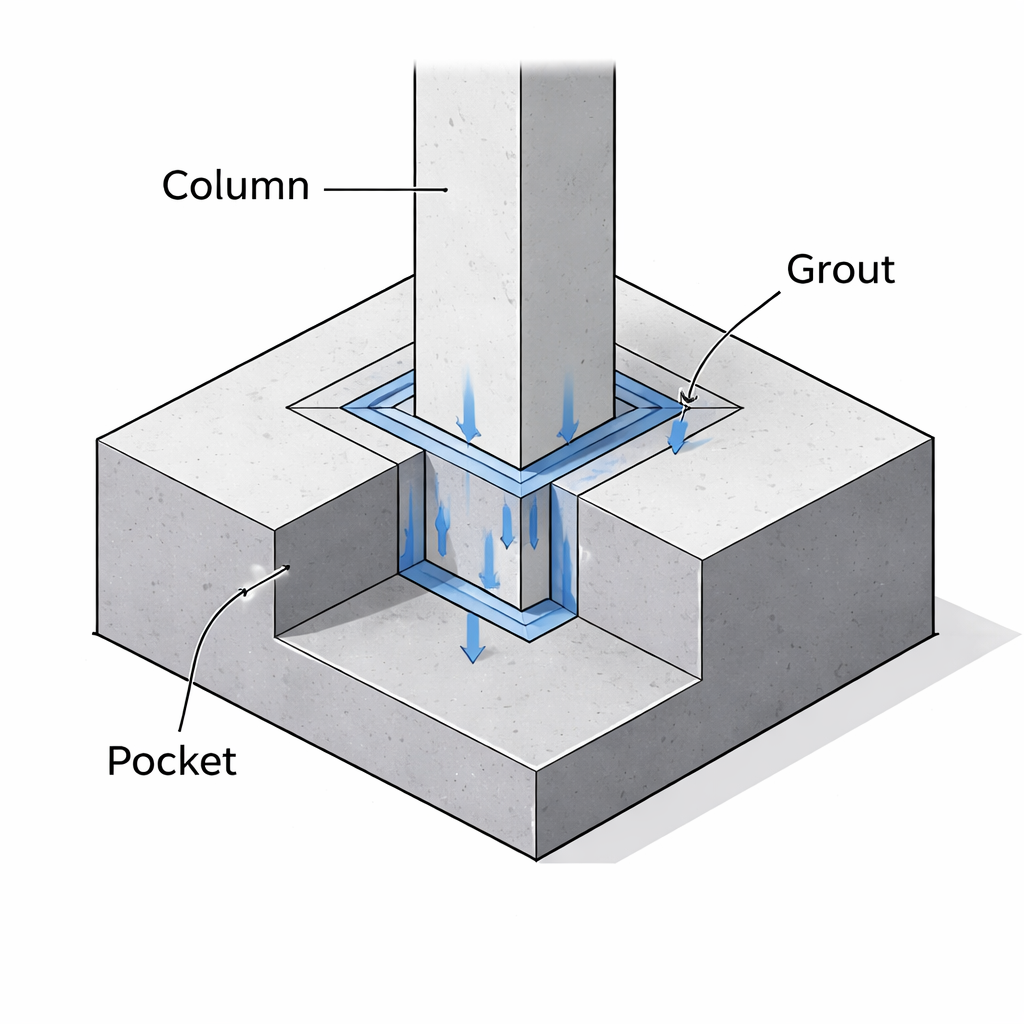
In conventional construction, columns and foundations are usually poured as one continuous block of concrete, creating a seamless connection. In precast construction, the column is made in a factory and later attached to the foundation on site. One promising method is the pocket connection: the foundation is cast with a recess (the pocket), the precast column is lowered into it, and the gap is filled with a high-strength grout. This grout, together with friction and the bearing of the column against the roughened pocket surfaces, allows the joint to behave much like a solid, one-piece connection. Because earthquake damage often concentrates at these joints, improving pocket details could make precast buildings both safer and easier to repair.
Designing two ways to improve the joint
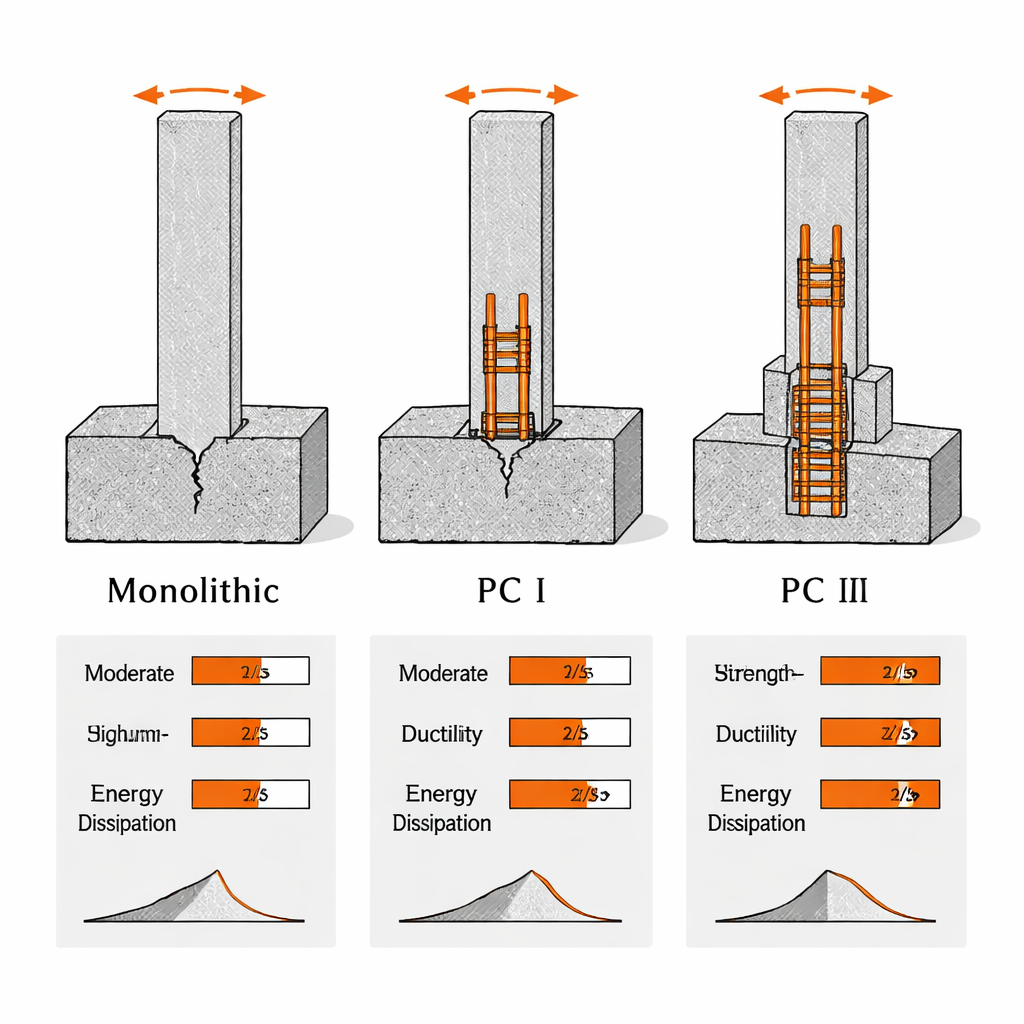
The researchers focused on how steel bars are arranged inside the pocket region, since this hidden “skeleton” controls how forces are carried during shaking. They started from a realistic four-storey building designed to Indian and Singaporean codes, identified a highly loaded column at the base, and then created half-scale models for computer simulation. One model represented a monolithic, cast-in-place column and foundation. Two others represented different pocket details: PC I, based on an existing design with added corner dowel bars, and PC II, in which each wall of the pocket was reinforced more independently with vertical and horizontal bars plus extra stirrups near the column base. All three were subjected, in a numerical model, to repeated back-and-forth sideways movement—similar to what a column would experience in an earthquake—while carrying a constant vertical load.
What the virtual shaking revealed
The team used advanced finite element software to capture cracking, crushing and steel yielding under this repeated loading. The simulations reproduced earlier laboratory tests to within about 15%, giving confidence in the virtual results. The monolithic connection was the strongest overall, as expected, but the PC II pocket connection came surprisingly close, losing only about 16% of the peak strength, while PC I lost about 22%. More importantly for earthquakes, the precast pockets allowed the columns to bend further before failing. Compared with the monolithic joint, PC I showed roughly two-thirds more deformation capacity, and PC II more than doubled it. Strain maps indicated that the monolithic joint concentrated damage right at the column–foundation interface, whereas the pocket connections spread damage more evenly, suggesting that they might be easier to repair after shaking.
How the joints handled energy from shaking
When a building sways in an earthquake, good connections do more than just stay intact—they also absorb and dissipate energy so that less is passed up into the structure. The researchers measured this “energy dissipation” from the loops formed by repeated load–displacement cycles in the simulations. Both pocket connections outperformed the monolithic joint. PC I dissipated about 63% more energy overall, though at the cost of more concentrated damage in the pocket region. PC II dissipated about 37% more energy than the monolithic connection and did so in a more controlled way, with less severe cracking and better confinement of the core concrete. Its response remained stable even at larger sideways movements, making it especially promising for use in earthquake-prone regions.
What this means for future buildings
For non-specialists, the key takeaway is that precast does not have to mean weaker. With thoughtful detailing of the hidden steel inside pocket foundations, precast column–foundation joints can match, and in some ways exceed, the performance of traditional solid concrete. The PC II layout in particular offers a balanced combination of strength, flexibility and energy absorption. That means buildings can sway safely without sudden failure and can be repaired more easily afterward. The study also shows that modern computer simulations, once carefully checked against experiments, can guide safer, more resilient designs before a single piece of concrete is cast.
Citation: Hemamathi, A., Jaya, K.P. & Sukumar, B. Numerical simulation of reverse cyclic loading in precast column and pocket foundation connection. Sci Rep 16, 5714 (2026). https://doi.org/10.1038/s41598-026-36686-w
Keywords: precast concrete, earthquake engineering, column foundation connection, seismic resilience, finite element simulation