Clear Sky Science · en
Identification of a novel natural compound that acts on the membrane progestin receptor α (paqr7) from the marine algae Padina
Seaweed, Hormones, and Future Medicines
Many modern medicines have started life in unexpected places, from moldy bread to rainforest trees. This study follows that tradition, uncovering a new compound from a common brown seaweed that can switch off a key reproductive signal in animals. The work not only hints at new ways to control fertility but also opens a path toward gentler, non‑steroidal drugs for hormone‑related diseases, including some cancers.
A Hidden Signal on Cell Surfaces
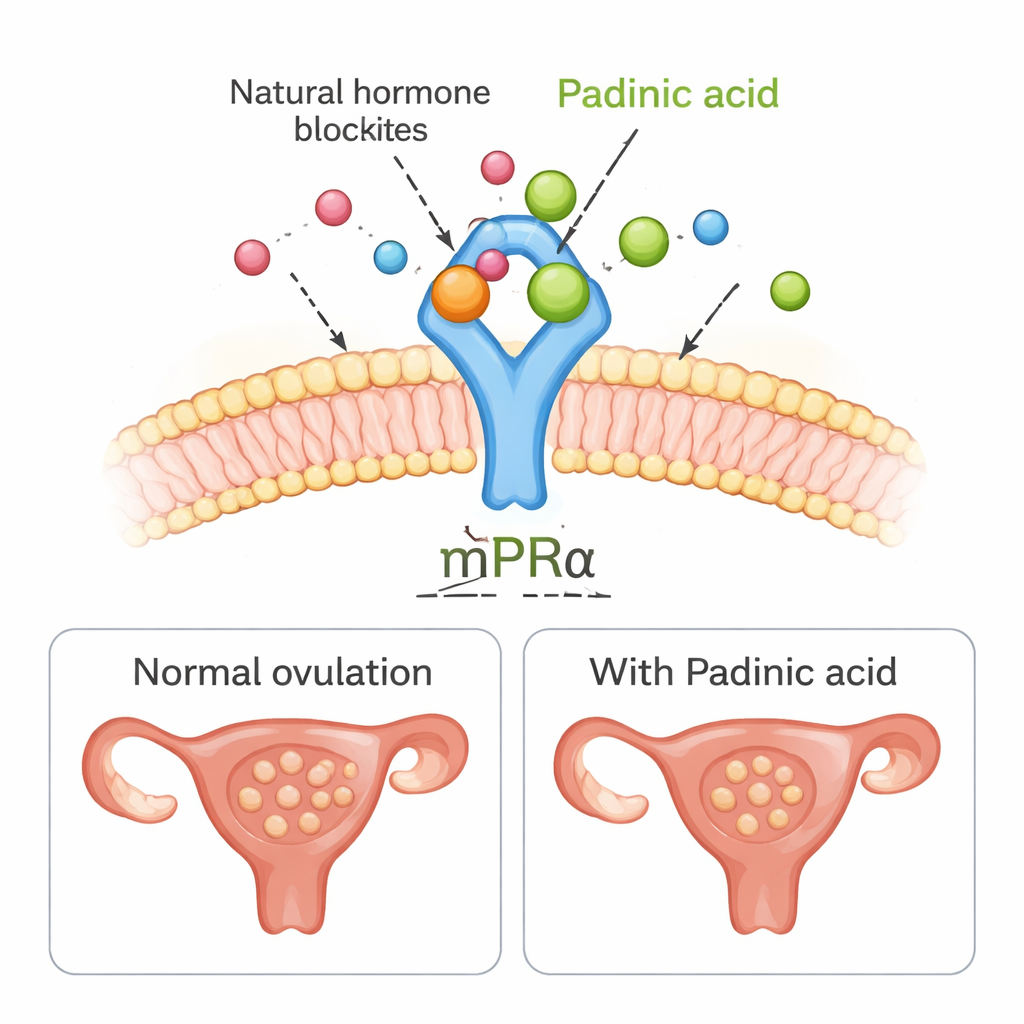
Our bodies respond to hormones like progesterone through two main routes. One is the classic pathway, where hormones slip into cells and act directly on DNA. The other is faster and uses receptors sitting on the cell surface, acting more like doorbells than keys. One such receptor, called membrane progestin receptor alpha (mPRα), is found in many animals, from fish to humans. It helps control egg maturation and ovulation and is unusually abundant in several cancers. Because of this, scientists have long searched for substances that can specifically turn this receptor on or off, hoping to better understand its roles and eventually design new drugs.
Mining a Brown Alga for a New Molecule
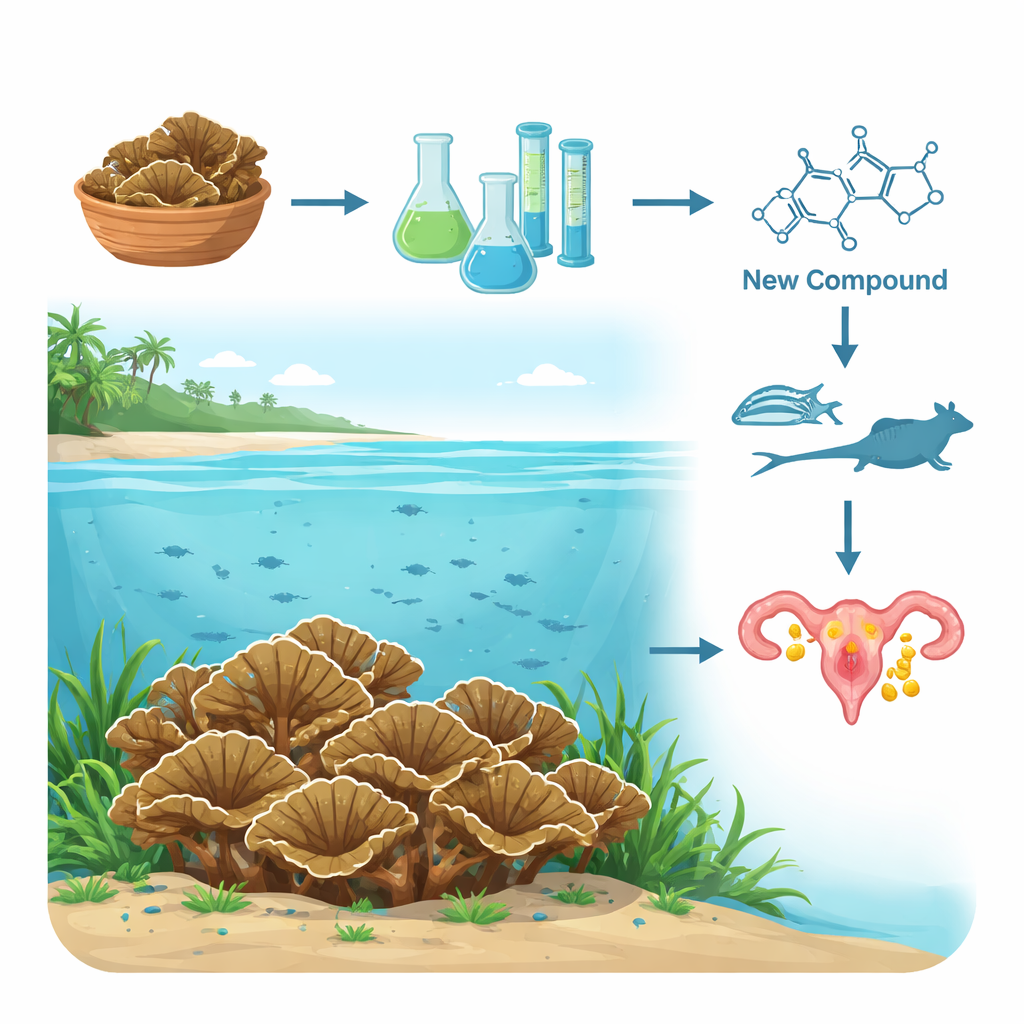
The research team turned to Padina arborescens, a brown seaweed growing along Japanese shores. Earlier work had shown that water‑based extracts from this alga could bind to mPRα and block egg maturation in fish. In the new study, the scientists prepared a methanol extract from Padina and painstakingly separated it using several rounds of high‑performance liquid chromatography, a technique that sorts molecules by how they move through specialized columns. From a large starting amount of seaweed, they finally isolated a tiny fraction containing one dominant molecule. Using advanced methods such as nuclear magnetic resonance and high‑resolution mass spectrometry, they worked out its structure and named it 1‑carboxybutyl‑2‑hydroxypentanoate. Because it comes from Padina, they proposed the more approachable name “Padinic acid.”
How the New Compound Blocks a Hormone Switch
To test whether Padinic acid truly interacts with mPRα, the team used a fluorescent assay built around graphene quantum dots—tiny glowing particles linked to human mPRα. In this setup, a fluorescent progesterone‑like probe normally binds the receptor and lights up. When competitors are present, the signal drops. Padinic acid reduced the fluorescence in a dose‑dependent way, showing it binds the receptor about as strongly as natural progesterone does. Follow‑up tests using radioactive progesterone confirmed that the seaweed compound competes directly for the same binding site. Importantly, a related hormone, estradiol, did not displace the probe, underlining the selectivity of the interaction.
From Fish Tanks to Mice: Stopping Egg Release
The researchers then asked what Padinic acid actually does in living animals. In zebrafish, they examined both isolated egg cells in dishes and whole fish in tanks. A known mPRα‑activating drug reliably triggered egg cells to resume maturation and proceed toward ovulation. When Padinic acid was added, however, it blocked this process in a clear dose‑dependent fashion, both in vitro and in vivo, at very low concentrations. The team went further, testing the compound in mice undergoing hormone‑induced superovulation, a procedure similar to that used in assisted reproduction. Mice given Padinic acid produced far fewer ovulated eggs, with an effect comparable to that of mifepristone, a well‑known antiprogesterone drug. Yet, when tested in developing zebrafish embryos, Padinic acid showed no obvious toxicity even at concentrations far higher than those needed for its biological effects.
Why This Matters for Contraception and Cancer
This work introduces Padinic acid as the first known natural antagonist that specifically targets mPRα, a key player in rapid hormone signaling. For a non‑specialist, the takeaway is that a simple, non‑steroidal molecule from seaweed can reliably “mute” a hormone switch that controls egg maturation and release in both fish and mice, without obvious early‑stage toxicity. That makes it an intriguing candidate for future contraceptive approaches and for exploring new treatments for hormone‑sensitive cancers in which mPRα is abundant. Challenges remain—most notably, producing enough of the compound, either by large‑scale purification or by chemical synthesis—but the study shows how marine life can still surprise us with molecules that may one day reshape reproductive medicine and cancer therapy.
Citation: Amin, M.T., Kodani, S., Nakagawa, H. et al. Identification of a novel natural compound that acts on the membrane progestin receptor α (paqr7) from the marine algae Padina. Sci Rep 16, 5988 (2026). https://doi.org/10.1038/s41598-026-36682-0
Keywords: marine natural products, hormone receptors, contraception, zebrafish research, ovarian cancer