Clear Sky Science · en
Hidden patterns in volcanic seismicity: deep learning insights from Mt. Etna’s 2020–2021 activity
Listening to a Restless Volcano
Mount Etna in Sicily is one of the world’s most active volcanoes, and its eruptions can threaten nearby towns, airports, and critical infrastructure. Volcano observatories already keep a close eye on Etna using many instruments, but the sheer volume of data makes it hard for humans alone to spot every warning sign in time. This study shows how modern artificial intelligence can sift through a year of Etna’s seismic “heartbeat” to uncover hidden patterns that reveal when the volcano is quiet, when it is recharging, and when it is gearing up to erupt.
Why Volcanic “Soundtracks” Matter
Volcanoes constantly generate vibrations that travel through the ground as seismic waves. Some are sharp, earthquake-like jolts, while others are more like a continuous hum called volcanic tremor or special tones known as long-period events. At Etna, these signals are recorded day and night by a dense network of seismometers. Traditionally, experts examine the strength and frequency of this shaking, along with gas emissions, ground swelling, and visual observations, to judge whether the volcano is safe or approaching a dangerous eruption. But Etna’s activity from late 2020 to late 2021 was especially intense, producing two long sequences of spectacular lava fountains and a flood of data that is difficult to interpret in real time.
Teaching Computers to Spot Hidden Patterns
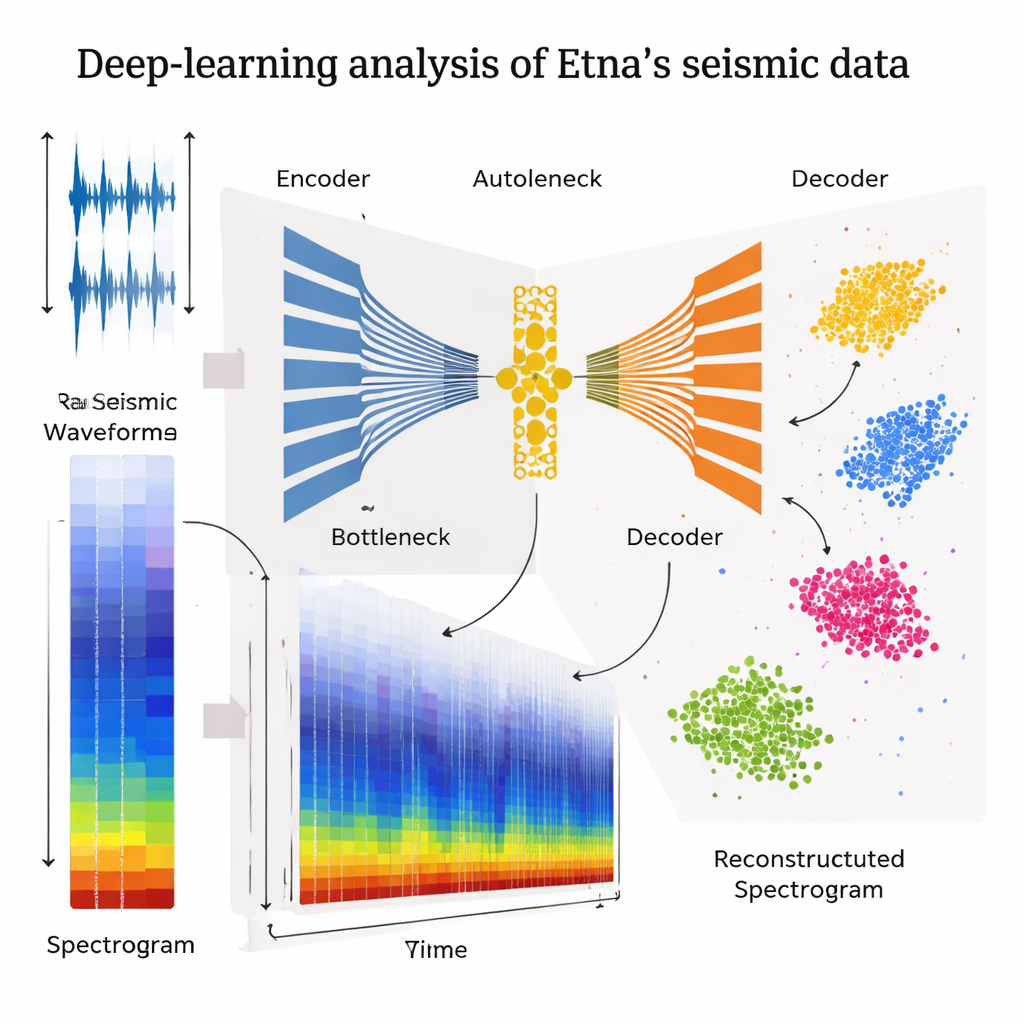
The researchers used an unsupervised deep-learning approach, meaning the computer was not told in advance which days were eruptive or quiet. Instead, they fed in daily spectrograms—color images that show how the strength of seismic vibrations varies with time and frequency—from two summit stations on Etna. A type of neural network called an autoencoder first learned to compress each day’s complex seismic “picture” into a small set of key features and then reconstruct it, ensuring that important information was preserved. A clustering method then grouped days with similar seismic fingerprints into four distinct clusters. The team checked these groups against independent evidence: when lava fountains were reported, how strong the tremor was, how many long-period events occurred, and how many small earthquakes struck beneath the volcano.
Four Faces of Etna’s Activity
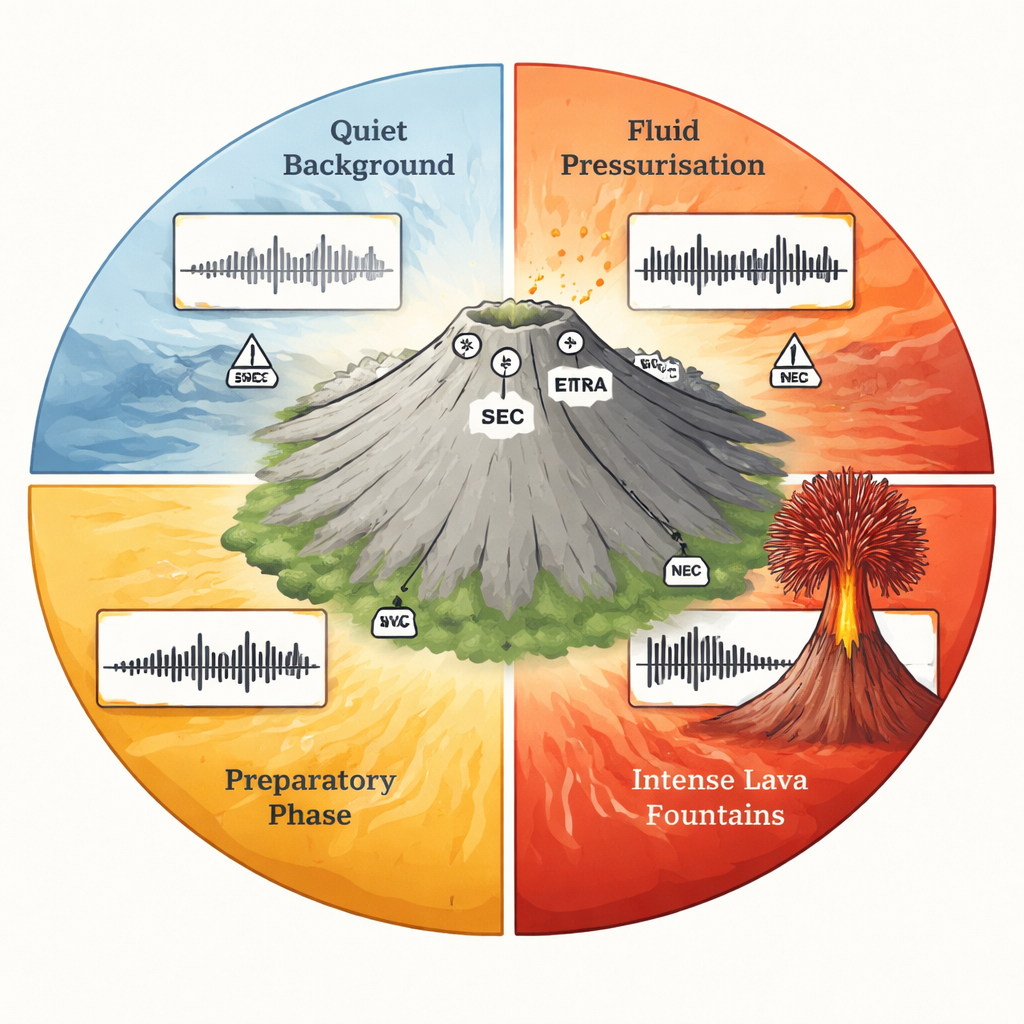
The computer’s four clusters neatly lined up with meaningful volcanic behaviors. One group corresponded to relatively quiet or mixed days, when only background tremor and occasional mild explosions were present. A second group captured days dominated by numerous long-period events, likely reflecting rising gases and fluids pressurizing the shallow plumbing system without yet producing large eruptions. A third group highlighted a “preparatory phase,” when tremor grew stronger and more persistent over weeks from mid-December 2020 to mid-February 2021, even though no major lava fountains had yet occurred at the surface. The fourth group matched the spectacular lava-fountain episodes themselves with remarkable accuracy, catching about 95 percent of eruptive days and showing intense, broadband seismic energy during paroxysms.
Seeing Transitions and Ambiguous Days
By combining data from both summit stations and looking for days when multiple instruments agreed on the same cluster, the researchers could distinguish clear regimes from more ambiguous intervals. Some days fell into an “undefined” category, where signals were mixed or different at the two sites—likely reflecting overlapping processes such as earthquakes, tremor, and gas-driven events happening at once. Interestingly, the method also picked up signs of a preparatory regime at the end of November 2021 and detected hints of the second eruptive cycle several days before lava fountains were confirmed, suggesting that subtle changes in the seismic patterns can precede visible activity.
What This Means for People Living Near Volcanoes
For non-specialists, the key message is that computers can now “listen” to a restless volcano and automatically sort its complex vibrations into a few understandable states: background activity, internal pressurisation, a build-up phase, and full-blown eruptions. The study shows that such unsupervised deep-learning tools can closely match expert judgment while working quickly and consistently across large datasets. Although this approach does not replace human volcanologists or other monitoring methods, it provides a powerful extra pair of eyes—helping observatories recognise when a volcano like Etna is quietly simmering, when it is recharging, and when it may be on the verge of another dramatic outburst.
Citation: Abed, W., Zali, Z., Sciotto, M. et al. Hidden patterns in volcanic seismicity: deep learning insights from Mt. Etna’s 2020–2021 activity. Sci Rep 16, 6155 (2026). https://doi.org/10.1038/s41598-026-36677-x
Keywords: volcano monitoring, machine learning, Mount Etna, seismic activity, eruption forecasting