Clear Sky Science · en
Effect of calcined street sweeping sediment on the mechanical and rheological properties of fly ash–slag geopolymers
Turning Street Dust into Stronger Buildings
Every day, street sweepers collect tons of dirty sediment from our roads—usually destined for landfill. This study explores a surprising alternative: using that waste, after a heat treatment, as an ingredient in next‑generation “green” binders that can partly replace traditional cement. By doing so, the researchers aim to cut carbon emissions, improve material performance, and give a second life to an underused urban waste stream.
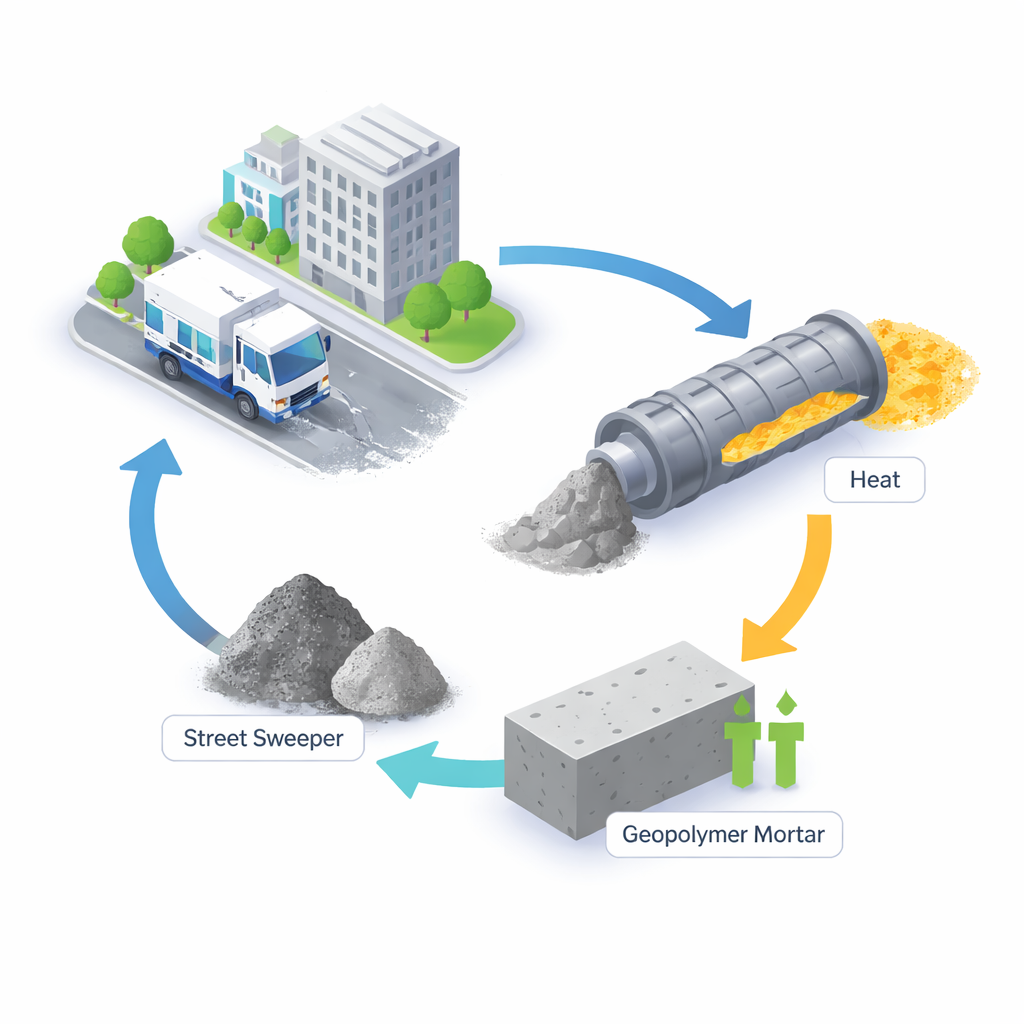
From Road Sweepings to Building Blocks
The sediment studied here comes from routine street‑cleaning in French cities. It is a mix of sand, tiny stones, organic matter, and traces of urban pollutants. Instead of discarding it, the team first heats the sediment to high temperature (a step called calcination). This burns off organics, breaks down some minerals, and makes the remaining powder more reactive. They then blend it with fly ash from coal power plants, granulated blast furnace slag from steelmaking, and a solid alkaline salt. When water is added, this powder mixture hardens into a geopolymer mortar, a low‑carbon alternative to ordinary cement.
Why This Waste Actually Helps
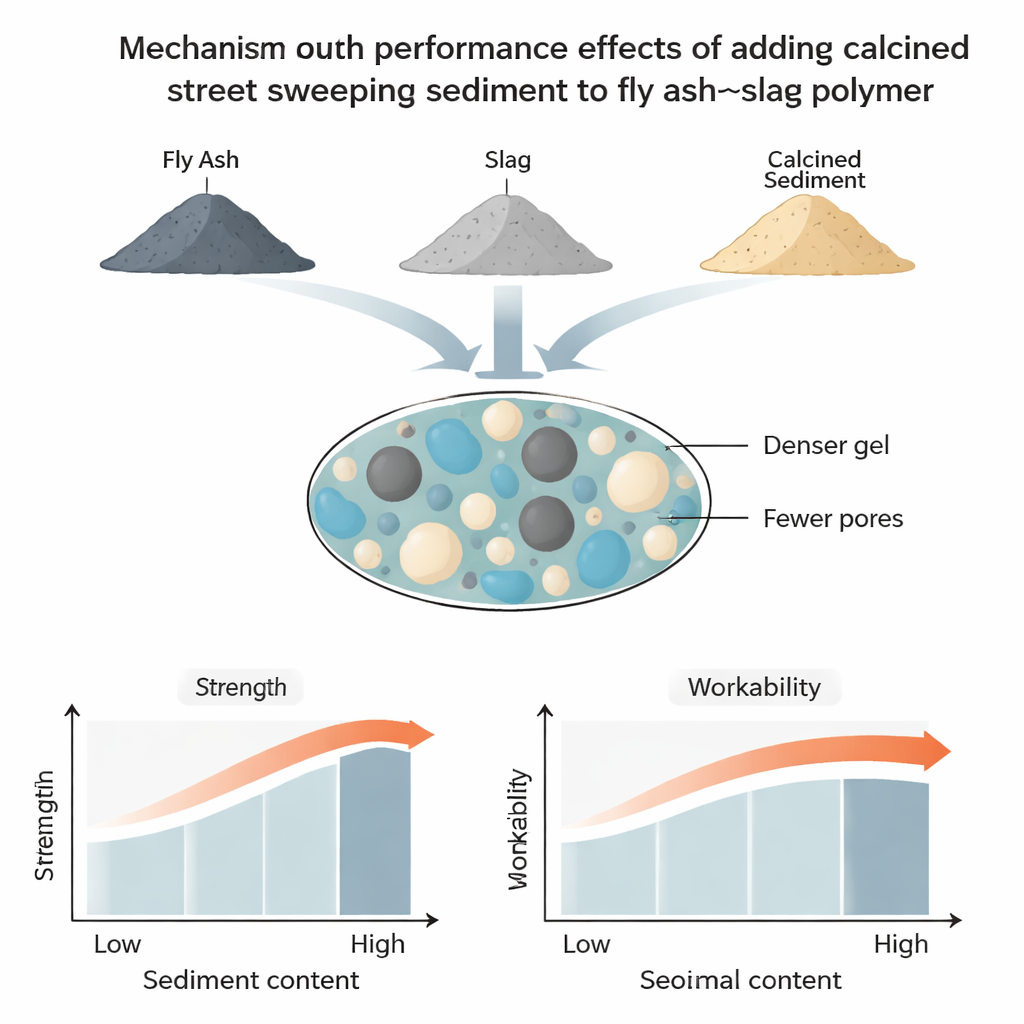
By replacing part of the fly ash with 9–30% calcined sediment, the researchers found that the hardened mortars actually became stronger. Tests on small beams and blocks showed that both bending and compressive strength increased at 7 and 28 days compared with a reference mix without sediment. Microscopic and chemical analyses revealed why: the sediment is rich in calcium and magnesium, which promote the formation of dense binding gels that glue the grains together and fill in pores. As a result, the internal structure becomes more compact, with fewer and smaller voids where cracks can start or water can enter.
Getting the Fresh Mix to Behave
Fresh concrete or mortar must not only be strong when hardened, it also needs to be workable when poured and stable while it sets. Here, the street‑derived sediment plays a second role as a natural thickener. In simple settling tests using graduated cylinders, mixtures with no sediment quickly separated, with clear water rising to the top. Adding as little as 9% sediment sharply reduced this “bleeding,” and at 18–30% the water was almost completely trapped inside the paste. Rheometer measurements—devices that gently stir and measure resistance to flow—showed that sediment increases both the initial stress needed to make the paste move and its viscosity. Moderate amounts keep the mix fluid enough to place, while still cohesive; very high amounts make it stiff and harder to handle.
Finding the Sweet Spot
The study compared several formulations and found clear trade‑offs. At low sediment levels, the mixes are easy to work with but prone to water separation and larger pores in the final material. As sediment content rises, the pore structure becomes finer and strengths climb to their highest levels, but the paste becomes increasingly resistant to flow and shows stronger “memory” after shearing, meaning it rebuilds its internal structure and stiffens quickly. The researchers highlight a practical window around 9–18% sediment replacement where stability and mechanical performance are much improved while the material remains reasonably workable for casting and construction.
What This Means for Future Construction
For non‑specialists, the takeaway is simple: dusty material scraped off city streets can, after careful heat treatment and blending, help make stronger, more stable, and potentially lower‑carbon building components. The calcined sediment acts both as a reactive ingredient that creates additional binding gel and as a natural viscosity modifier that reduces water separation in fresh mixes. While long‑term durability still needs to be fully assessed, this work shows how urban waste streams can be turned into valuable resources, supporting a more circular, climate‑conscious construction industry.
Citation: Zeggar, M.A., Sebaibi, N., Maherzi, W. et al. Effect of calcined street sweeping sediment on the mechanical and rheological properties of fly ash–slag geopolymers. Sci Rep 16, 6747 (2026). https://doi.org/10.1038/s41598-026-36673-1
Keywords: geopolymer concrete, street sweeping sediment, low carbon construction, waste valorization, alkali activated materials