Clear Sky Science · en
Optical coherence tomography and histological assessment of cutaneous vasculature and neural changes in long-term smokers: an exploratory study
Why this matters for your skin and health
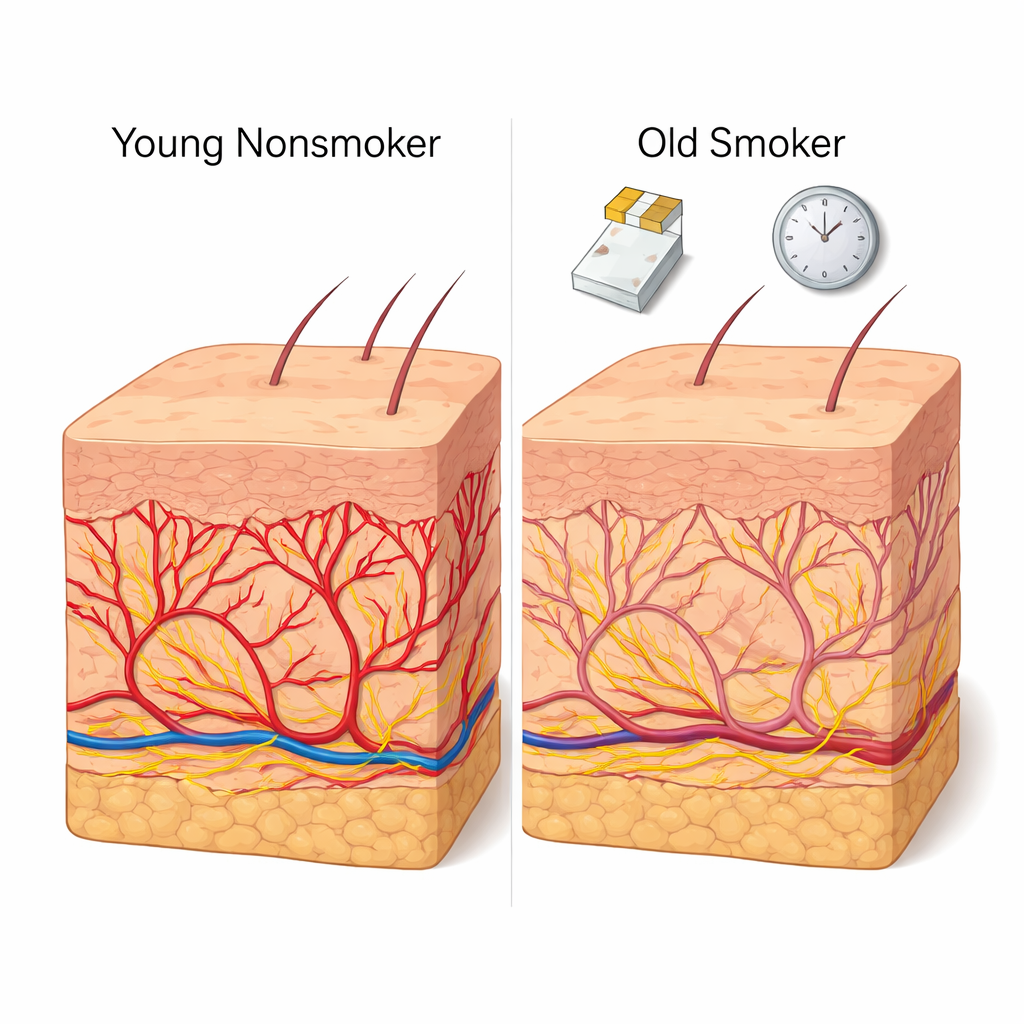
Cigarette smoking is usually blamed for harming the lungs and heart, but it also quietly reshapes the tiny blood vessels and nerves in your skin. This study uses a noninvasive imaging technique, along with skin biopsies, to ask a simple question with big implications: does long-term smoking make the skin’s microcirculation and nerve supply look “older” than it should for a person’s age?
Looking beneath the surface of the skin
The researchers focused on the skin of the forearm, an accessible “window” into the body’s small blood vessels. Because the skin’s microcirculation mirrors what happens in other organs, changes here can hint at broader vascular health. The team studied four groups of women: young smokers, young nonsmokers, older smokers, and older nonsmokers. They measured how many tiny blood vessels were present and how long and branched these networks were, and they also counted nerve fibers in the outermost skin layer. A separate device measured the build-up of so‑called advanced glycation end products (AGEs), harmful compounds that accumulate with age and are increased by smoking and metabolic stress.
A stress test for the skin’s blood flow
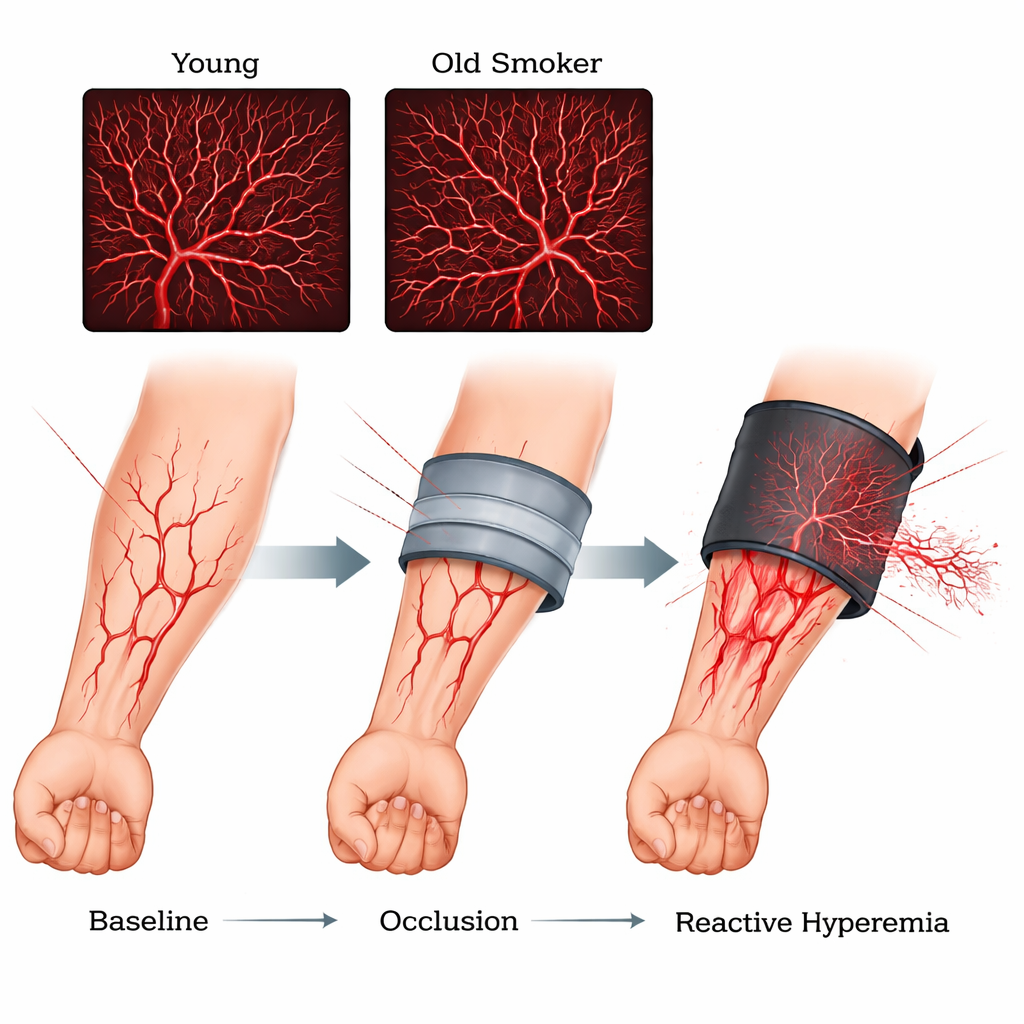
Instead of simply taking a snapshot of resting blood flow, the investigators used a technique called reactive hyperemia optical coherence tomography angiography. In everyday terms, they briefly pressed on the skin to stop blood flow and then imaged what happened when the pressure was released. Healthy vessels respond to this mini “tourniquet test” with a surge of blood. This approach, combined with light-based imaging, produced high‑resolution maps of the skin’s tiny vessels without the need for dyes or injections. From these images, they calculated vessel density, the total length of the vascular network, and the number of branching points.
How aging and smoking show up in the skin
Age alone had a clear impact: older women had fewer vessels, fewer nerve fibers, and more AGE build-up than younger women. Vessel density in older subjects was significantly lower, nerve fiber counts were reduced, and AGE readings were higher, all consistent with well-known features of aging skin—thinner, less elastic, and less well supplied with blood and nerves. When the team compared smokers and nonsmokers, overall differences in vessel density were small and not statistically significant, likely in part because the groups were not perfectly age-matched. Still, a meaningful pattern emerged: within each age band, smokers tended to have slightly lower vessel density than nonsmokers, with the largest gap seen in older women.
Smoking history versus the calendar
To dig deeper, the researchers looked at “pack years,” a measure that combines how much and how long someone has smoked. Among smokers, vessel density dropped as pack years increased, and this link was stronger than the link between vessel density and age itself. In other words, how heavily someone had smoked tracked skin vessel loss better than their birth date did. Surprisingly, nerve fiber counts did not clearly decline with smoking; in this small sample, smokers sometimes had higher nerve densities than nonsmokers of the same age, and there was no direct relationship between vessel density and nerve density. However, higher AGE levels were associated with fewer vessels and fewer nerves, reinforcing the idea that chemical damage in the skin accompanies structural decline.
What this means for everyday life
For a layperson, the takeaway is that long-term smoking appears to nudge the skin’s tiny blood vessels toward an older pattern, even if the effect is modest in this small, exploratory study. The more someone had smoked over their lifetime, the fewer vessels their skin could recruit during a stress test, suggesting a kind of accelerated vascular aging. The study also shows that noninvasive imaging of the skin can capture these subtle changes, offering a possible future tool for tracking the hidden impact of lifestyle choices on vascular and nerve health. While larger, better‑controlled studies are needed, the message is straightforward: every cigarette adds to a history that your skin—and likely the rest of your microcirculation—does not forget.
Citation: Doyle, A.E., Patel, P.M., Elmariah, S.B. et al. Optical coherence tomography and histological assessment of cutaneous vasculature and neural changes in long-term smokers: an exploratory study. Sci Rep 16, 6179 (2026). https://doi.org/10.1038/s41598-026-36667-z
Keywords: skin aging, smoking, microcirculation, optical coherence tomography, nerve fiber density