Clear Sky Science · en
Numerical modeling of coupled stress-fracture evolution in water-resisting key strata during longwall mining
Why this matters for coal, water, and safety
In many dry regions, coal seams lie directly beneath precious underground water. Mining the coal risks cracking the rock layers that normally act as a natural dam, allowing water to pour into tunnels or drain away from the surface. This study asks a practical question: how does the rock barrier between coal and groundwater deform and fracture as mining progresses, and under what conditions can it still safely hold back water?
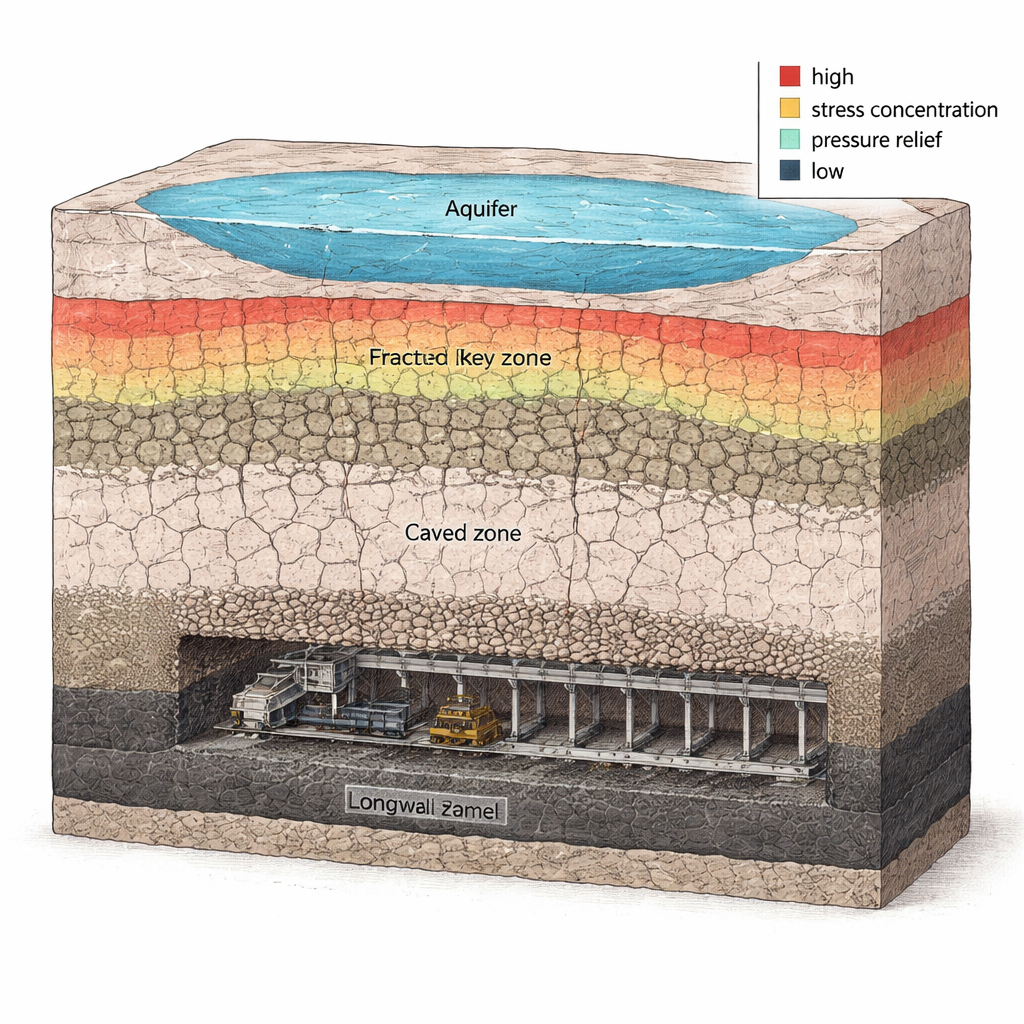
A hidden rock shield above the coal
Above many coal seams sits a relatively strong rock layer that blocks water from the aquifer above. The authors call this the water-resisting key stratum, and treating it as an underground shield is central to modern “water-preserved” coal mining. If this layer stays mostly intact, groundwater remains stable and mine flooding is unlikely. If it breaks into a heavily cracked zone, its ability to seal water is lost. The key control is how far this layer is from the coal seam—its interburden thickness—compared with the mining height. That ratio, called relative interburden thickness, determines whether the shield ends up in a zone of violent caving, moderate fracturing, or gentle bending as coal is removed.
Virtual experiments on mining and rock stress
Because it is hard to watch deep rocks in real time, the team used a computer program that simulates thousands of separate rock blocks and the joints between them. They modeled a longwall mining panel 400 meters long, assuming fairly uniform rock and no extra tectonic squeezing, so they could clearly see the influence of distance from the coal. Three cases were tested: the barrier rock only 20 meters above the seam, 40 meters above, and 60 meters above, while mining height and rock type stayed the same. In each case, they tracked how vertical and sideways (horizontal) stresses in the barrier changed as the mining face advanced, and how pre-existing joints opened into fractures or closed again.
Stress waves and crack belts inside the rock shield
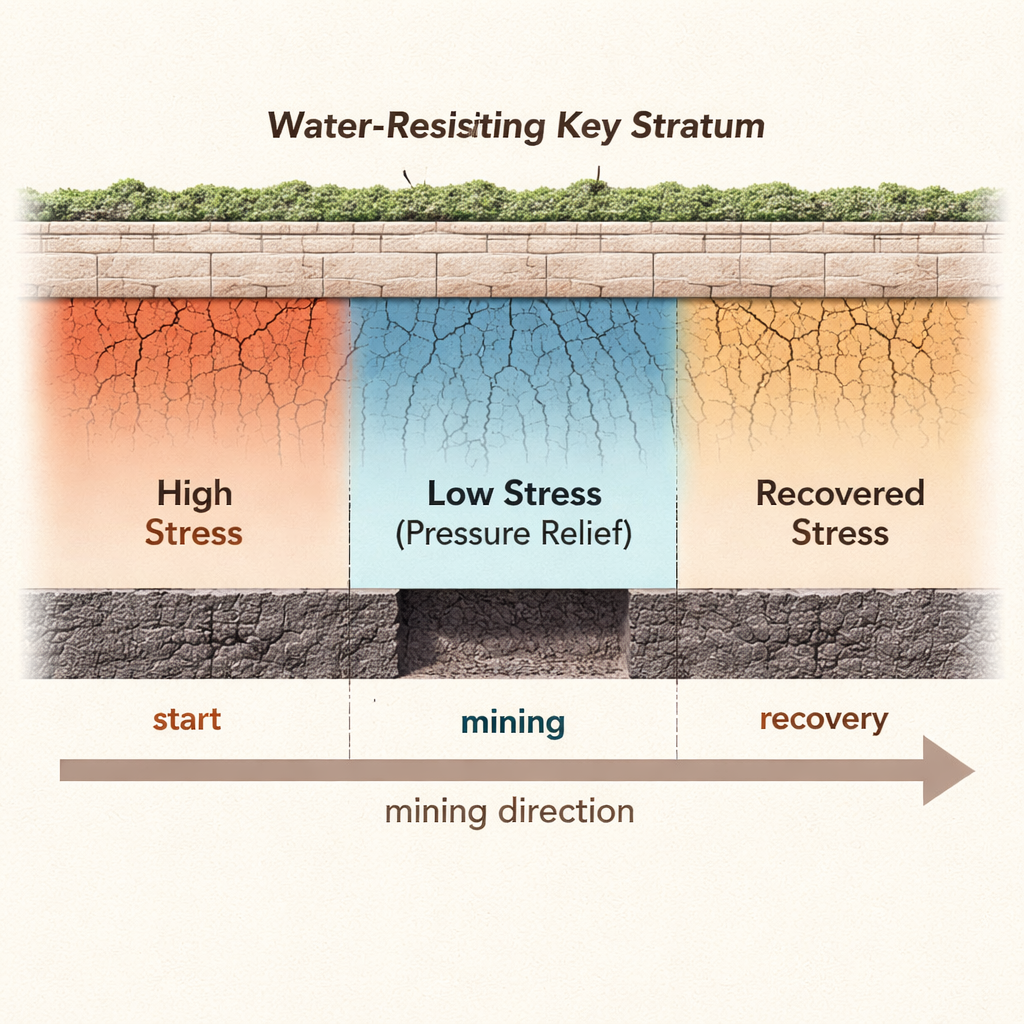
The simulations show that as the coal face advances, the barrier rock does not simply sag; it passes through a repeating pattern of stress zones along its length. Starting from the untouched ground, the pattern becomes: initial stress, then a belt where stress piles up, then a belt where stress drops sharply, then a central zone where stress gradually recovers, followed by another low-stress belt and finally another high-stress belt near the moving face, before returning to initial conditions farther away. Over time, the central recovery zone widens as broken overlying rock compacts and begins to carry more load. At the same time, places very close to the mined-out void experience very low stress, especially vertically, which favors the opening of cracks.
How cracks grow, then mostly close again
The crack network in the barrier rock closely follows this stress landscape. Where stress is high, cracks are squeezed and tend to stay closed. When the rock passes into a strong pressure-relief zone, cracks suddenly open and connect, forming a fracture belt that could let water pass. As the overlying rock settles and stress recovers, many of these cracks gradually close again, though a few stubborn ones remain partly open. The simulations reveal a consistent timeline at a fixed point in the barrier: an initial undisturbed state; stress increase; rapid unloading and crack growth; a period of maximum cracking; and finally partial closure as stress rebuilds. The farther the barrier lies above the coal seam (that is, the larger the relative interburden thickness), the weaker the stress swings, the smaller and shorter the fracture belt, and the easier it is for cracks to close.
Turning rock mechanics into design rules
By tying together stress paths and fracture evolution, the authors offer a practical guide for mine planning. If the barrier lies very close to the coal, it will likely fall into the fully broken caved zone and cannot be relied on to hold water, so engineers should lower water levels or use strong artificial supports. At moderate distances, the barrier sits in a fractured zone that can still function if mining speed, panel layout, and possible grouting are tuned to limit and then heal fractures during the stress-recovery stage. When the barrier is far enough above the seam, it remains in a gently bending zone and stays a robust natural seal. In essence, the single geometric ratio of barrier distance to mining height provides a quick way to judge whether water-preserving coal mining is feasible and what extra safeguards are needed to keep both energy and water resources secure.
Citation: Gao, H., Ji, L., Huang, Y. et al. Numerical modeling of coupled stress-fracture evolution in water-resisting key strata during longwall mining. Sci Rep 16, 6585 (2026). https://doi.org/10.1038/s41598-026-36660-6
Keywords: longwall mining, groundwater protection, rock fractures, numerical simulation, mine water inrush