Clear Sky Science · en
Early-Stage degradation of electrolytic iron particle-based magnetorheological elastomer under natural weathering conditions
Smart rubber that responds to magnets
Imagine a rubber-like material in a bridge or car that quietly stiffens when needed, softens when vibrations die down, and does all this just by switching a magnet on or off. That is the promise of magnetorheological elastomers, or MREs. But like any outdoor material, they must survive years of sunshine and rain. This study asks a practical question: in the first weeks outdoors, do these smart rubbers already start to age in ways that could affect safety and performance?
What makes this rubber “magnet-smart”
MREs are made by mixing tiny soft iron particles into a flexible rubber. When no magnetic field is applied, the material behaves like ordinary rubber. When a magnetic field is turned on, the iron particles line up and lock together, and the material becomes much stiffer in a fraction of a second. The team focused on a version that uses irregularly shaped electrolytic iron particles, which create stronger contact with the surrounding silicone rubber than smooth, spherical particles. That makes this type especially attractive for vibration control in buildings, bridges, and vehicles.
Putting samples through real tropical weather
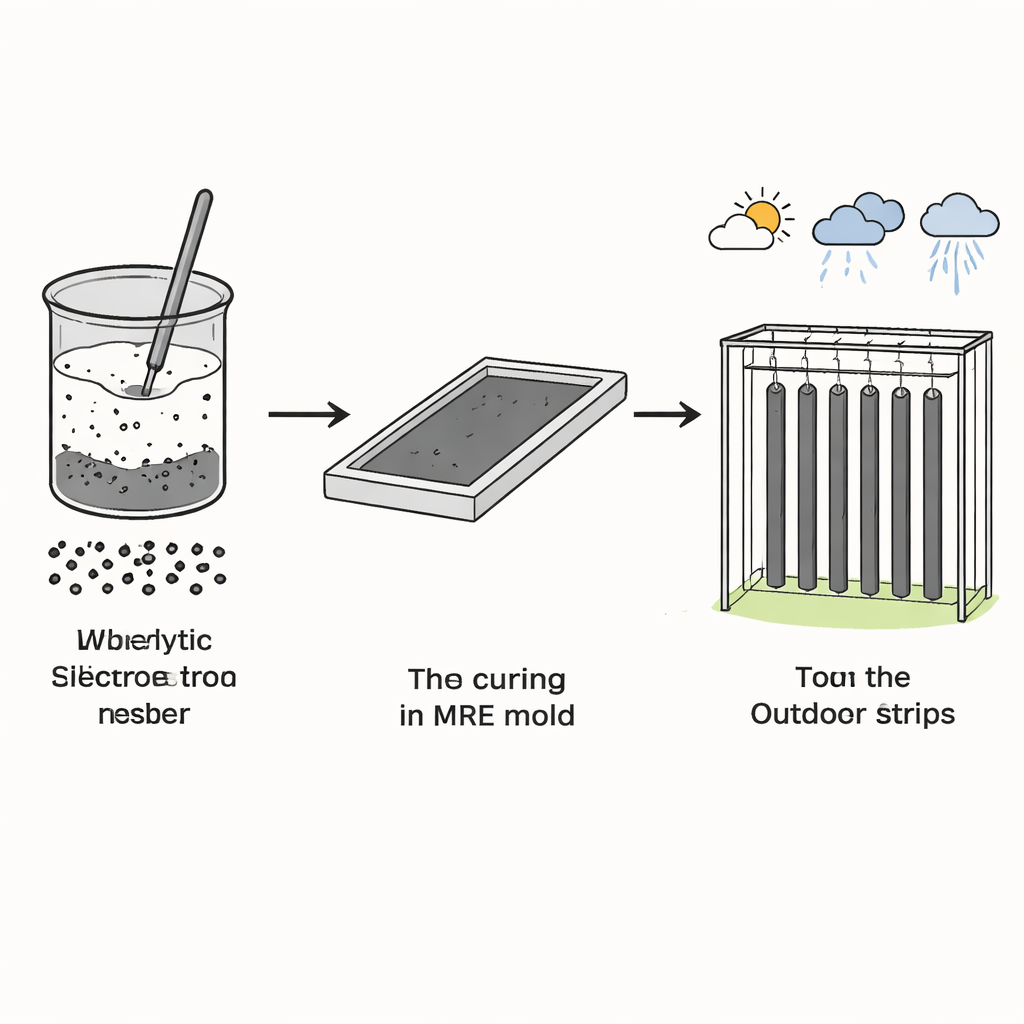
To see how early weathering plays out, the researchers made thin strips of this smart rubber and hung them outdoors in Kuala Lumpur for six weeks. The city’s tropical climate supplied intense sunlight, humidity, and frequent rain. One strip was kept as a fresh reference, while the others were collected week by week. For every stage, the team measured how magnetic the samples were, how stiff and elastic they felt under gentle twisting, and what their surfaces looked like under an electron microscope. They also matched these measurements with actual records of sunlight and rainfall from the national weather service.
Stiffer on the outside, but magnetically stable
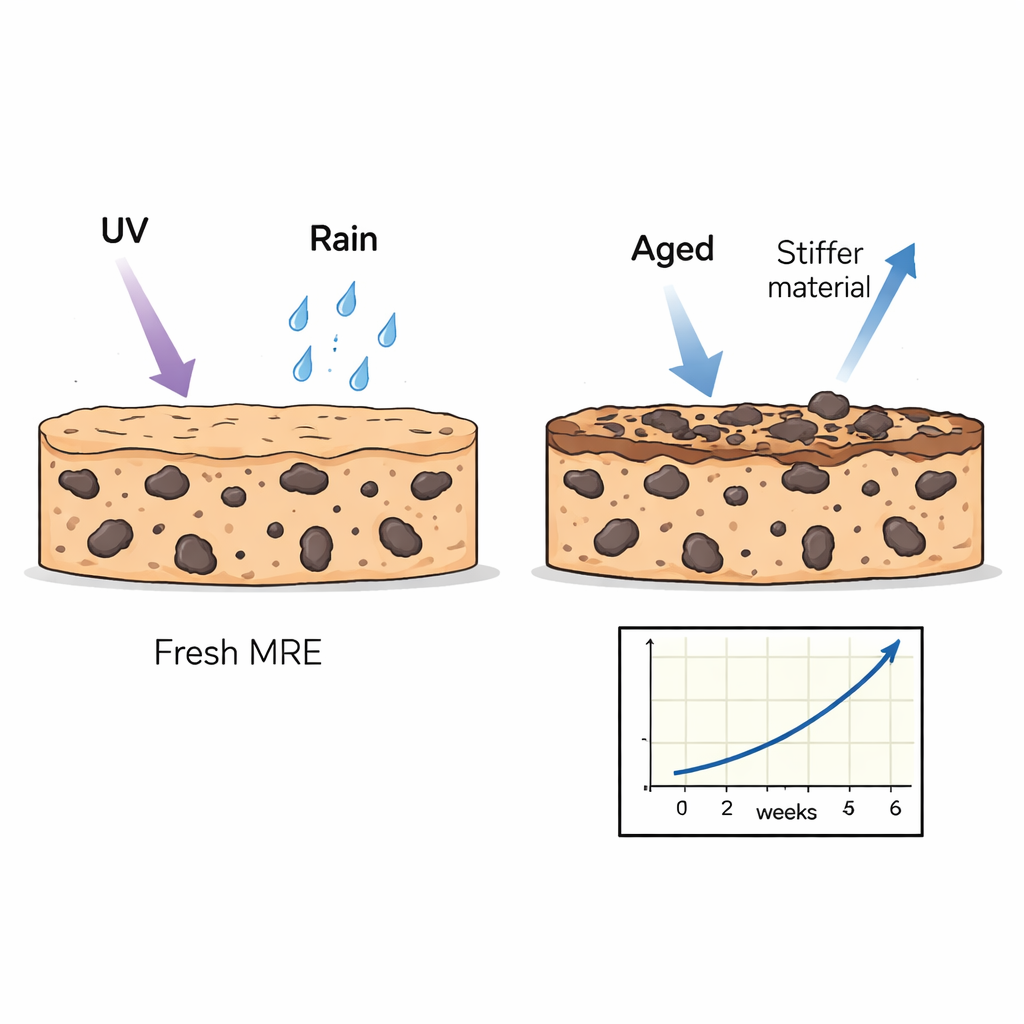
The first changes showed up not inside the material but at its surface. Over time, the top layer developed small pits, erosion lines, and scratch-like marks. These defects grew deeper and wider with continuing sun and rain, eventually exposing some of the iron particles at the surface. Yet cross-sectional images showed that the inner structure remained essentially unchanged after six weeks. Magnetic tests told a similar story: the overall magnetic strength of the samples changed only slightly, with a small increase that likely came from those newly exposed particles participating more strongly in the magnetic response.
How weather subtly reshapes mechanical behavior
Mechanical tests revealed more pronounced early changes. The material’s baseline stiffness roughly doubled over the six weeks, meaning it became noticeably harder to deform even without a magnetic field. This was linked to two competing processes. Sunlight, especially ultraviolet radiation, encourages extra crosslinks between rubber chains, which harden the network. Rain, on the other hand, can temporarily soften the surface by letting water seep in and loosen interactions between chains. The researchers saw a brief dip in stiffness in the rainiest week, followed by a steady rise as sun-driven hardening took over. Under a strong magnetic field, the material still stiffened dramatically at every stage, showing that its core “tunable” behavior survived, even as its easy, flexible range of motion shrank.
Why early changes matter for real-world devices
From a layperson’s point of view, the message is reassuring but cautionary. In their first weeks outdoors, these magnet-smart rubbers keep their essential magnetic function and internal structure. They still respond strongly when a magnetic field is applied, which is crucial for vibration control systems. However, their outer skin begins to roughen, and the material as a whole becomes stiffer and less stretchy, early signs of brittleness that could grow over longer periods. Understanding this early-stage degradation helps engineers design coatings, formulations, or maintenance schedules so that future smart bridges, trains, or buildings can rely on these materials not only on day one, but for years in challenging weather.
Citation: Viension, R.H., Nordin, N.A., Mazlan, S.A. et al. Early-Stage degradation of electrolytic iron particle-based magnetorheological elastomer under natural weathering conditions. Sci Rep 16, 6676 (2026). https://doi.org/10.1038/s41598-026-36655-3
Keywords: magnetorheological elastomer, smart materials, weathering, vibration control, polymer degradation