Clear Sky Science · en
Nicotinamide counteracts Rotenone-induced mitochondrial and neuronal dysfunction in a translational early-life model
Why tiny cell engines matter for the developing brain
During brain development, billions of young nerve cells must grow long branches and form precise connections. This study explores how the cell’s “power plants” — mitochondria — shape that process, and what happens when they are subtly poisoned by a pesticide-like compound. The researchers also test whether a common vitamin-related molecule, nicotinamide, can help protect developing brain cells from this hidden energy stress, with possible implications for conditions such as schizophrenia.
From pesticide model to brain cell experiment
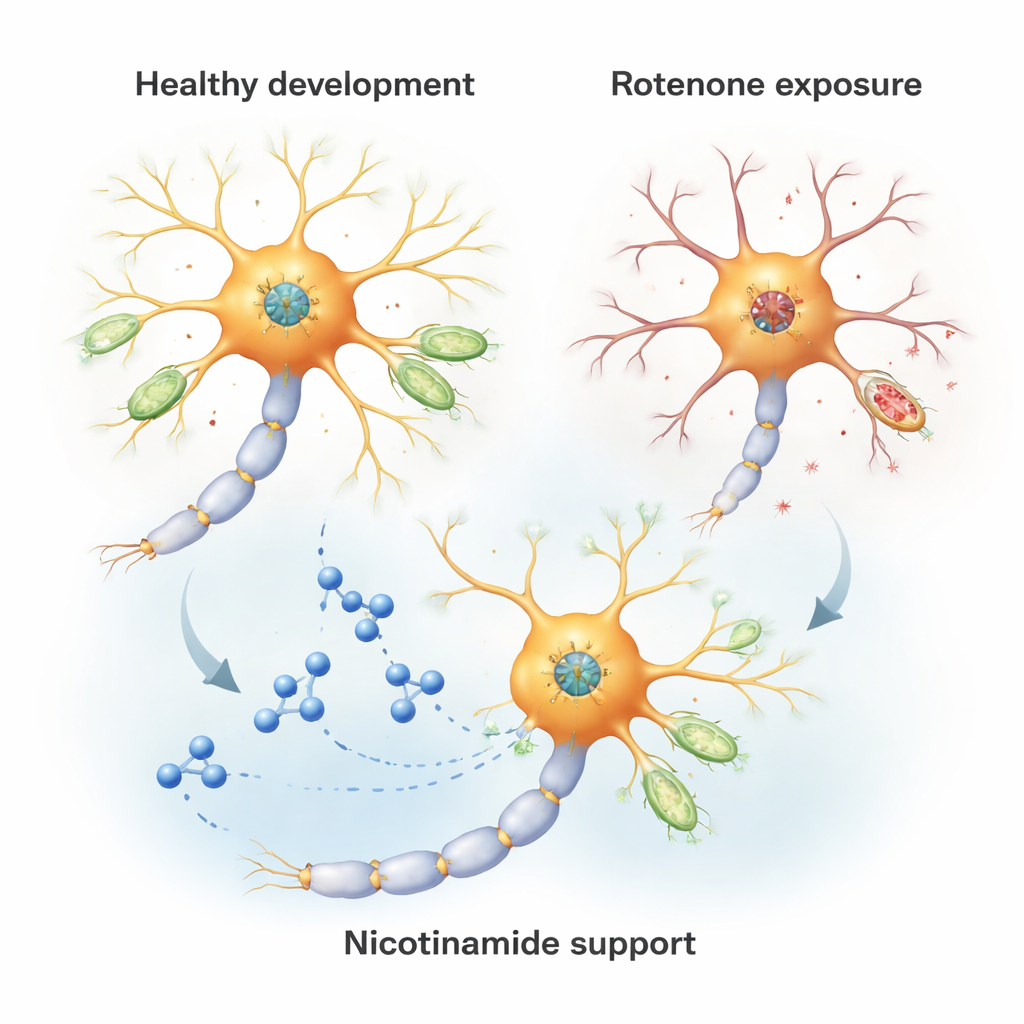
The team built on earlier work showing that baby rats briefly exposed to rotenone, a pesticide that blocks a major step of mitochondrial energy production (complex I), later show behaviors reminiscent of schizophrenia. To understand what is happening at the level of individual brain cells, they isolated immature nerve cells from rat cortex and exposed them to the exact concentration of rotenone measured in the animals’ brains. This “translational” approach allowed them to ask: at realistic low doses that do not kill cells, does rotenone still derail how neurons grow and wire up?
Energy slowdown without outright cell death
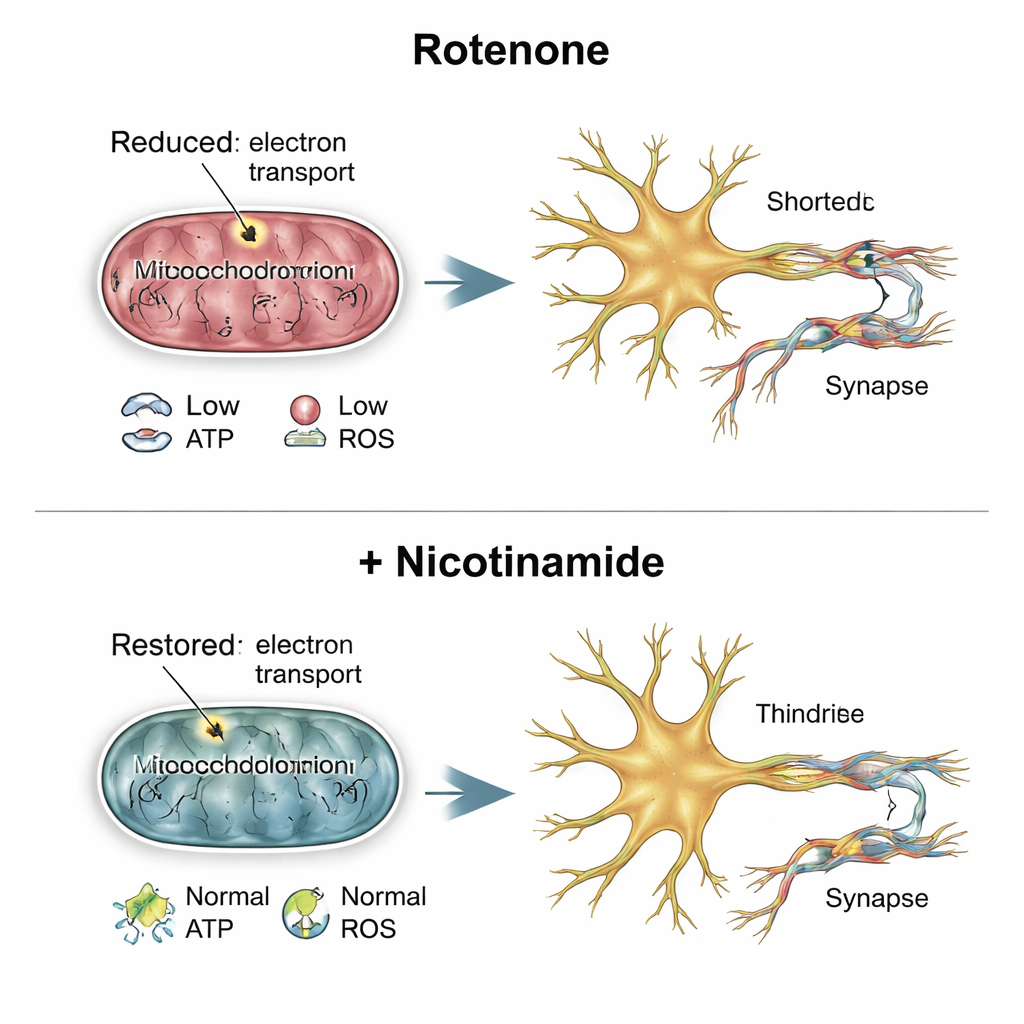
Surprisingly, the low rotenone dose did not cause neurons to die or disrupt basic calcium balance or the electrical charge across mitochondrial membranes — features often seen when cells are in acute trouble. Instead, it produced a quieter but important shift in metabolism. Mitochondria made less energy (ATP) and consumed less oxygen, and the overall activity of complex I dropped. At the same time, production of a particular reactive molecule, mitochondrial superoxide, went down rather than up. That finding contrasts with high-dose rotenone studies, which usually report a toxic spike in reactive oxygen species. Here, the picture is of a “slow engine” rather than a smoking, overheated one.
Shifts in quality control and cell shape
When mitochondrial performance falters, cells typically reshape and recycle these organelles. The researchers found signs that this quality-control system was disturbed. Proteins involved in chopping and remodeling mitochondria, as well as those marking how many mitochondria are present, were altered after rotenone exposure. Components of the cellular recycling pathway (autophagy) also accumulated in patterns suggesting that waste packages were being formed but not efficiently cleared. At the same time, the neurons themselves became structurally simpler: their tree-like dendrites were shorter and less numerous. Because dendrites are crucial for receiving signals, this pruning hints that even mild, chronic mitochondrial stress can leave lasting marks on brain circuitry.
Weakened synapses and how nicotinamide helps
The team then asked whether the points of communication between neurons — synapses — were affected. Using fluorescent markers for pre- and postsynaptic proteins, they saw that rotenone-treated neurons had more synaptic components but poorer alignment between them, implying that the machinery was piling up without forming fully functional connections. Introducing nicotinamide before rotenone exposure changed this story. Nicotinamide, a building block for the energy-carrying molecule NAD, restored mitochondrial respiration, ATP levels, and superoxide output toward normal values. It also normalized recycling markers, reduced the abnormal buildup of synaptic proteins, improved their alignment, and brought dendrite number and length back in line with untreated cells.
What this could mean for brain disorders
Taken together, the results suggest that even modest, non-lethal hits to mitochondrial function during early life can ripple outward to impair neuron shape and synapse formation — processes thought to be altered in disorders like schizophrenia. Nicotinamide did not magically reset every molecular change, but it was enough to rescue energy balance, clean-up systems, dendritic architecture, and synaptic organization in this dish model. For a layperson, the key message is that keeping the cell’s power plants healthy during development may be central to building robust brain circuits, and that supporting mitochondrial fuel pathways with molecules related to vitamin B3 could be one way to counteract subtle early-life insults. While much work remains before any treatment can be considered for people, this study offers a mechanistic bridge between environmental exposures, mitochondrial stress, and long-term brain health.
Citation: Siena, A., Souza e Silva, L.F., Araujo, V.C. et al. Nicotinamide counteracts Rotenone-induced mitochondrial and neuronal dysfunction in a translational early-life model. Sci Rep 16, 7159 (2026). https://doi.org/10.1038/s41598-026-36651-7
Keywords: mitochondria, brain development, schizophrenia, nicotinamide, rotenone