Clear Sky Science · en
Characterization, in-vitro biological and antimicrobial testing of replacing Sr/Ca in wollastonite (Ca1 − x Srx SiO3) glass-ceramics
Why stronger, cleaner bone implants matter
Broken bones and worn-out joints are often repaired with metal screws, plates or bone cement. These implants must do more than simply fill a gap: they should encourage new bone to grow, stay strong while healing takes place, and avoid infections. This study explores a new ceramic material based on a mineral called wollastonite, tweaked by adding the element strontium, to see whether it can better support bone repair and fend off certain harmful microbes in the lab. 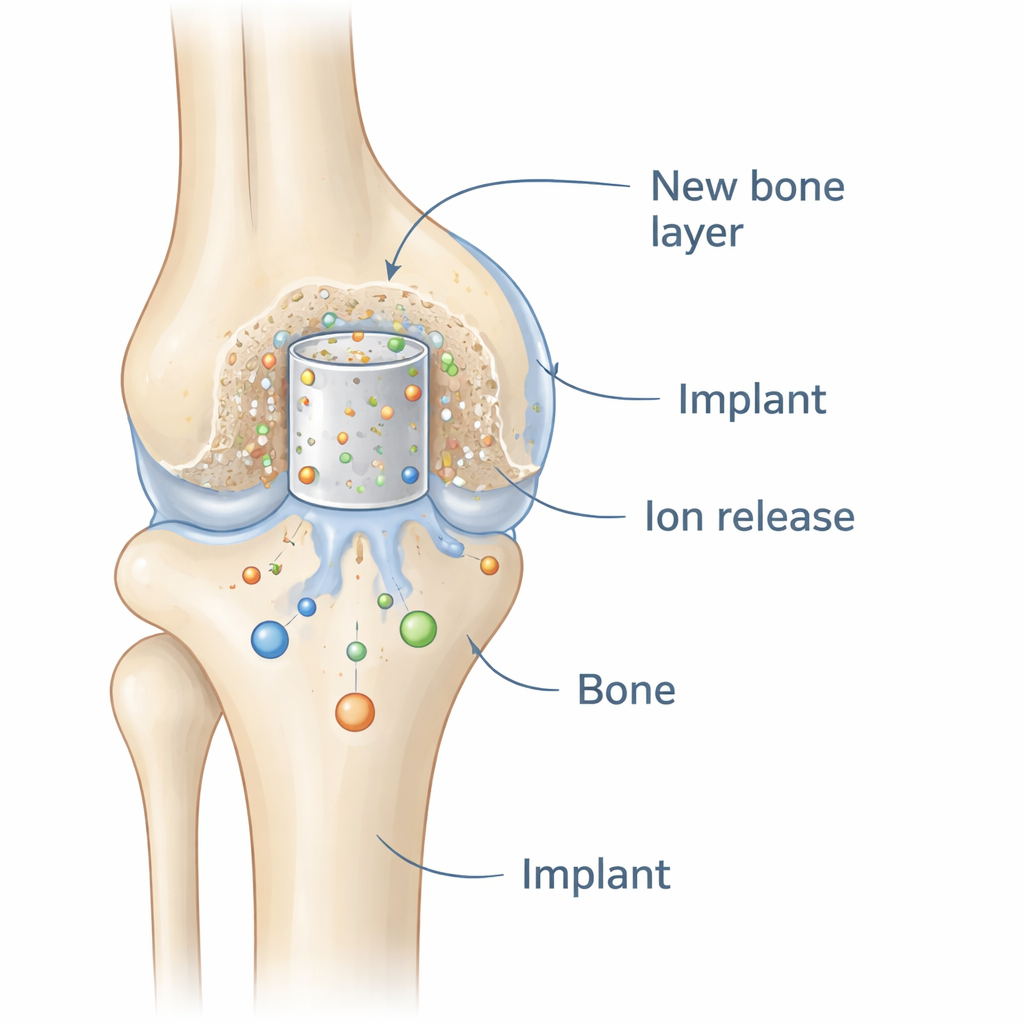
Building a bone-friendly glass-ceramic
The researchers started with wollastonite, a calcium–silicate material already known to bond well with bone, but limited by modest strength. They melted and cooled mixtures that partly replaced calcium with three different levels of strontium, then heat-treated the resulting glasses to form glass-ceramics. By carefully analyzing how the internal structure changed with each strontium level, they aimed to design a material that dissolves at a controlled rate, releases helpful ions and develops a bone-like surface. Techniques such as X-ray diffraction, infrared spectroscopy and electron microscopy revealed how the crystal phases, particle size and surface texture evolved as more strontium was added.
How the material behaves in a body-like fluid
To mimic what happens after an implant is placed in the body, samples were soaked for up to 28 days in a liquid with the same salt content and pH as human blood plasma. Over time, all compositions developed a coating of hydroxyapatite, the main mineral in bone. Strontium-rich samples formed this layer more quickly and more completely than pure wollastonite. Chemical fingerprints and element measurements showed not just any mineral, but a carbonated, bone-like version whose calcium-to-phosphorus ratio closely matched that of natural bone. The highest-strontium sample, called W3Sr, produced a dense, needle-like coating that covered the surface evenly and most closely resembled real bone mineral. 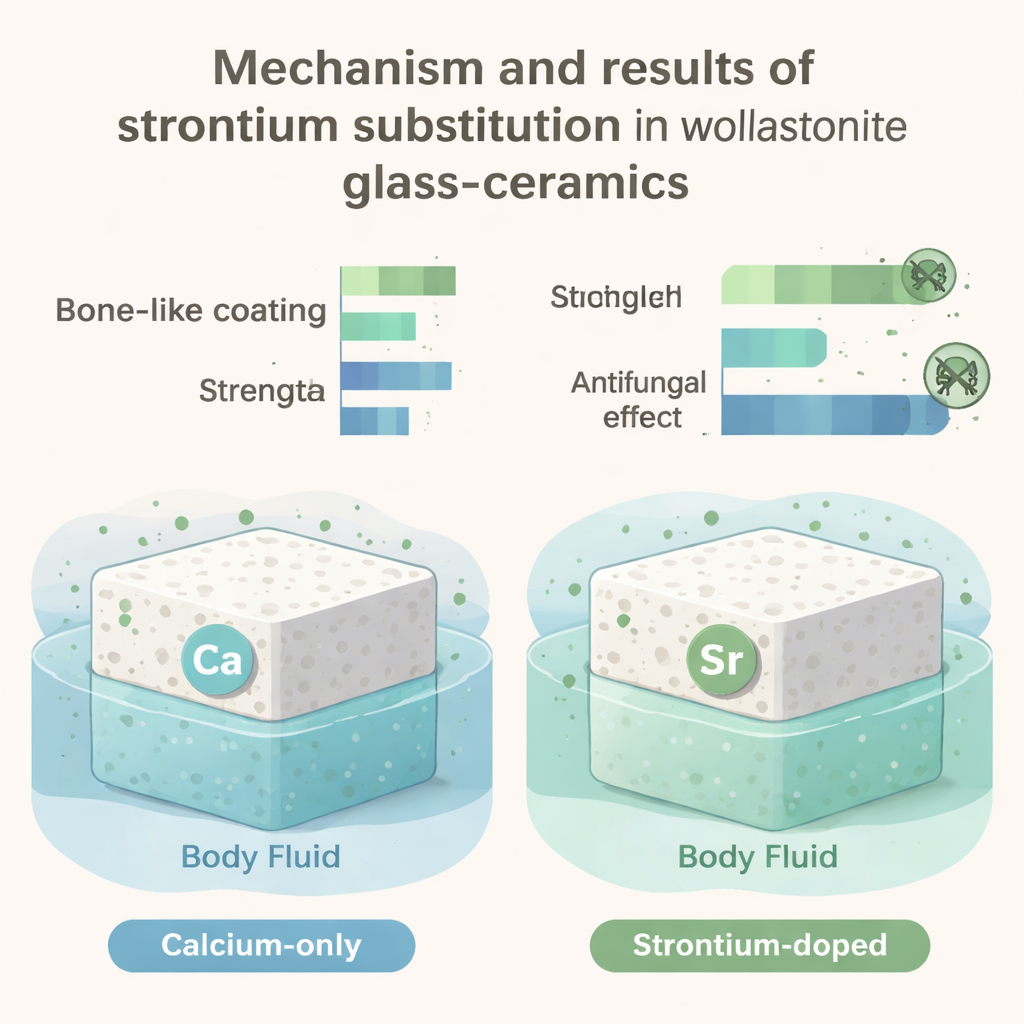
Strength, slow wear and friendly to human cells
Implants must be strong enough to support everyday loads yet slowly give way as new bone takes over. After immersion in the body-like fluid, the strontium-doped materials became denser and less porous, which translated into higher compressive and bending strength. W3Sr reached compressive strength values approaching those of natural bone, while still degrading gradually rather than crumbling away. Tests of weight loss and changes in solution chemistry showed that more strontium led to slightly slower, more controlled dissolution. Crucially, when pieces of the material were ground and exposed to human skin-like fibroblast cells in culture, cell survival remained high across all tested doses. Strontium-rich samples were actually less irritating than pure wollastonite, supporting the idea that the material is gentle on human tissue.
Targeting troublesome fungi, not bacteria
Infections can derail bone healing, and fungi are an underappreciated threat around implants. The team challenged their materials with common bacteria and two filamentous fungi. None of the formulations harmed the bacteria, but the strontium-containing versions clearly slowed fungal growth in a dose-dependent way. At the highest strontium level, clear “no-growth” zones formed around the samples for both tested fungi, and this effect persisted for several days. The results suggest that strontium release and surface chemistry combine to stress fungal cells, while leaving bacteria and human cells largely unaffected. This selective antifungal action is rare among bone repair materials and could be valuable in preventing difficult-to-treat implant-related fungal infections.
What this means for future bone repairs
Put simply, adding strontium to wollastonite turns a promising bone-bonding ceramic into a more capable all-rounder. The best version in this study forms a bone-like coating more readily, becomes stronger after contact with body-like fluid, dissolves at a controlled pace, shows no meaningful toxicity to human cells and selectively inhibits certain problem fungi. While these findings are from laboratory tests and will need confirmation in animals and, eventually, patients, they point toward new glass-ceramic implants and coatings that could help bones heal more reliably while quietly lowering the risk of stubborn fungal infections.
Citation: El-Hamid, H.K.A., El-Bassyouni, G.T., Amin, A.M.M. et al. Characterization, in-vitro biological and antimicrobial testing of replacing Sr/Ca in wollastonite (Ca1 − x Srx SiO3) glass-ceramics. Sci Rep 16, 6347 (2026). https://doi.org/10.1038/s41598-026-36649-1
Keywords: bone implants, bioactive glass-ceramics, strontium-doped wollastonite, antifungal biomaterials, bone regeneration