Clear Sky Science · en
Evolution of jets generated by noncircular nozzles with varying aspect ratios
Why the Shape of a Water Jet Matters
Modern agriculture depends on sprinklers to deliver water efficiently to crops, but not all sprinklers are created equal. This study explores how changing the shape of the tiny openings—called nozzles—that water passes through can dramatically alter how a jet of water breaks up into droplets and how evenly those droplets fall on the ground. Understanding this hidden behavior inside every sprinkler can help farmers save water, improve crop yields, and design smarter irrigation systems.
Different Openings, Different Water Fans
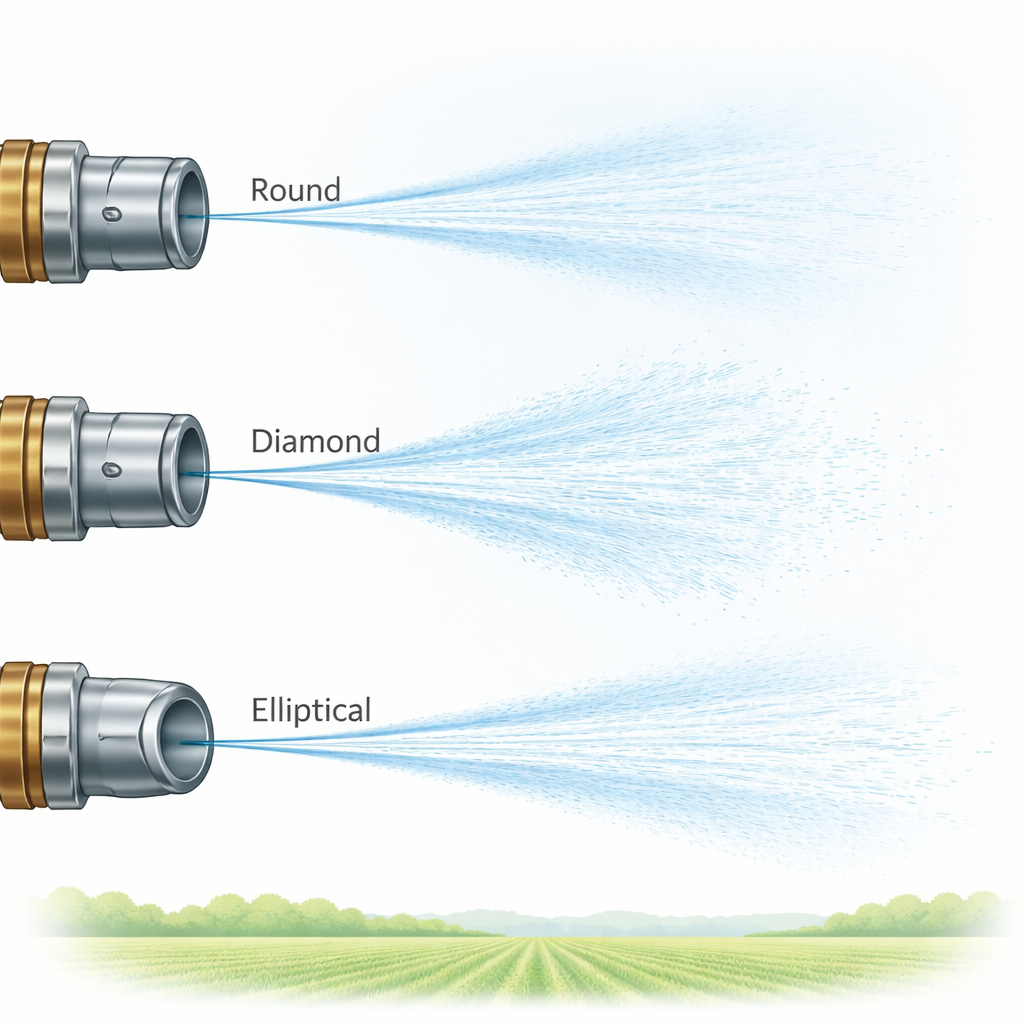
The researchers started with a common farm sprinkler and redesigned its nozzles in three ways: round, diamond-shaped, and elliptical (oval). Although all versions were built to deliver the same flow rate, their internal shapes and the ratio between their long and short dimensions (the aspect ratio) were carefully varied. Using high-speed cameras that capture 10,000 frames per second, the team filmed how water jets left each nozzle and spread into the air. They also created detailed computer simulations to track how the jet changed shape as it moved away from the nozzle.
Hidden Sheets and Films of Water
When water leaves a noncircular nozzle, it does not form a smooth, round stream. Instead, the flow tends to gather at parts of the opening where the curve is sharpest—such as the corners of a diamond or the “tips” of an ellipse. In these regions, the jet can thin out into delicate liquid films. The study found that these films appear most readily along the short axis of the jet, where its thickness is smallest. Elliptical jets with a higher aspect ratio (very long and narrow openings) produced more visible liquid films, especially at lower jet speeds. Diamond-shaped nozzles, with their sharp corners, formed the most pronounced films and the widest spray angles, while circular nozzles produced the narrowest, most compact jets.
When a Jet Twists and Swaps Its Axes
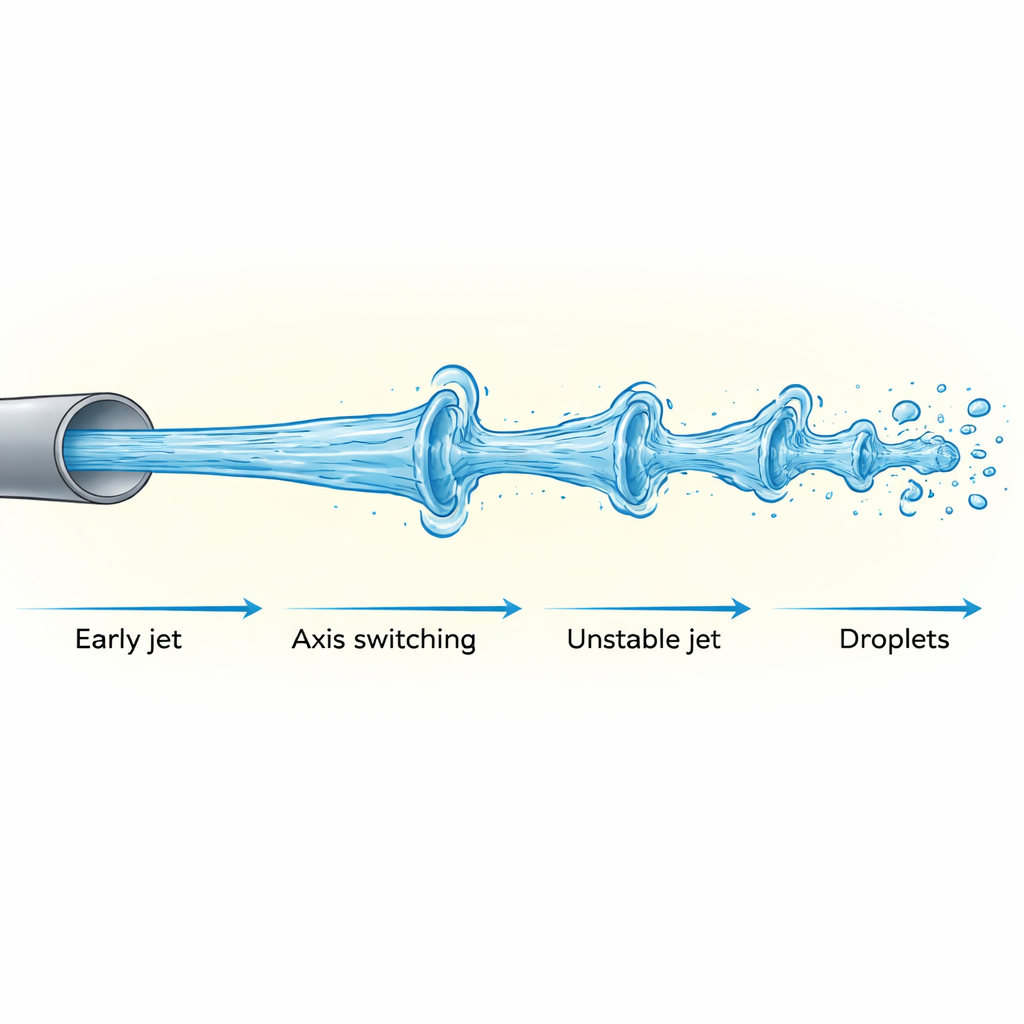
One of the most intriguing behaviors observed is called axis switching. As a noncircular jet travels, its cross‑section can periodically stretch and compress so that its long side and short side swap places. The authors divided this evolution into four stages: incomplete axis switching, complete axis switching, an unstable stage, and final breakup into droplets. Early on, surface tension and sideways motion within the jet compete but only partly reshape the jet. Farther out, this motion becomes strong enough to fully flip the jet’s long and short directions, sometimes multiple times. Diamond jets and elliptical jets with different aspect ratios showed distinct patterns of where this first full flip occurred and how often it repeated, controlled by swirling structures in the flow called paired vortices.
From Smooth Streams to Spray and Droplets
Eventually, all jets reach a point where they become unstable and break up into droplets—the stage that really matters for irrigation. The distance from the nozzle to the first breakup point, known as the breakup length, turned out to be very sensitive to nozzle shape and aspect ratio. In the experiments, diamond nozzles produced longer coherent jets than elliptical ones, while among the elliptical nozzles, smaller aspect ratios (less elongated shapes) led to longer, calmer jets with fewer surface disturbances. Higher aspect ratios caused stronger disturbances, more pronounced axis switching, and earlier fragmentation. The simulations matched the measured breakup lengths closely, supporting the use of advanced fluid models (VOF–LES) to design better nozzles without exhaustive field tests.
What This Means for Smarter Sprinklers
For a layperson, the key message is that the outline of a nozzle hole—whether round, diamond, or oval, and how stretched that oval is—has a major impact on how water jets behave in the air. These subtle differences control how far the jet stays together, where it falls apart into droplets, how evenly water is spread, and how efficiently energy is used. By tuning nozzle shape and aspect ratio to encourage helpful axis switching and controlled breakup, engineers can design sprinklers that deliver water more uniformly at lower pressures. This translates into better crop coverage, less wasted water, and more sustainable irrigation systems.
Citation: Haiyan, Z., Wen, W., Yukun, Z. et al. Evolution of jets generated by noncircular nozzles with varying aspect ratios. Sci Rep 16, 5776 (2026). https://doi.org/10.1038/s41598-026-36648-2
Keywords: sprinkler irrigation, water jets, nozzle shape, jet breakup, axis switching