Clear Sky Science · en
Epigenetic suppression of synovial inflammation and osteoclast differentiation in rheumatoid arthritis by I-BET762
New Hope for Protecting Arthritic Joints
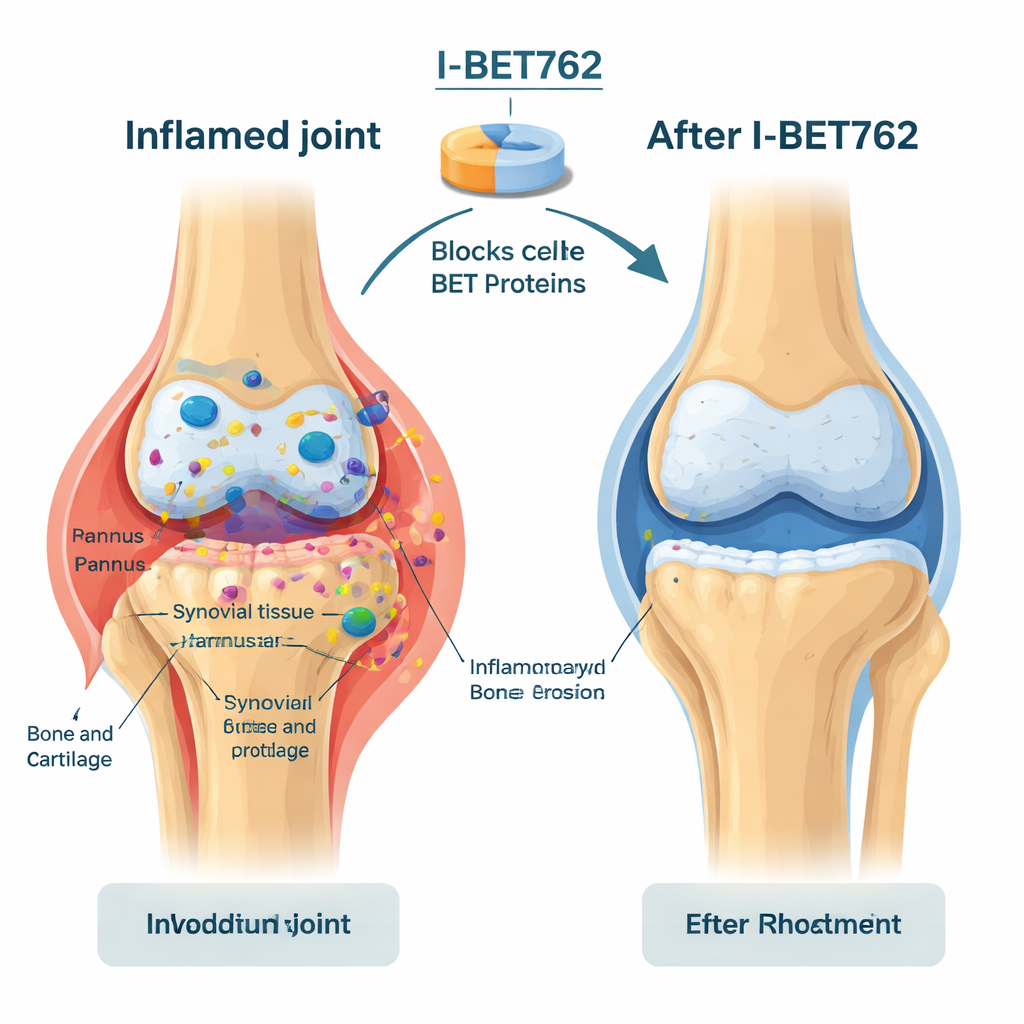
Rheumatoid arthritis does not just cause pain and swelling; over time it can permanently damage joints and bones. Many current drugs try to quiet the immune system, but they do not directly reverse the aggressive behavior of the joint-lining cells that eat away cartilage and bone. This study explores a pill-like compound called I-BET762 that works at the level of gene switches, asking whether it can calm both joint inflammation and bone loss in rheumatoid arthritis.
When Joint Lining Cells Turn Rogue
In rheumatoid arthritis, the smooth inner lining of the joint, called the synovium, transforms into a thick, invading tissue known as pannus. Key cells in this tissue, fibroblast-like synoviocytes, begin to behave almost like cancer cells: they multiply, migrate, and invade nearby cartilage and bone while pumping out inflammatory molecules and tissue-destroying enzymes. At the same time, specialized bone-eating cells called osteoclasts are overactivated, eroding the bone right next to the inflamed tissue. Together, these changes drive the gradual loss of joint structure, even when inflammation at the surface seems under control.
Flipping Epigenetic Switches with a Small Molecule
The researchers focused on a family of proteins called BET bromodomain proteins, which act as “readers” of chemical tags on DNA-packaging proteins and help turn genes on. I-BET762 is a laboratory-designed molecule that blocks several BET proteins at once, preventing them from boosting the activity of many inflammation-related genes. Using joint tissue from people with rheumatoid arthritis, the team grew synovial fibroblasts in the lab and exposed them to tumor necrosis factor (TNF), a powerful inflammatory signal found in diseased joints. They then added I-BET762 to see whether this could reset the cells’ overactive behavior without killing them.
Dialing Down Inflammation and Tissue Damage
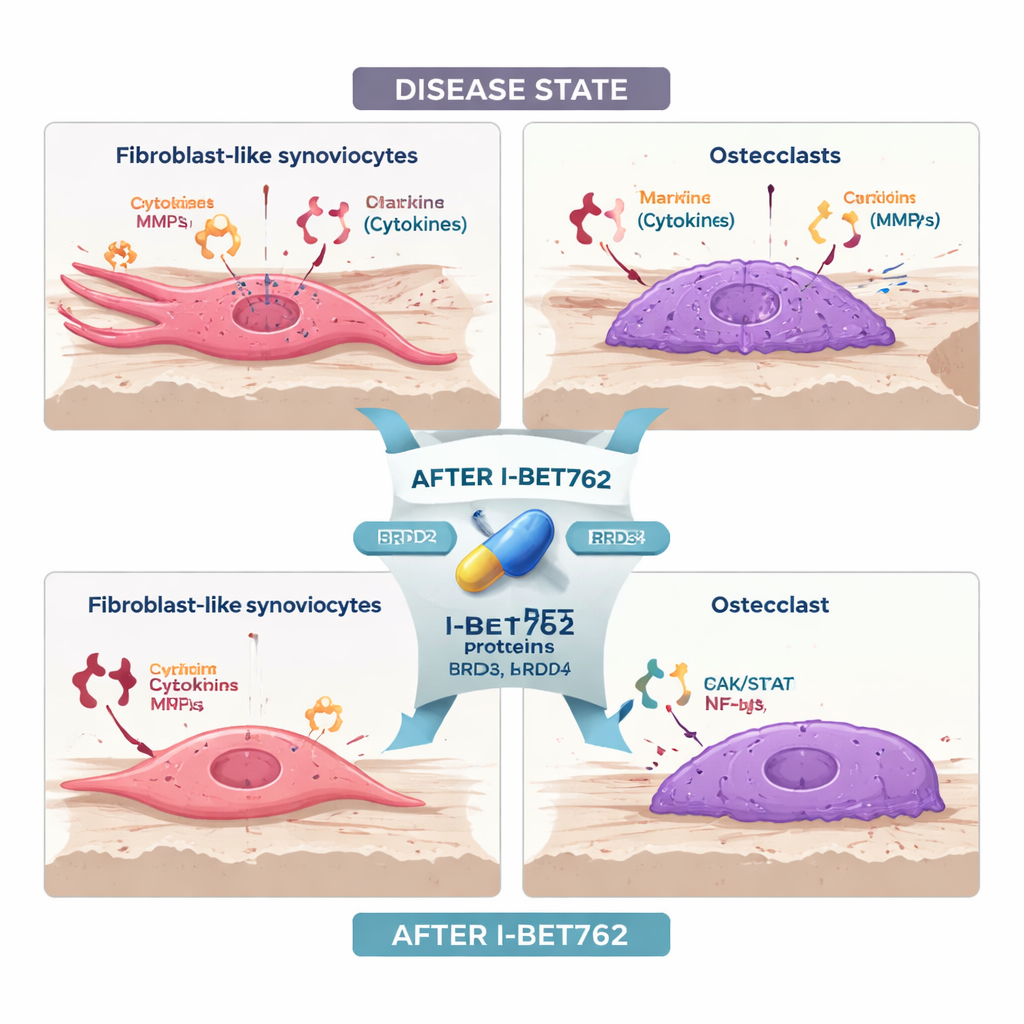
I-BET762 did not harm the joint-lining cells, but it sharply lowered the levels of two BET proteins (BRD3 and BRD4) and c-Myc, a master switch that drives cell growth and survival. As a result, cells produced far less of the inflammatory messengers IL-6, IL-8, and CXCL-10, which are known to attract and activate more immune cells. The drug also reduced key tissue-degrading enzymes, MMP-1 and MMP-3, and decreased a surface molecule (VCAM-1) that helps these cells stick and migrate. In lab tests that mimic wound closure and invasion through a gel-like barrier, treated cells moved and invaded much less, suggesting that I-BET762 makes the synovial fibroblasts less aggressive and less able to chew through cartilage.
Protecting Bone by Taming Bone-Eating Cells
The team then turned to osteoclasts, the cells that normally reshape bone but become overactive in rheumatoid arthritis. When they grew human blood cells under conditions that normally turn them into mature, bone-resorbing osteoclasts, adding I-BET762 prevented full maturation in a dose-dependent way. Treated cells were smaller, with fewer nuclei and weaker “actin rings,” the specialized structures osteoclasts use to grip and dissolve bone. The activity of MMP-9, an enzyme that helps break down the bone matrix, also dropped. Together, these findings show that I-BET762 not only calms inflammation but also directly weakens the machinery used to erode bone.
How This Could Change Rheumatoid Arthritis Treatment
By blocking BET proteins, I-BET762 appears to interrupt two major signaling routes inside cells—p38 MAP kinase and NF-κB—that keep inflammatory and bone-destroying genes switched on. This dual action on joint-lining cells and bone-eating cells suggests a single epigenetic drug might both reduce inflammation and slow structural damage. The work was done in cells in the lab, not yet in animals or patients, so safety and long-term effects remain unknown. Still, the study points to epigenetic drugs like I-BET762 as promising candidates for future treatments that address not only pain and swelling, but also the underlying processes that silently wear away joints in rheumatoid arthritis.
Citation: Kim, R.H., Choi, S.U. & Song, Y.W. Epigenetic suppression of synovial inflammation and osteoclast differentiation in rheumatoid arthritis by I-BET762. Sci Rep 16, 6042 (2026). https://doi.org/10.1038/s41598-026-36645-5
Keywords: rheumatoid arthritis, epigenetics, BET inhibitor, joint inflammation, bone erosion