Clear Sky Science · en
Intelligent RBF neural network-based control for dynamic stability and power control in renewable-integrated microgrids
Why Smarter Local Power Matters
As homes, campuses and small communities add more rooftop solar panels and wind turbines, keeping the lights on becomes surprisingly tricky. Sunshine and wind rise and fall from minute to minute, making local power systems, or microgrids, vulnerable to flickers, voltage dips and wasted clean energy. This paper explores an intelligent control approach that uses a blend of advanced electronics and a fast-learning neural network to keep a renewable-heavy microgrid stable, efficient and ready for real-world operation.
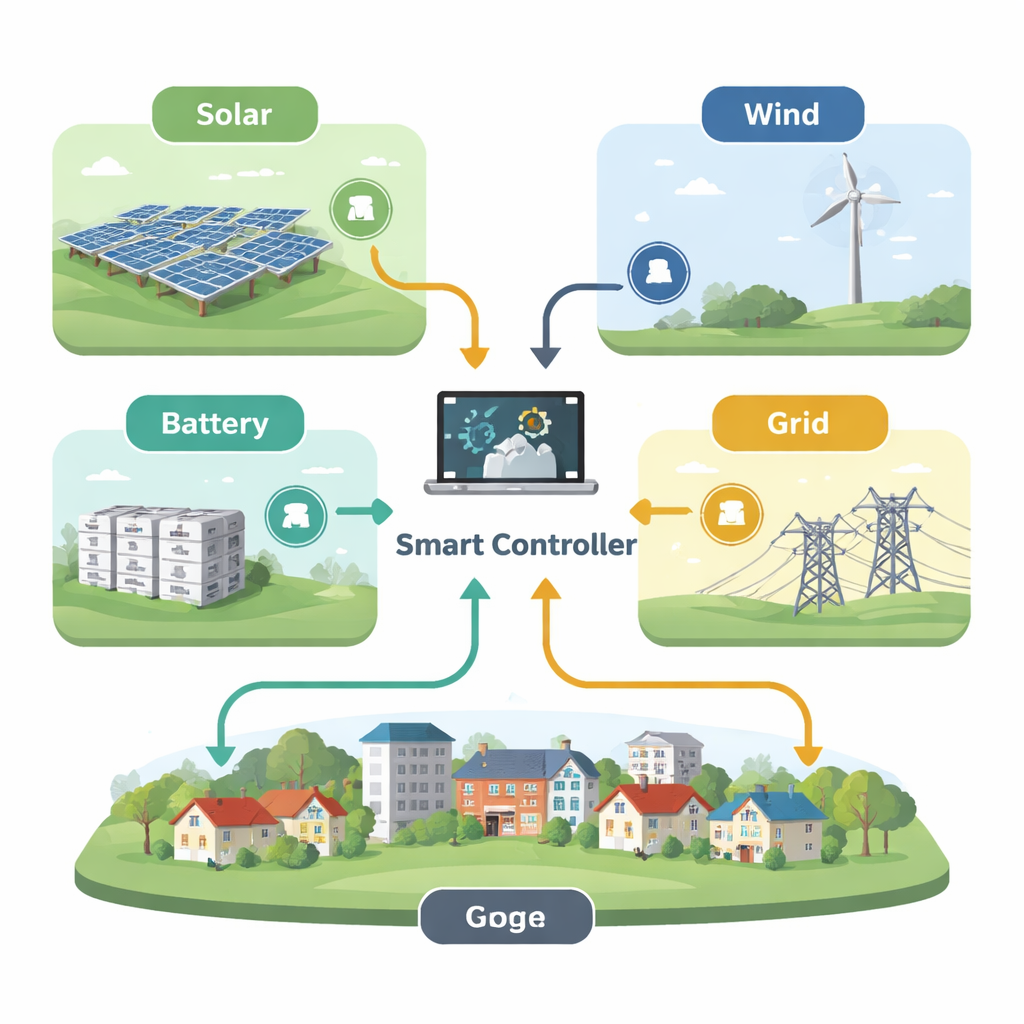
Keeping a Small Grid in Balance
A microgrid is like a neighborhood-sized power system that can combine solar panels, wind turbines, batteries and a connection to the larger utility grid. The challenge is that each piece behaves differently: solar panels produce direct current (DC), the grid uses alternating current (AC), and wind turbines change their output as the breeze shifts. The authors design a microgrid where solar power, wind power and a battery all feed into a common DC “bus” that then supplies the local grid. To keep this miniature power system in balance, they focus on two goals that everyday users care about: stable voltage and frequency (so appliances work correctly) and high efficiency (so little of the precious renewable energy is lost as heat in the electronics).
Smarter Brains for Renewable Power
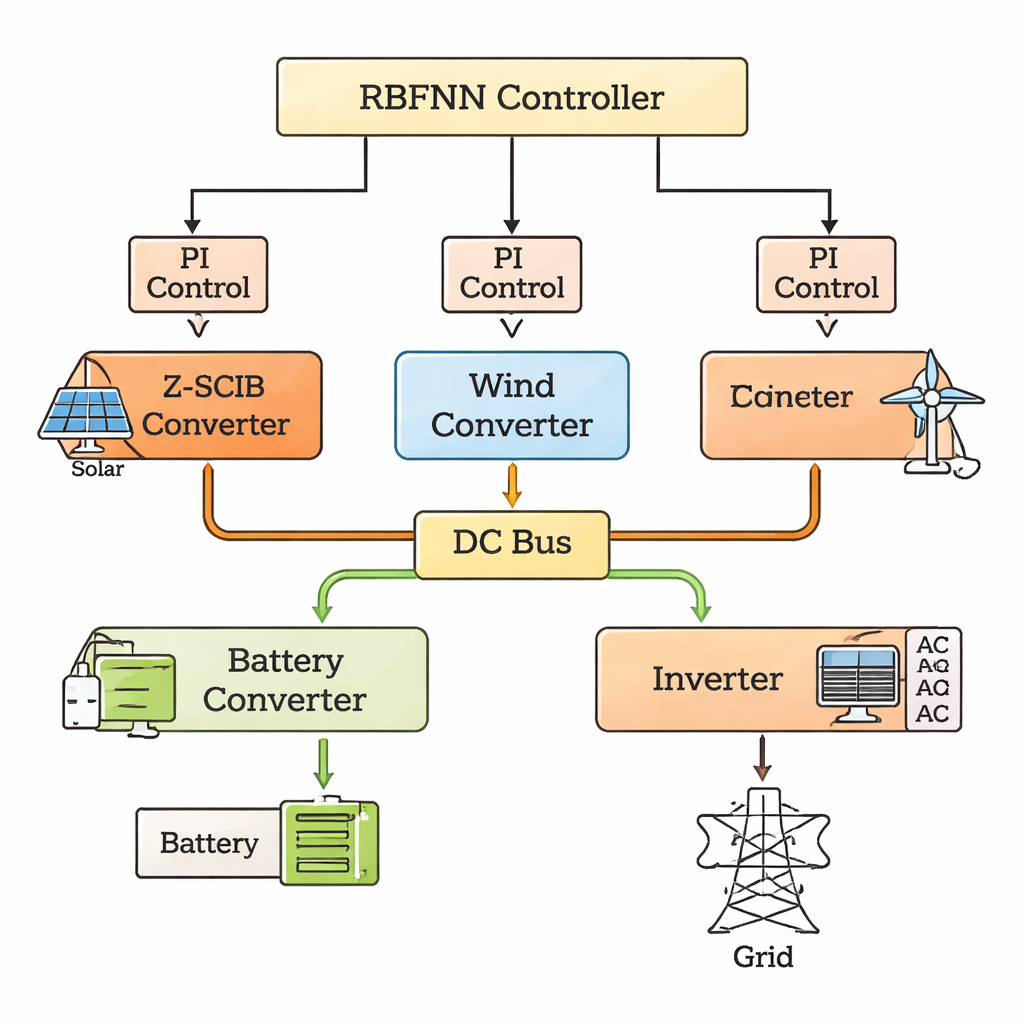
At the heart of the system is an intelligent controller built from a Radial Basis Function Neural Network (RBFNN). In simple terms, this is a machine-learning “brain” that can quickly learn how the microgrid behaves under many different conditions and then adjust control settings in real time. It collects measurements such as voltage, current and power from across the microgrid, analyzes them and sends optimized commands to local controllers that drive the electronics connected to the solar panels, wind turbine, battery and grid interface. Because the RBFNN learns quickly and can adapt on the fly, it handles sudden changes in sunlight, wind or electricity demand better than traditional controllers, which often need time-consuming manual retuning.
Boosting Solar Power and Taming Fluctuations
Solar panels naturally produce relatively low voltages that must be increased before they can feed the microgrid. The authors introduce a specialized power electronic device, called a Z-source integrated coupled inductor boost (Z-SCIB) converter, that can step up the solar output to a much higher, more useful level while keeping stress on its internal components low. This converter is steered by a classic proportional–integral (PI) controller whose tuning is automatically optimized by a bio-inspired search method modeled on the migration of geese, called Grey Lag Goose Optimization (GGO). Together, the Z-SCIB converter and GGO-tuned PI controller quickly settle the solar voltage at its target level, achieving an efficiency of about 97%, which means very little solar energy is wasted in the conversion process.
Wind, Batteries and Clean Power Quality
Wind energy enters the microgrid through a doubly fed induction generator, a type of wind turbine generator that can adjust both the amount of real power delivered and the reactive power that helps support grid voltage. Its output is converted to DC and tightly regulated before joining the common bus. A bidirectional converter links a battery to the same bus, allowing the battery to soak up excess power when sun and wind are plentiful and release it when demand rises or renewable output drops. Additional PI controllers keep the battery’s charging current safe and the grid-facing inverter synchronized with the main grid. Simulations show that even when temperature, sunlight, wind speed and load all fluctuate, the system holds the grid voltage and current steady and keeps electrical distortion (harmful harmonics) very low.
What It Means for Everyday Energy Use
The study concludes that combining an efficient solar boost converter, a flexible wind generator, smart battery management and an RBFNN-based supervisory controller can make renewable-heavy microgrids both stable and highly efficient. In practice, this means fewer flickers, better use of clean energy and improved reliability for places that depend on local generation, from remote villages to urban campuses. While the approach still depends on good training data for the neural network and adds some computational complexity, it shows a clear path toward microgrids that can automatically adapt to the chaotic behavior of real-world weather and power demand, bringing dependable clean energy closer to everyday life.
Citation: Chiluka, V., Sekhar, G.G.R., Reddy, C.R. et al. Intelligent RBF neural network-based control for dynamic stability and power control in renewable-integrated microgrids. Sci Rep 16, 6250 (2026). https://doi.org/10.1038/s41598-026-36641-9
Keywords: microgrid control, renewable energy, solar and wind power, battery storage, neural network controller