Clear Sky Science · en
AI based sagittal spinal posture assessment for adolescent screening in low resource school settings
Why your child’s posture now matters more than ever
Across Southeast Asia, teenagers are spending longer hours hunched over phones, tablets, and laptops. Doctors are warning that this everyday slouching can quietly strain growing spines, potentially leading to pain and deformity later in life. Yet many public schools and clinics cannot afford expensive motion-capture labs or routine X‑rays. This study introduces PostureGuard, a low‑cost, smartphone‑based “early warning system” that uses artificial intelligence (AI) to spot worrying spinal posture in schoolchildren before it becomes a serious problem.
A new way to spot slouching in schools
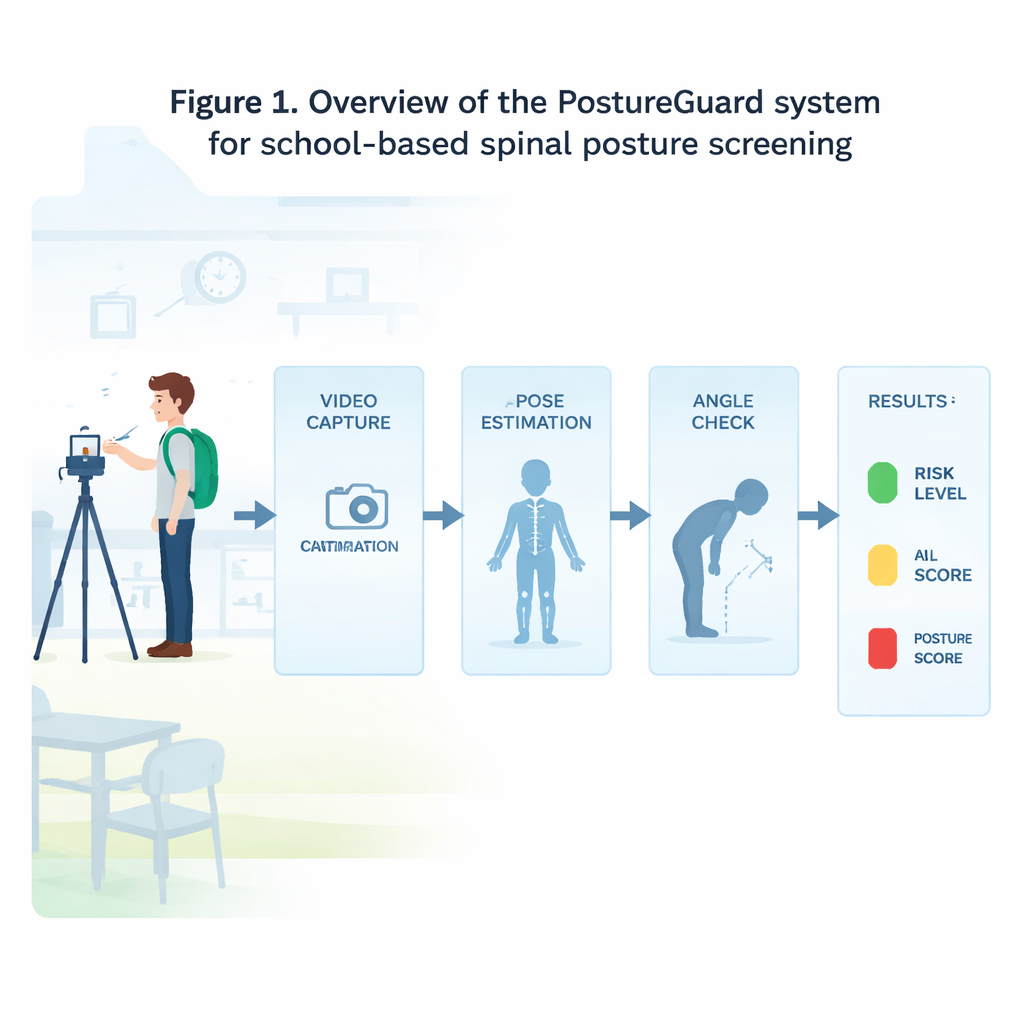
PostureGuard was designed specifically for crowded, low‑resource classrooms in Indonesia and neighboring countries. Instead of relying on hospital‑grade scanners, it uses an ordinary Android phone camera to film a student standing or using a device. AI software then draws a simple digital skeleton over the child’s body and calculates key posture angles, such as how far the head is drifting forward or how rounded the upper back has become. Because most posture apps were originally trained on Western body shapes, the researchers built in adjustments tailored to Southeast Asian teens, whose proportions—such as torso length and shoulder width—differ in important ways.
Teaching AI to understand local body shapes
To correct this “one‑size‑fits‑all” problem, the team created a special calibration process using 3D body measurements from more than 400 adolescents in Indonesia, Malaysia, and Thailand. They compared these local body ratios to those in global research datasets and then rescaled the AI’s internal skeleton so that the digital shoulders, hips, and neck better matched Southeast Asian physiques. This step sharply reduced positioning errors of key joints, cutting average shoulder misplacement from nearly five centimeters to about one centimeter. In simple terms, the system learned to see local students as they actually are, not as the average Western body in its training data.
Checking AI against X‑rays and wearable sensors
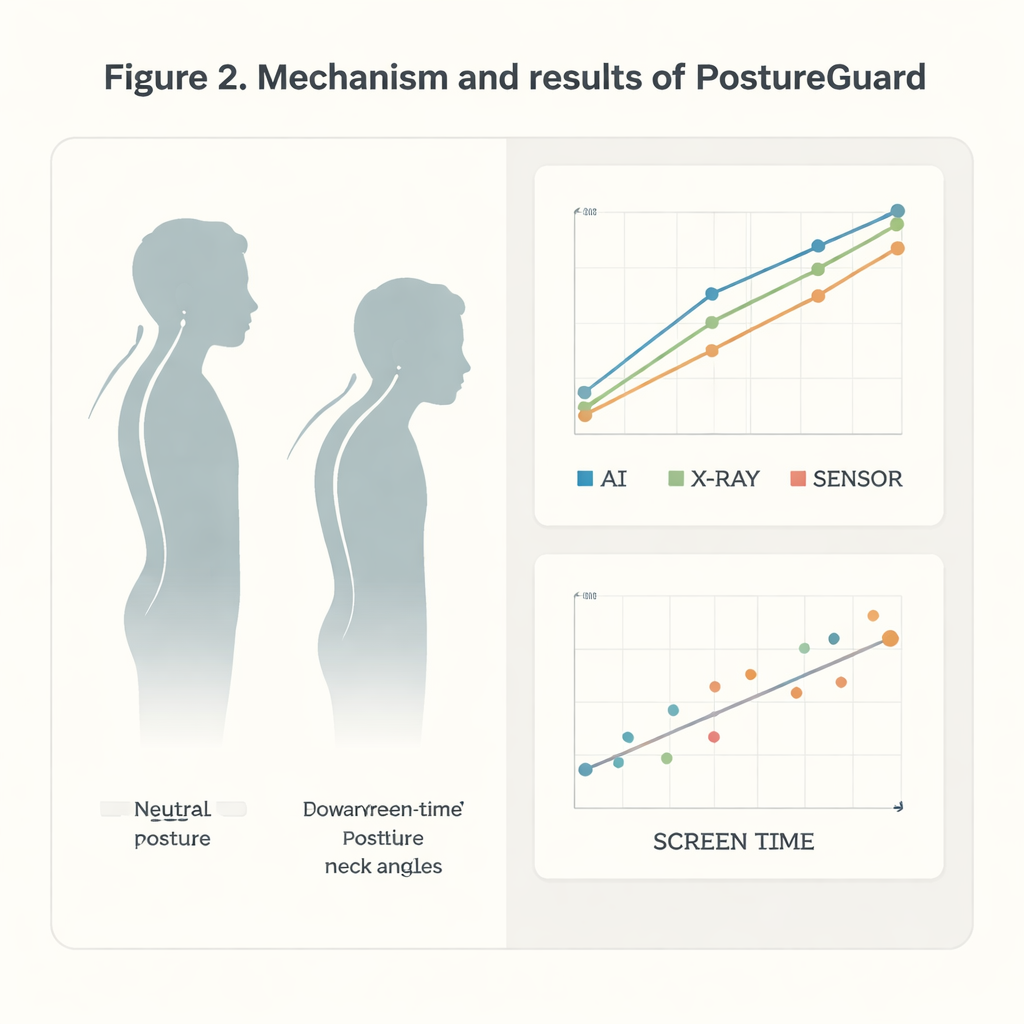
Because health decisions cannot rest on untested software, the researchers benchmarked PostureGuard against the medical gold standard: spinal X‑rays carefully measured by radiologists. They also strapped small motion sensors to students’ upper backs and necks to track how those segments tilted in real time. In a field study of 200 students across 15 public schools, the AI’s estimates of neck, upper‑back, and pelvic angles stayed within just a few degrees of both X‑ray and sensor readings—accurate enough, doctors said, for screening. The system correctly flagged more than 90% of students who exceeded agreed‑upon “at‑risk” thresholds, all while running on phones that cost less than many textbooks.
How screen time and posture move together
With this validated tool in hand, the team examined how daily device use relates to posture. Instead of relying on memory, they pulled actual usage logs from students’ phones and matched them to their posture measurements. A clear pattern emerged: the more hours of screen time per day, the greater the forward tilt of the head and the rounding of the upper back. Students using screens more than six hours a day had, on average, more than ten degrees of extra forward head bend compared with those using screens less than two hours. Statistical checks suggested that each extra hour of daily screen time was linked to roughly a two‑degree increase in forward head angle, even after accounting for exercise, body weight, and study load.
From classroom experiment to health policy
Crucially, PostureGuard was not tested only in a lab. Teachers and school health staff used it during routine checks in 15 Indonesian schools, achieving high participation without extra technical support. The system produced simple color‑coded risk labels and posture scores that could be tracked over months, giving schools a way to notice worsening trends and encourage stretches, breaks, or referrals to a clinic. Early observations over six months hinted at better posture habits where the tool was used, though the authors stress this was not a formal clinical trial and longer follow‑up is needed.
What this means for families and schools
For non‑specialists, the message is straightforward: long, unbroken screen time is showing up in children’s spines, but it is possible to monitor risks cheaply and quickly. PostureGuard does not diagnose disease or replace doctors; instead, it acts like a smoke detector for spinal strain, helping schools and parents see which students may need closer attention or lifestyle changes. By tailoring AI to local body shapes and proving it can run on everyday phones, this work points toward a future where regular posture checkups become as easy as taking a photo—giving millions of adolescents a better chance to grow up straight and pain‑free.
Citation: Rahman, B., Sutedja, I. AI based sagittal spinal posture assessment for adolescent screening in low resource school settings. Sci Rep 16, 7076 (2026). https://doi.org/10.1038/s41598-026-36634-8
Keywords: adolescent posture, screen time, spinal health, school health screening, AI posture assessment