Clear Sky Science · en
Delta gamma oscillatory interactions support visuomotor processing in the lateral frontal cortex of macaque monkeys
How the Brain Turns Seeing into Doing
Every time you catch a ball, reach for a cup, or tap a phone icon, your brain must turn what you see into a carefully timed movement. This study explores how that transformation happens in a small but important part of the brain’s frontal lobe, using recordings from monkeys performing a simple reaching task. The work reveals that slow and fast brain rhythms work together like a hidden timing code to link vision and action.
Watching Monkeys Reach for a Target
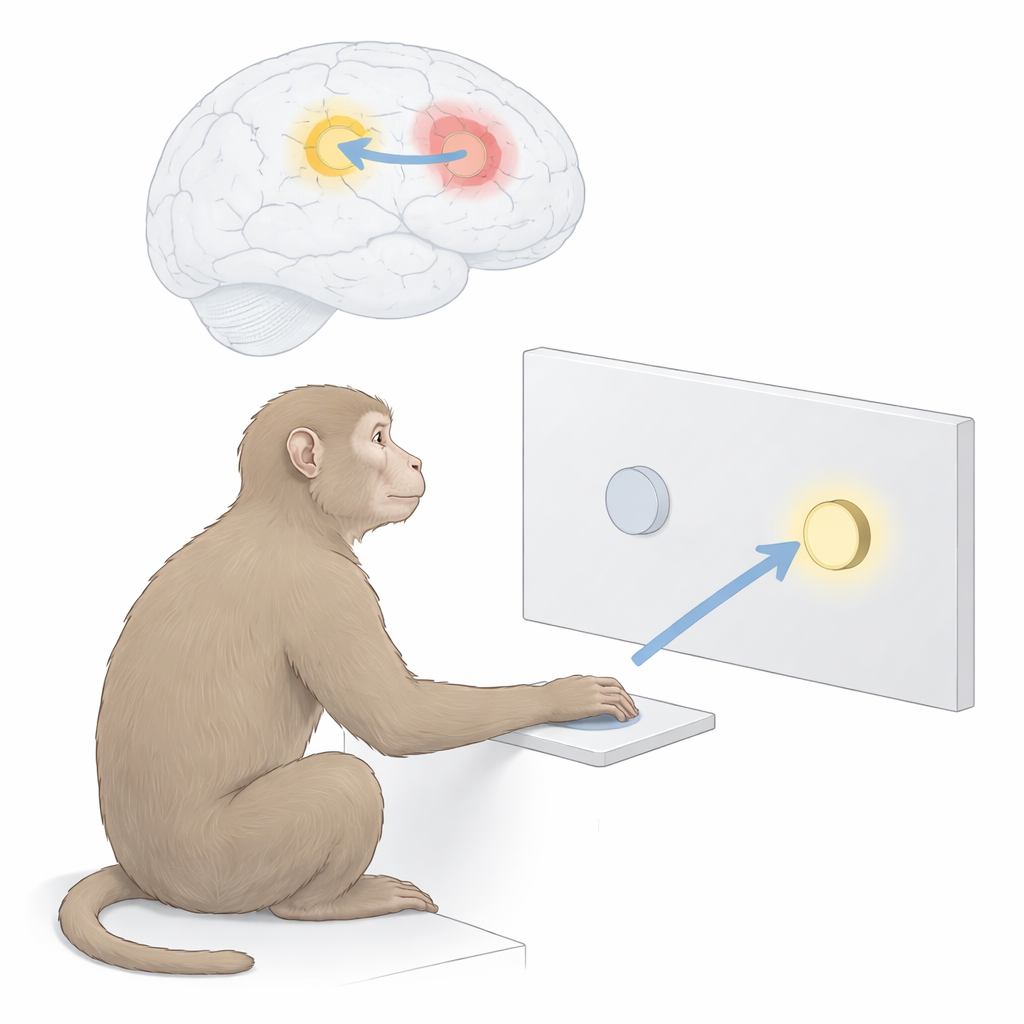
To probe this hidden code, researchers trained two macaque monkeys to perform a straightforward task. Each trial began with the monkey resting one hand on a “home” button. Then one of two lights in front of the animal turned on, telling it which target to reach for. After a brief waiting period, a tone signaled that it was time to move the hand from the home button to the chosen target. While the monkeys watched and reached, scientists recorded tiny voltage changes from the surface of the brain over two key areas: the frontal eye field, which helps process visual information and attention, and the premotor cortex, which helps plan and organize movements.
Slow Waves and Fast Bursts Working Together
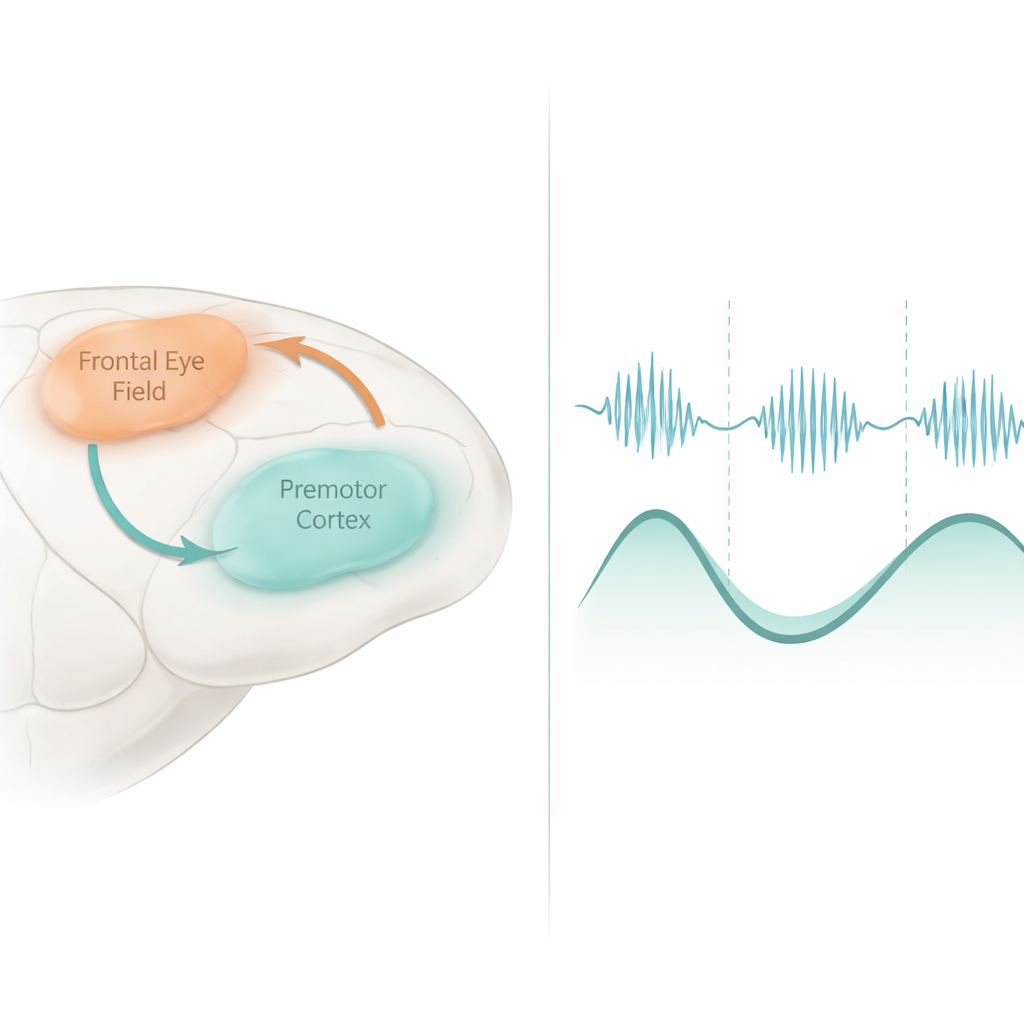
Brain activity naturally includes rhythmic waves at different speeds, from very slow to very fast. In this study, the team focused on slow “delta” waves (about 3–6 cycles per second) and very fast “gamma” activity (100–200 cycles per second). They found that when the monkeys saw the visual cue, the phase, or timing, of the slow delta waves became more aligned across repeated trials. At the same time, the strength of the fast gamma bursts rose and fell in sync with particular phases of the slow wave. This relationship, called phase–amplitude coupling, means that slow rhythms act as a kind of metronome, opening and closing windows when local groups of cells fire strongly.
Brain Maps That Reflect Task Demands
The researchers did not just look at the strength of these rhythms at single spots; they also examined how patterns across many recording sites changed with the task. After a cue light appeared, the spatial pattern of delta timing and delta–gamma coupling shifted in ways that depended on which target was lit. Using a mathematical score of similarity, they showed that these patterns could reliably distinguish between the two target locations. Similar, rapidly appearing patterns were seen around the time of movement, especially during the quiet pause just before the hand left the home button. This suggests that the same network of frontal areas flexibly reconfigures its rhythmic activity to carry both visual and movement-related information.
Recycling Codes from Seeing to Moving
One striking finding was that the spatial pattern of activity that best separated the two targets during the visual instruction period tended to reappear, in altered form, just before movement. Signals dominated by slow-wave timing during the viewing phase gave way to stronger slow–fast coupling during movement preparation, as if the brain reused an existing pattern of connections but shifted it from a “seeing” mode to a “doing” mode. This transformation was not random: matched patterns across time were more similar than shuffled, mismatched combinations created for comparison. The result points to a flexible but consistent code in which slow phase and fast amplitude collaborate to maintain target information across the delay and into movement planning.
Why These Hidden Rhythms Matter
For a non-specialist, the takeaway is that the brain does not just pass signals forward like a chain of static wires. Instead, it coordinates distant regions using shared rhythms, especially slow waves that organize bursts of fast activity. In the frontal eye field and premotor cortex of monkeys, these slow and fast rhythms help encode where a target is and when and how to move toward it. Understanding this rhythmic code may eventually improve brain–computer interfaces, rehabilitation after injury, and our general picture of how perception and action are seamlessly linked in everyday life.
Citation: Harigae, S., Watanabe, H., Aoki, M. et al. Delta gamma oscillatory interactions support visuomotor processing in the lateral frontal cortex of macaque monkeys. Sci Rep 16, 5883 (2026). https://doi.org/10.1038/s41598-026-36628-6
Keywords: visuomotor processing, brain rhythms, frontal cortex, motor planning, neural oscillations