Clear Sky Science · en
Comparative habits and habitat in extant and extinct nautiloid cephalopods from acoustic telemetry and stable oxygen isotope analyses
Ancient Sea Creatures in Today’s Changing Oceans
Nautiluses, with their beautifully coiled shells, look like relics from another age—and in many ways they are. These "living fossils" are the last survivors of a once-dominant group of shelled predators. This study asks a deceptively simple question with big implications: where do nautiluses actually live in the water column today, how does that change as they grow, and how does this compare to their extinct relatives from deep time? The answers help us understand both modern reef ecosystems and how ancient oceans once worked.
Where the Last Nautiluses Still Roam
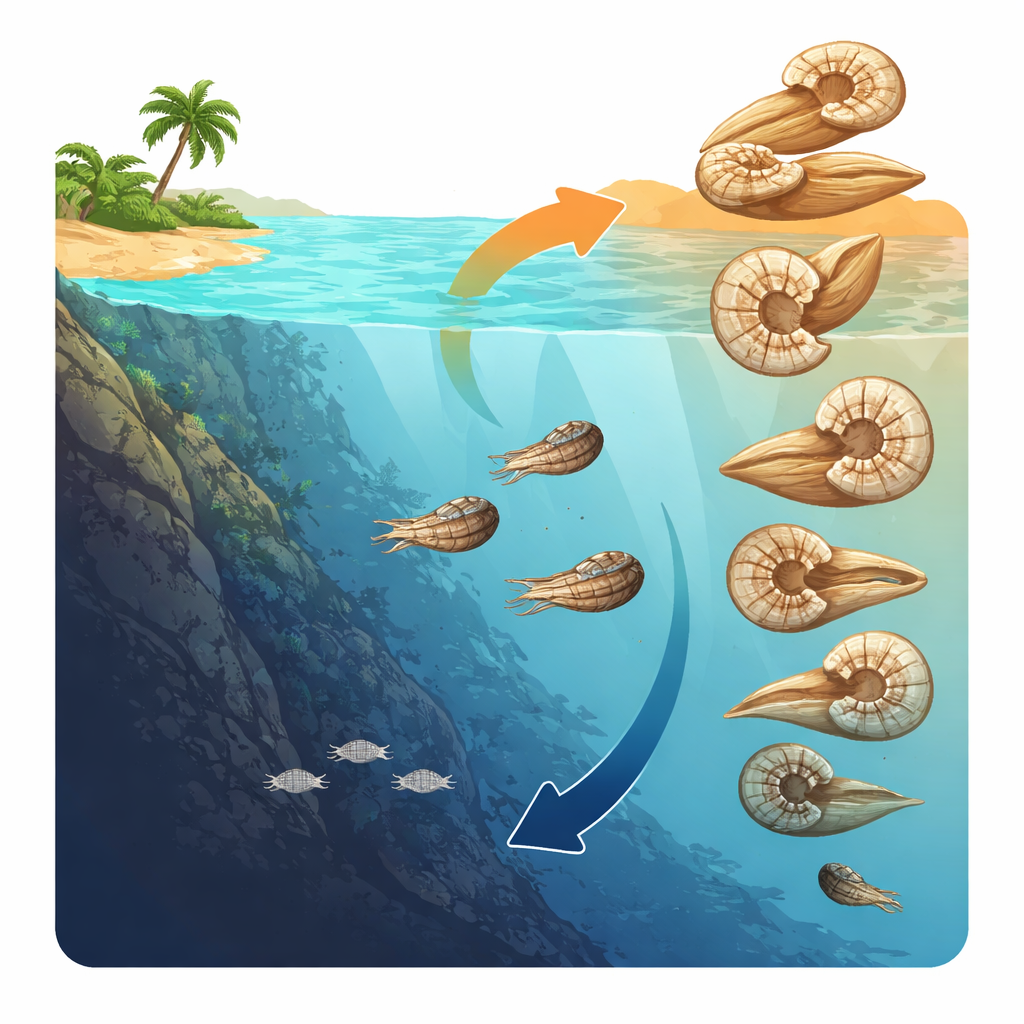
Today, nautiluses and their close cousins, allonautiluses, are confined to steep reef slopes in the tropical western Pacific and eastern Indian oceans. Although their global range has shrunk since the age of dinosaurs, the area of suitable seafloor they occupy is still vast—likely over a million square kilometers. Using small shell-mounted acoustic transmitters, the researchers tracked 27 mature individuals from seven populations across places such as Palau, Papua New Guinea, Fiji, Vanuatu, Australia, and the Philippines. The tags reported depth, temperature, and position day and night, revealing how far and how fast these animals move along the reef slopes, and how deeply they dive.
Daily Journeys Up and Down the Reef
The tracking data showed that most adult nautiluses spend much of their time around 200 meters below the surface, with one species, Nautilus belauensis from Palau, living somewhat deeper at about 250 meters. Allonautiluses tended to remain even shallower, near 150 meters, and displayed strikingly regular daily migrations: they moved up and down the slope in tune with dawn and dusk, in a neat, repeated pattern. In contrast, nearby nautiluses of the same region showed far more erratic vertical movements, with some making unusually deep or mid-water excursions between islands. In every site, individuals swam several kilometers per day along the reef contour, sometimes following the slope closely, sometimes striking out in mid-water, suggesting that even these seemingly slow animals can maintain gene flow between distant reef systems.
Growing Up in the Dark
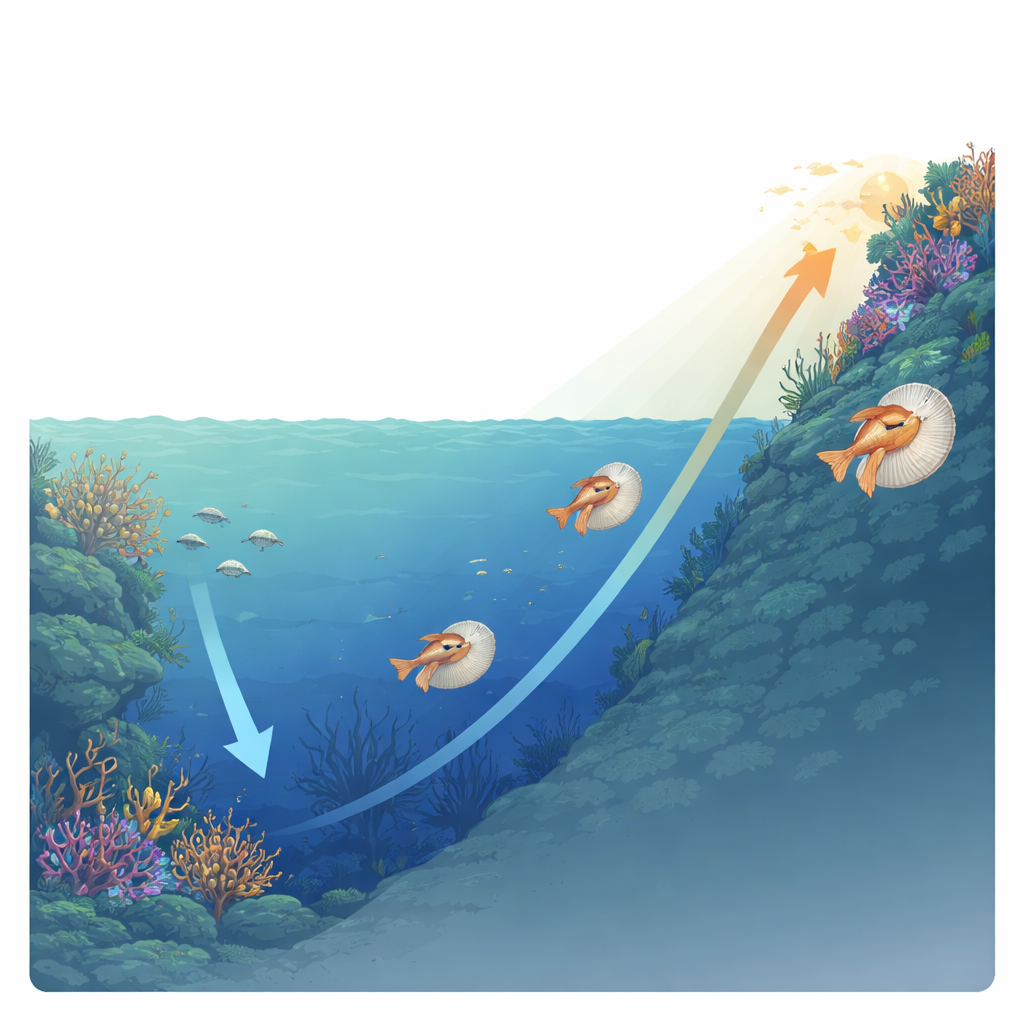
To understand where younger nautiluses live—a life stage too small to track—the team turned to chemistry locked in the shell. By measuring the ratio of oxygen isotopes in shell material and comparing it to local temperature–depth profiles, they reconstructed the temperatures, and thus approximate depths, at which different parts of the shell formed. Across all modern species examined, a consistent life story emerged. Eggs are laid at intermediate depths, roughly 100–200 meters, in relatively warm water. Shortly after hatching, juveniles head downslope into much colder depths of about 350–400 meters, where they spend many years adding new shell chambers. Only when they near sexual maturity do they gradually move back up to shallower, warmer waters, where the final one or two chambers and outer shell edge form.
Lessons from Fossil Shells
The researchers applied the same isotope techniques to more than 500 samples from 19 extinct nautiloid species spanning the Cretaceous through the Miocene. Most fossil species appear to have grown in significantly warmer water than modern nautiluses do, implying that they lived in shallower, more sunlit habitats—even after accounting for the generally warmer climates of the past. Shells from famous fossil sites such as the Eocene London Clay in England and similar deposits in Antarctica suggest typical living depths of perhaps only tens of meters. One standout exception is the genus Aturia, a later-evolving nautiloid with more complex internal shell structure. Its shells record colder growth temperatures, much closer to those of living nautiluses, implying that it already occupied deeper, cooler zones of the ocean, akin to modern forms.
Why These Deep-Dwelling Survivors Matter
Put together, the evidence paints modern nautiluses and allonautiluses as unusual survivors that have retreated into deeper, colder habitats compared with most of their extinct relatives. Juveniles spend their long “childhood” in the dim, cold depths, only moving shallower as adults to reproduce and exploit richer food near the reef. Stronger shells and low metabolic needs may have helped them cope with high pressure and sparse resources in these environments, potentially shielding them from some predators and competitors that helped drive other nautiloids to extinction. Understanding this hidden life history not only clarifies how these animals persist today on overfished and changing reefs, but also provides a powerful key for reading the life stories of fossil shells—and reconstructing how ancient oceans once functioned.
Citation: Ward, P.D., Barord, G., Carlson, B. et al. Comparative habits and habitat in extant and extinct nautiloid cephalopods from acoustic telemetry and stable oxygen isotope analyses. Sci Rep 16, 9032 (2026). https://doi.org/10.1038/s41598-026-36623-x
Keywords: nautilus, deep sea, reef slope, stable isotopes, paleoecology