Clear Sky Science · en
The role of take-over cue informativity in interrupted take-over requests in a semi-automated driving scenario
Why split-second handovers matter
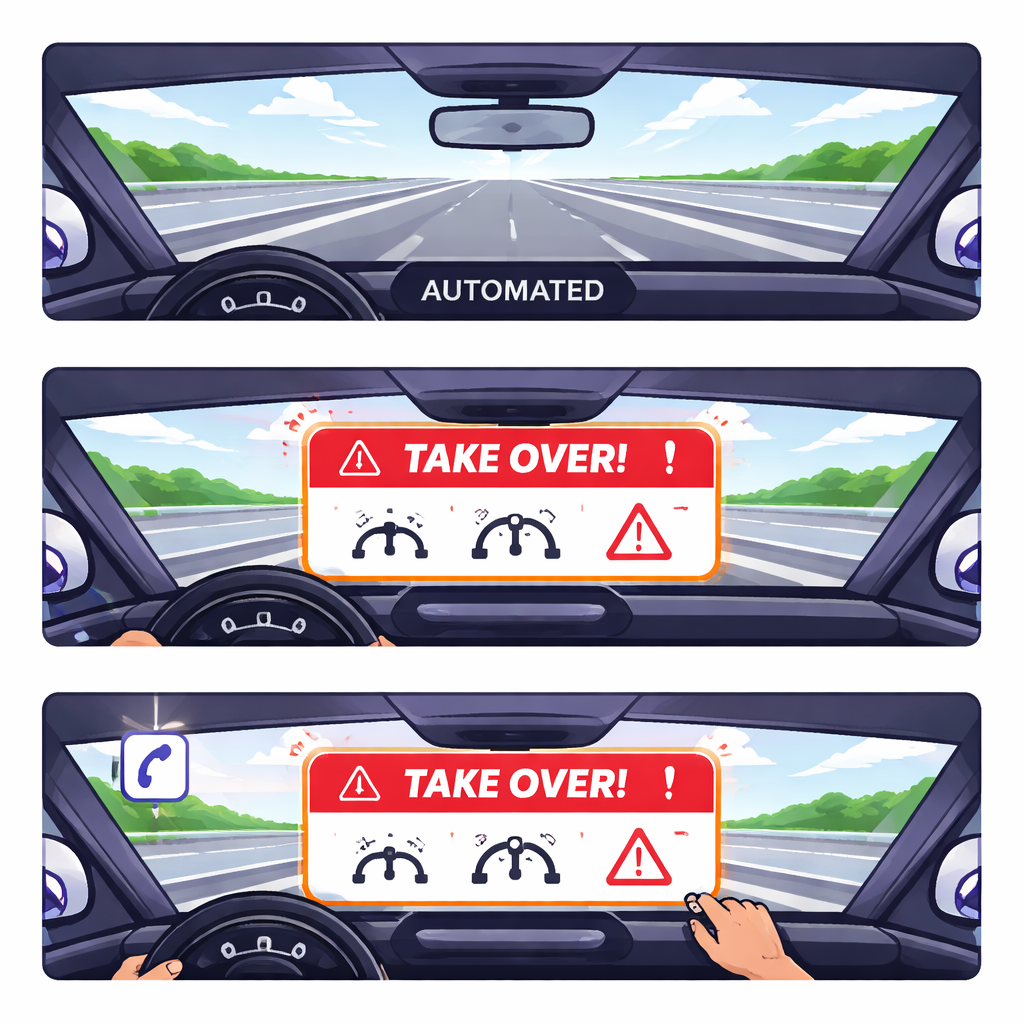
As cars become increasingly automated, many drivers imagine a future where they can read, work, or watch videos while the car does the driving. But today’s semi-automated systems still sometimes need a human to take back control very quickly. This paper explores what happens when the car asks the driver to step in, gives more or less detailed information about why, and then that process is suddenly interrupted — for example, by a ringing phone. Understanding these moments is crucial, because a few hundred milliseconds can make the difference between a smooth handover and a dangerous delay.
Signals that say more than “watch out”
Modern semi-automated cars issue take-over requests (TORs) when they encounter a situation they cannot handle alone. These cues can be generic — essentially “pay attention now” — or they can be informative, hinting at the specific action the driver will likely need to perform, such as changing lanes or adjusting speed. Earlier studies showed that informative warnings help drivers react faster and build better awareness of the traffic situation. However, research from basic psychology suggested a possible twist: when people prepare for a specific task and are then interrupted by another task, that original preparation can actually be weakened or even suppressed. The authors asked whether this paradox could also apply to take-over cues in automated driving.
A lab-made drive with sudden interruptions
To test this, the researchers created a tightly controlled lab experiment that mimicked a level 3 automated driving scenario. Participants watched videos from the driver’s perspective of a car cruising on a four-lane road at different speeds, with no other traffic. At unpredictable moments, they saw a cue that either clearly signaled the upcoming driving action (for example, a lane change or speed change) or served as a non-informative, generic warning. After the cue, participants had to carry out the requested lane or speed change on the basis of a simple visual symbol, measuring how quickly and accurately they responded. In half of the trials, though, an extra task appeared in between: a short word test where people decided whether a letter string was a real German word or a made-up one. This second task stood in for distractions like a phone call or message that intrudes just after the car signals a take-over.
Helpful details, but sensitive to distraction
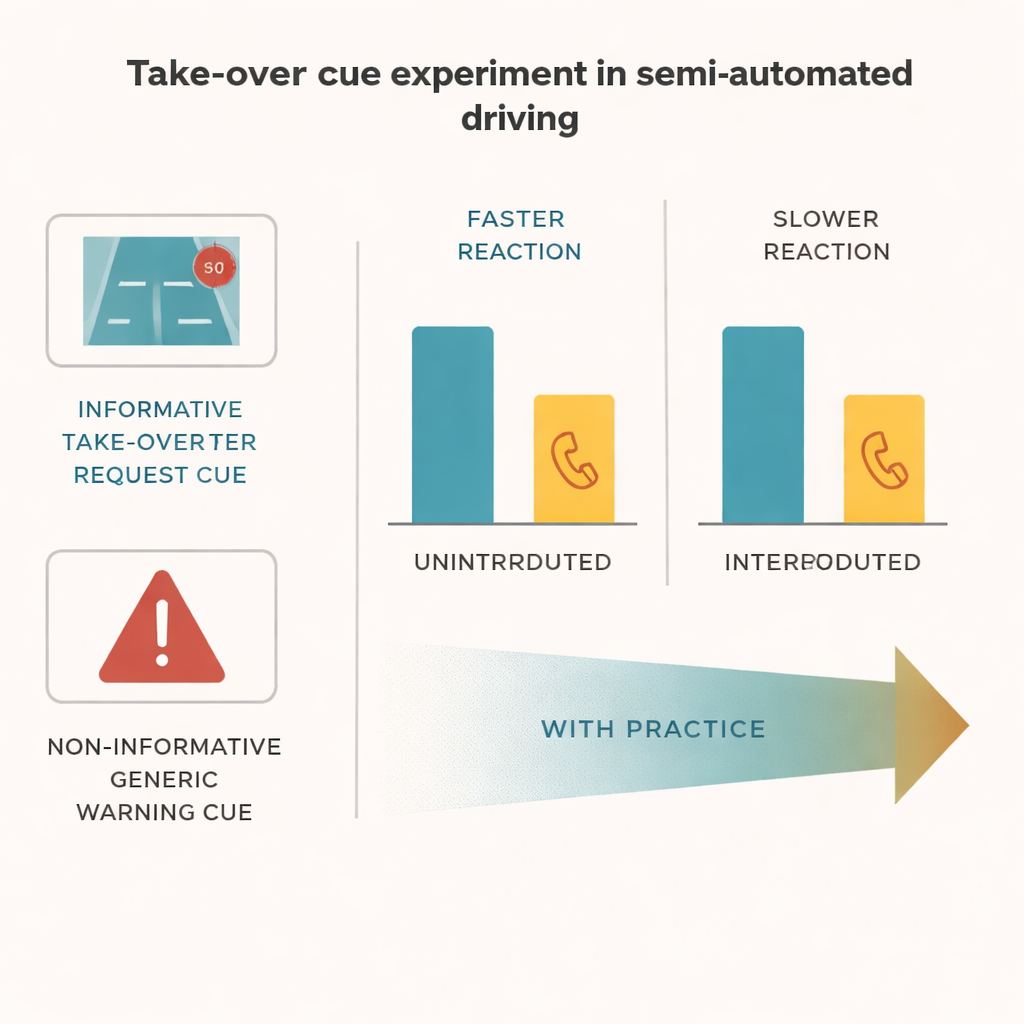
The results showed a clear benefit of detailed information. Across the experiment, drivers responded to the take-over task about 40 milliseconds faster when the cue was informative than when it was generic, without increasing errors. That advantage held even when the interrupting word task appeared: informative take-over cues never became worse than non-informative ones. However, the interruption did trim the size of the benefit. When there was no extra task, the time savings from informative cues were larger; when the interrupting task appeared, that advantage shrank. In other words, the interruption did not flip helpful cues into harmful ones, but it did partially erode their positive effect and slightly slowed preparation for the driving action.
Practice makes handovers smoother
The researchers also examined how these effects changed over the course of the session, trial by trial. At the start, informative cues produced the strongest gains in reaction time, especially when they were not interrupted. As participants gained practice with the overall pattern — cue, possible interruption, then driving task — they became more efficient. The harmful impact of the interrupting task on the benefit of informative cues peaked after some early experience, and then gradually faded. By the end of the experiment, participants appeared to have developed mental strategies that reduced interference between the distraction and the take-over, making the system more resilient to interruptions.
Designing safer alerts for real cars
For everyday drivers, the main takeaway is straightforward: detailed take-over warnings are good, and distractions right after such warnings are bad. Informative TORs help people prepare for the right action more quickly, even when something else briefly steals their attention. But to get the full safety benefit, the moment after a take-over request should be as distraction-free as possible. In practical terms, future semi-automated cars could combine rich, specific alerts with temporary suppression of incoming calls, messages, or other attention-grabbing features when a TOR is issued. The study also hints that supervised practice with automated driving handovers — for example in simulators — could help drivers become more robust to unexpected interruptions when it really counts on the road.
Citation: Berger, A., Damm, N., Baumann, M. et al. The role of take-over cue informativity in interrupted take-over requests in a semi-automated driving scenario. Sci Rep 16, 2628 (2026). https://doi.org/10.1038/s41598-026-36614-y
Keywords: semi-automated driving, take-over requests, driver distraction, human–automation interaction, reaction time