Clear Sky Science · en
Strengthening of corroded RC slab–column joints using thin-ply hybrid FRP under punching shear
Why aging concrete floors can suddenly fail
Many parking garages, warehouses, and high‑rise buildings rely on flat concrete floors supported directly by columns. This design saves space and materials, but it hides a dangerous weakness: a brittle failure called punching shear, where the slab can suddenly punch through around a column with little warning. When steel inside the concrete rusts, this risk grows. The study summarized here explores a new way to strengthen these vulnerable joints using very thin, lightweight composite strips made from glass and carbon fibers.
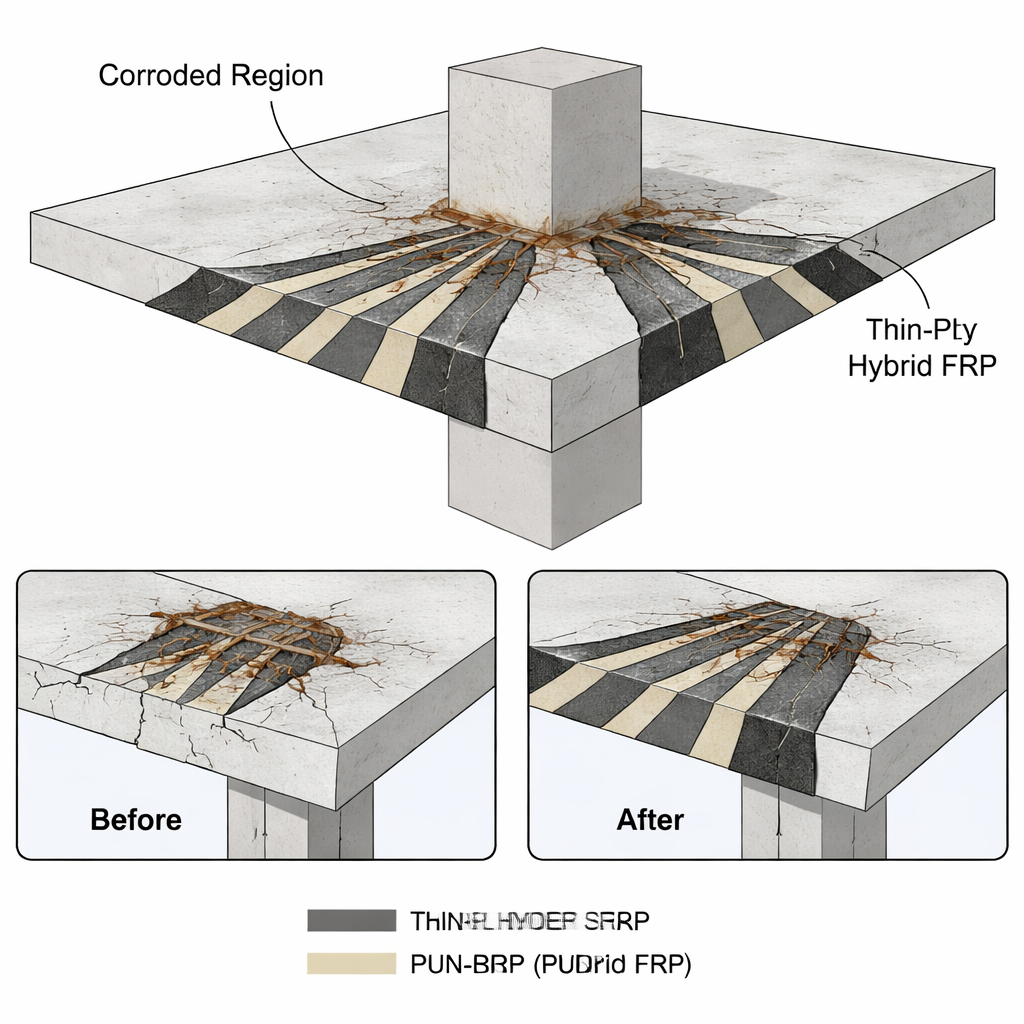
A hidden weak spot in everyday buildings
Flat slab–column systems are popular because they eliminate beams and allow open, flexible spaces. The trade‑off is that the area where each column meets the slab carries intense concentrated forces. If the concrete and reinforcing steel cannot resist these forces, the slab can fail abruptly around the column in a cone‑shaped fragment. Past earthquakes and unexpected collapses in garages have shown how catastrophic this “punching” failure can be. Traditional safety measures, such as extra steel, drop panels, or thickened slab regions, add weight, cost, and construction complexity, and are often absent in older buildings. Compounding the problem, de‑icing salts and harsh environments slowly corrode the internal steel, reducing strength and making punching failure more likely.
What corrosion does to concrete joints
When steel reinforcement corrodes, it expands and cracks the surrounding concrete. This process weakens several mechanisms that normally help resist punching shear: the rough interlock between cracked concrete surfaces, the “dowel” action of the bars crossing cracks, and the bond between steel and concrete. Even moderate rust can shift a slab from a more forgiving bending failure to a sudden punching break. Previous research has mostly looked at corrosion or strengthening in isolation, and often focused on beams or columns rather than the critical slab–column joint. The present work targets this specific joint, examining how different strengthening layouts perform when the steel is already damaged.
Testing thin hybrid strips on damaged joints
The researchers built eleven scaled interior slab–column joints, each representing a typical interior column in a flat slab floor. Some specimens were left intact, while others were deliberately corroded to about 15% mass loss in the reinforcement using an accelerated electrochemical method in a salt solution. They then bonded thin composite strips—made from glass fiber (GFRP), carbon fiber (CFRP), or a hybrid of both—to the underside of the slab around the column. The strips were arranged in various patterns, with special attention to a skewed layout designed to cross the radial cracks that form during punching. The slabs were loaded downward through the column until failure, while the team measured how much load they could carry, how much they deflected, and how cracks spread.
How the new strengthening strategy performed
Corrosion alone reduced the punching capacity by roughly one‑third and nearly doubled the deflection at failure compared with an undamaged joint. Adding composite strips reversed much of this loss. Glass‑fiber systems increased punching strength by about 30–51% over the corroded control, carbon‑fiber systems by 40–60%, and the hybrid glass–carbon strips by about 57–77%. Strengthened joints showed stiffer behavior before cracking, delayed crack formation, and a more stable load–deflection response. However, the benefit did not grow indefinitely: beyond about two layers or a total composite thickness around 0.6–1.2 mm, extra material gave only small strength gains because the strips began to peel away from the concrete (debonding) before they could be fully used. Using advanced computer simulations, calibrated against the experiments, the authors explored many variations in strip thickness, number of layers, placement, and corrosion level. They found that skewed hybrid strips offset 50 mm from the column face gave the best balance of added strength and controlled cracking for the tested geometry.
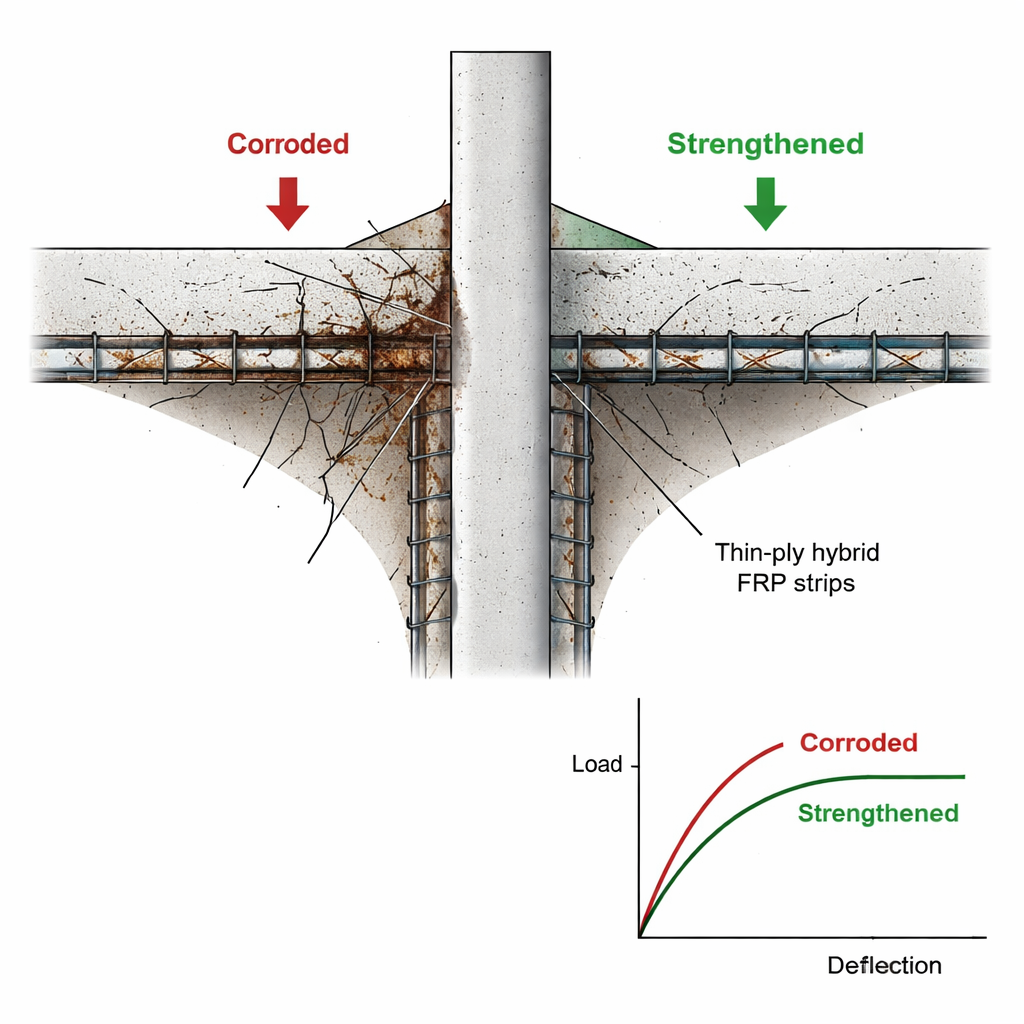
Limits of strengthening very corroded structures
The study also shows that there is a practical limit to how much strengthening can help once corrosion becomes severe. In simulated joints with corrosion levels ranging from 5% to 30%, the relative benefit of the optimal hybrid strengthening dropped from about 51% extra capacity at mild corrosion to about 25% at the highest level examined. As more steel rusts away and the concrete around it degrades, the connection becomes increasingly governed by brittle punching and debonding of the strips. At that point, adding more composite does little without also improving the bond or addressing the underlying deterioration.
What this means for real buildings
For engineers responsible for aging parking garages or flat‑slab buildings, the results suggest that very thin, strategically arranged hybrid glass–carbon strips could be a practical retrofit to partially restore safety in moderately corroded slab–column joints. The system is lightweight, externally applied, and does not require thickening the slab or adding heavy steel hardware. However, its success depends strongly on good bonding, careful detailing of the strip layout, and corrosion levels that have not yet become extreme. In short, this technique can buy valuable extra capacity and stiffness for at‑risk joints, but it is not a cure‑all: severe corrosion still demands more extensive repair or replacement, and each building must be assessed within the bounds of the conditions tested in this research.
Citation: Gomaa, A.M., Ahmed, M.A., Khafaga, S.A. et al. Strengthening of corroded RC slab–column joints using thin-ply hybrid FRP under punching shear. Sci Rep 16, 6526 (2026). https://doi.org/10.1038/s41598-026-36610-2
Keywords: punching shear, reinforced concrete slabs, corrosion, FRP strengthening, slab-column joints