Clear Sky Science · en
Enhancement of LTE and NR systems through efficient physical cell identity allocation
Why Your Phone’s Signal Can Suddenly Drop
Anyone who has watched a video freeze or a call drop while riding a train or walking downtown has felt the limits of today’s mobile networks. As 4G and 5G systems pack more antennas into busy cities to deliver faster data and lower delay, it becomes surprisingly hard to keep phones locked onto the right cell. This article explores a behind-the-scenes piece of the puzzle—a kind of “name tag” called the Physical Cell Identity (PCI)—and shows how smarter ways of assigning these names can make mobile networks more reliable and efficient.
The Hidden ID That Holds the Network Together
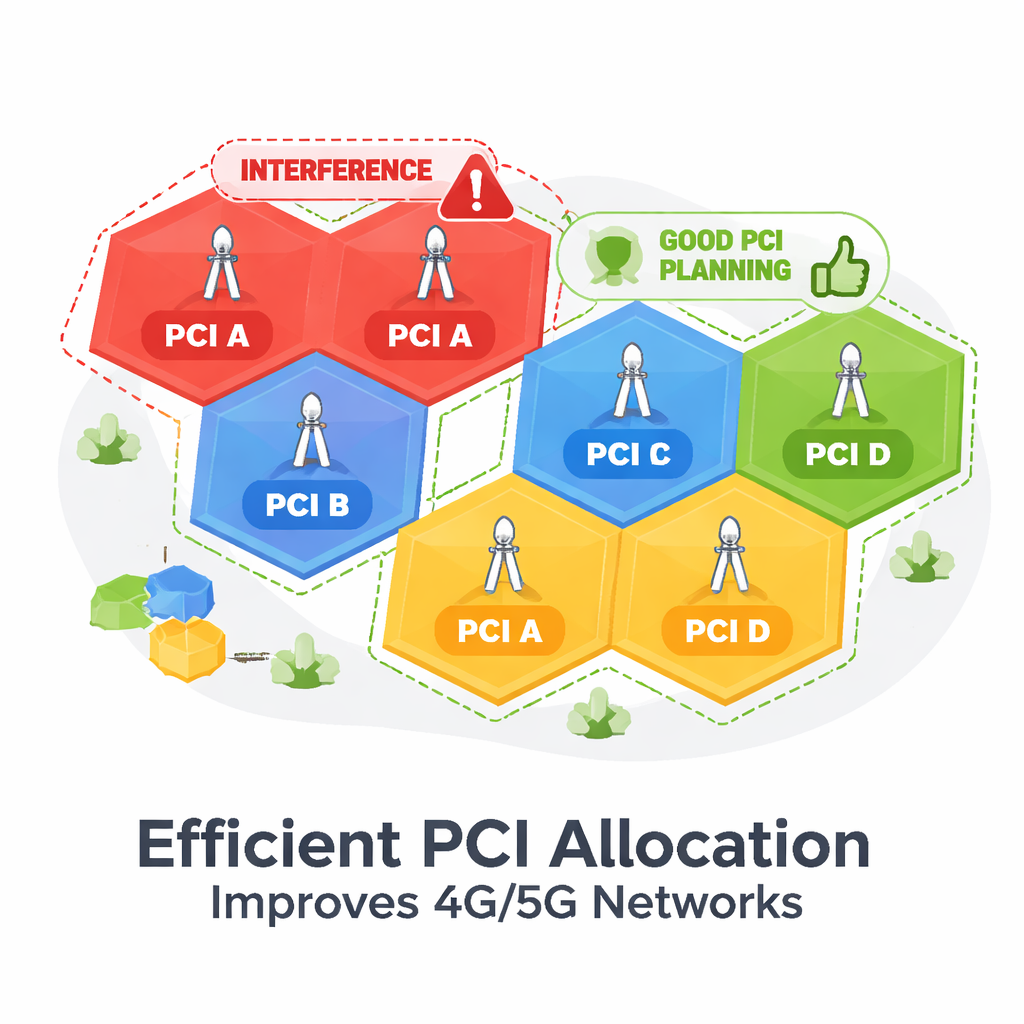
Every time your phone wakes up, it listens for special synchronization signals that tell it which cell tower to talk to, how to line up its timing, and how to switch smoothly between cells as you move. Those signals map to a PCI, a number that uniquely identifies each cell in your area. The problem is that the pool of these IDs is small: only 504 in 4G LTE and 1008 in 5G. In dense city networks with many small cells, reuse of the same IDs is unavoidable. If two neighboring cells share the same PCI, your phone can confuse them, causing interference, failed handovers, and dropped connections. Even when different numbers are used, certain patterns in how they are assigned can still create structured interference that hurts signal quality.
From Phone Towers to a Network of Connected Dots
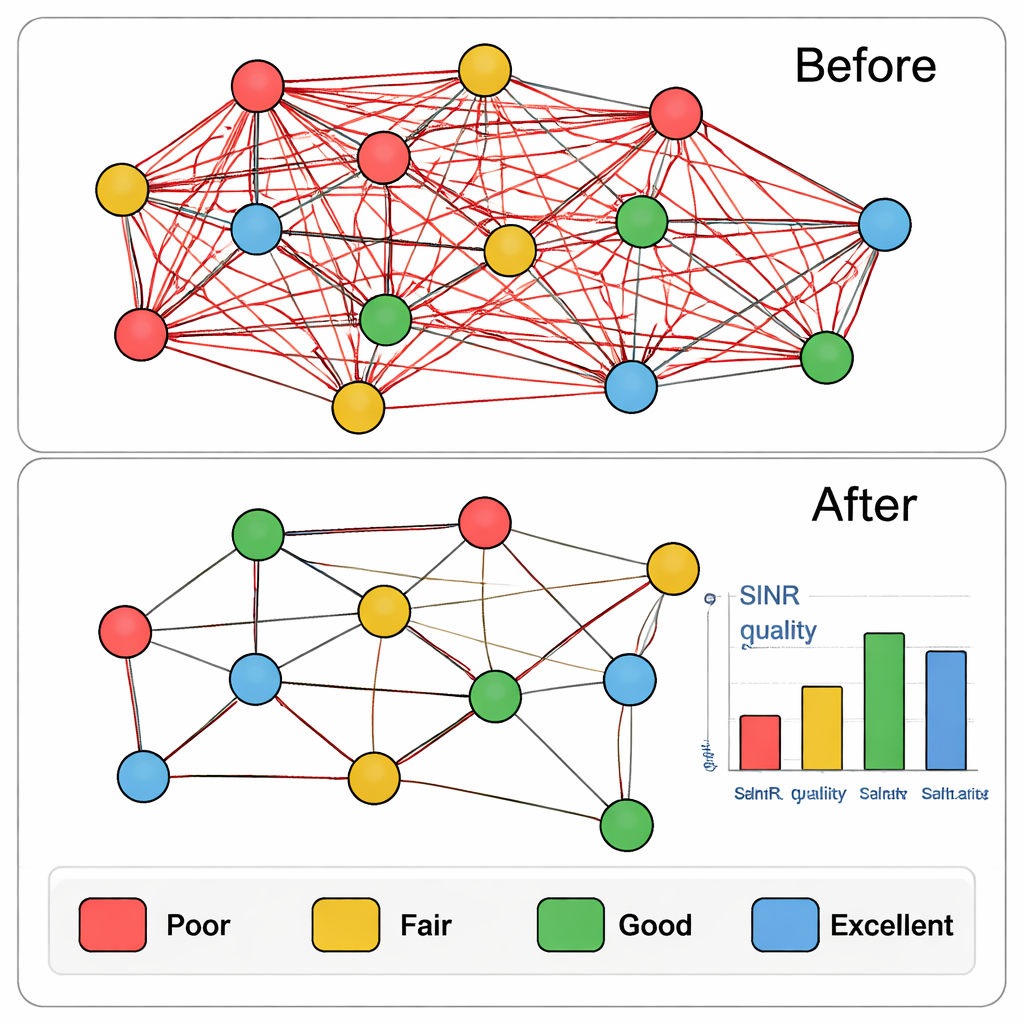
The researchers treat the mobile network like a graph—a web of dots and lines. Each dot is a cell, and each line marks a pair of cells that can interfere with each other or frequently hand users back and forth. In this picture, assigning PCIs becomes a coloring game: give each dot a color (an ID) so that strongly connected neighbors avoid sharing the same color or problematic patterns. The team uses a “top-neighbor” idea, focusing only on the most influential neighbors for each cell, which makes the problem more realistic and easier to scale. They also build detailed simulations in the NS-3 platform that reproduce how real LTE and 5G-like systems behave, including user movement, radio bandwidth, and the way interference degrades the signal-to-interference-plus-noise ratio (SINR), a key measure of link quality.
Smart Algorithms for a Crowded Airwaves World
To search for better PCI plans, the authors compare three families of algorithms. DSATUR, a classic graph-coloring method, assigns IDs one cell at a time, always tackling the most constrained cell next. A more exploratory method, called a Multi-Population Biased Random-Key Genetic Algorithm (BRKGA), borrows ideas from evolution: it keeps a population of candidate PCI plans, mixes their “genes,” and gradually improves them over many generations. Finally, an exact mathematical technique called Integer Linear Programming (ILP) is used, aided by clustering the network into smaller pieces. ILP can, in principle, find perfect solutions but tends to become too slow or impossible to run as the network grows. All three techniques are tested under the same simulated conditions and evaluated by how they change the distribution of SINR values for users, especially how many readings fall into an “excellent” category above 20 decibels.
What the Simulations Reveal About Real-World Gains
In smaller networks with only a handful of base stations, DSATUR shines. It sharply reduces the fraction of users stuck with very poor SINR while boosting the share enjoying excellent signal quality—sometimes by more than 25 percentage points compared with a simple baseline where PCIs are assigned in order. As the network becomes denser and more complex, BRKGA overtakes DSATUR. Its evolutionary search handles the tangled interference patterns of large graphs better, steadily increasing the proportion of high-quality links and cutting the worst cases, all while remaining relatively stable across many scenarios. ILP with clustering performs well for modest network sizes but struggles to scale; in very large networks it can even make things worse, highlighting the practical limits of purely exact optimization in this setting.
What It Means for Everyday Connectivity
For ordinary users, the takeaway is that better “naming rules” for cell towers can translate directly into fewer dropped calls, smoother video, and higher data rates, especially in busy city centers. The study suggests a simple playbook for operators: use fast heuristics like DSATUR when rolling out or adjusting small regions, then rely on genetic-style algorithms like BRKGA to maintain and refine PCI plans as networks grow and traffic patterns evolve. On average, the optimized schemes raise the share of excellent signal conditions by around 8 percentage points and sharply reduce the worst cases. While the work is based on simulations, it offers a practical, evidence-based roadmap for tuning 4G and 5G networks today and points toward future systems where AI could adapt these cell identities in real time as conditions change.
Citation: Farghaly, S.I., Khayal, H.M., Algohary, I.M. et al. Enhancement of LTE and NR systems through efficient physical cell identity allocation. Sci Rep 16, 5626 (2026). https://doi.org/10.1038/s41598-026-36608-w
Keywords: 5G networks, cell interference, network optimization, genetic algorithms, signal quality