Clear Sky Science · en
Comparative prognostic value of high-sensitivity cardiac troponin T and NT-proBNP for 30-day mortality in non-cardiac critically ill patients
Why heart blood tests matter beyond heart attacks
When people land in an intensive care unit (ICU), the immediate crisis is often pneumonia, sepsis, trauma or major surgery—not a classic heart attack. Yet doctors routinely measure heart-related blood tests to gauge how sick these patients are. This study asked a practical question with life-or-death implications: when the problem is not primarily the heart, which common heart blood test better signals who is at highest risk of dying within 30 days?
Two signals from a struggling heart
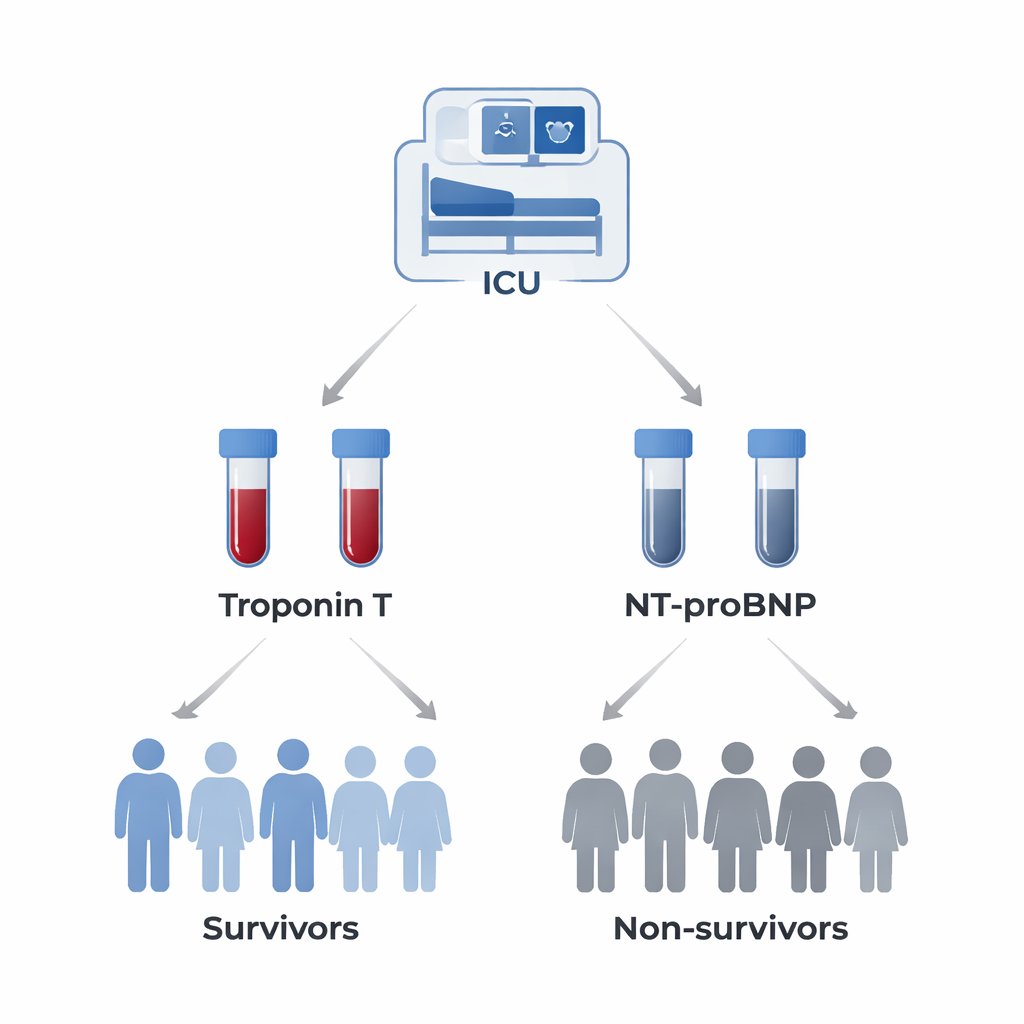
Modern medicine relies on laboratory clues called biomarkers—molecules in the blood that reflect what is happening inside organs. The researchers focused on two widely used heart biomarkers. High-sensitivity cardiac troponin T (often shortened to troponin) rises when heart muscle cells are injured, even slightly. NT-proBNP, in contrast, rises when the heart walls are stretched and under pressure, for example when the body holds onto too much fluid. Both tests are routinely ordered in ICUs, even for patients whose main problem is lung failure, infection, or shock. However, because these levels often go up in critical illness even without a classic heart condition, doctors have not been sure which test carries more weight for predicting survival.
How the study was carried out
The team reviewed records from 827 adults admitted to a mixed medical–surgical ICU in Kraków, Poland, between 2021 and 2022. They deliberately excluded patients whose main reason for admission was a heart emergency such as a heart attack, acute heart failure, major lung clot, or cardiac arrest. That left a group typical of many ICUs: people with severe breathing problems, different forms of shock, serious infections and post-operative patients after big non-cardiac operations. Troponin and NT-proBNP were measured for every patient at the very start of the ICU stay, using the same laboratory methods. The researchers then tracked who was alive or dead 30 days later, while also accounting for age and a standard score called SOFA that sums up how badly different organs are failing.
What the numbers revealed
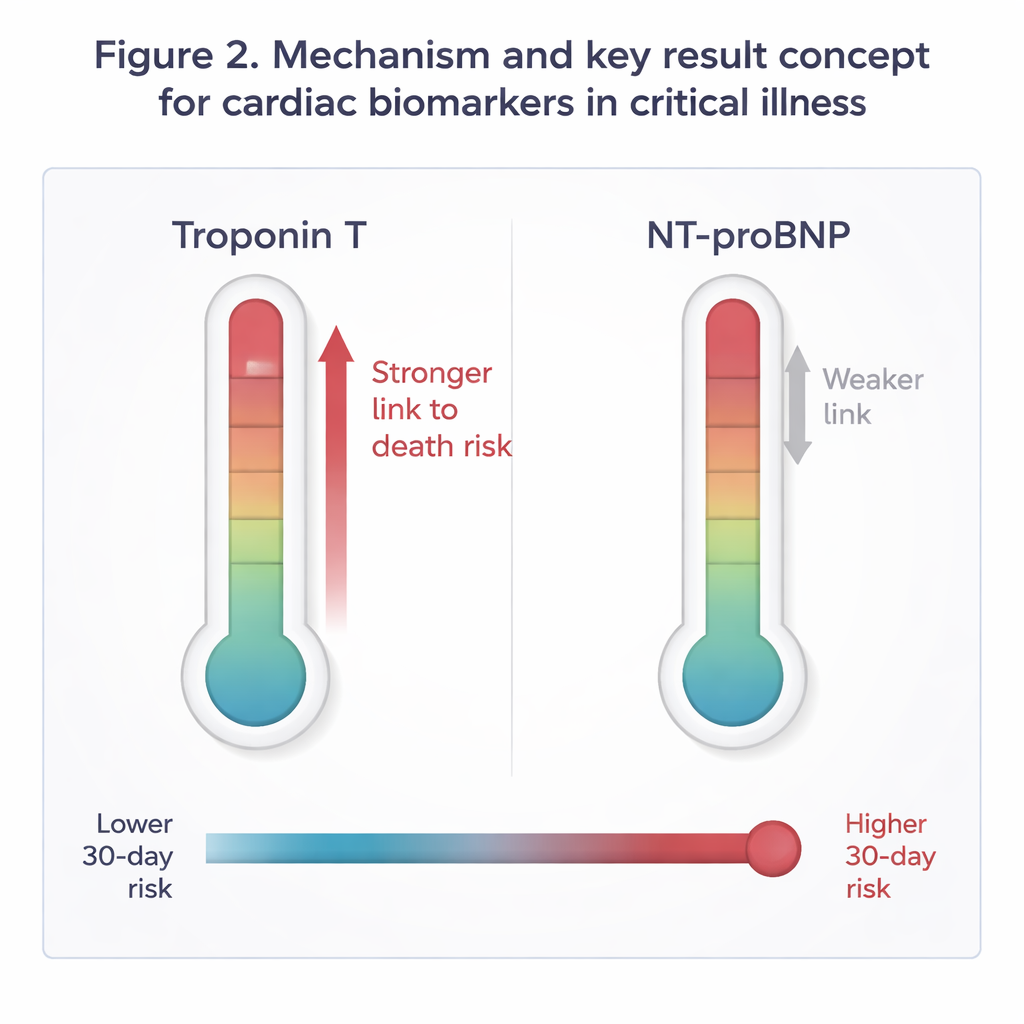
On first glance, both biomarkers seemed higher in patients who died: non-survivors had roughly double the median levels of troponin and NT-proBNP compared with survivors. But the crucial test was whether these differences still mattered after adjusting for age and overall illness severity. Using statistical models that put both biomarkers on equal footing, troponin remained clearly linked to a higher risk of death, while NT-proBNP did not. Patients in the highest quarter of troponin levels had about a 44% greater risk of dying within 30 days than those in the lowest quarter, even after taking age and SOFA into account. Adding troponin to the clinical model made predictions more accurate, whereas adding NT-proBNP did not meaningfully improve the forecast. Combining both markers offered no real advantage beyond troponin alone.
What this means for ICU care
These findings suggest that, in critically ill patients without a primary heart diagnosis, subtle or overt injury to the heart muscle itself may be a more telling warning sign than the degree of wall stress or fluid overload. Troponin appears to distill multiple harmful processes common in critical illness—low blood pressure, poor oxygen delivery and overwhelming inflammation—into a single risk signal. The study does not argue against using NT-proBNP; that test remains valuable for understanding fluid status and hidden heart strain. But when it comes to estimating short-term survival, troponin provided the more reliable early alarm, and did so consistently across medical and surgical patients and those with or without sepsis.
Take-home message for patients and families
For families watching a loved one fight for life in the ICU, long lab lists can be bewildering. This research offers a clearer message: when doctors measure heart blood tests in people whose main illness is not a heart attack, an elevated troponin level is a stronger sign of danger over the next month than a raised NT-proBNP level. Troponin acts as a sensitive indicator that the heart has been injured during the overall stress of critical illness, and those patients may warrant especially close monitoring and heart-focused checks. While no single test can predict the future with certainty, understanding which markers carry the most weight can help clinicians focus attention where it is needed most.
Citation: Świstek, R., Szpunar, W., Droś, J. et al. Comparative prognostic value of high-sensitivity cardiac troponin T and NT-proBNP for 30-day mortality in non-cardiac critically ill patients. Sci Rep 16, 6156 (2026). https://doi.org/10.1038/s41598-026-36605-z
Keywords: critical illness, intensive care, cardiac biomarkers, troponin, NT-proBNP