Clear Sky Science · en
Development of a carbon fiber-based microextraction sample preparation patch for the detection of 21 organochlorine pesticides from water
Why hidden pesticides in water matter
Many pesticides sprayed on farm fields do not stay put. A group known as organochlorine pesticides can linger for decades, drifting into rivers, lakes, and even drinking water. These chemicals, which include old but still troublesome names like DDT, are linked to cancers, nervous system damage, and hormone disruption. Tracking tiny amounts of them in water is vital for public health—but the testing methods are often slow, expensive, and wasteful. This study describes a new, low-cost patch that can quickly pull a wide range of these pesticides out of water so laboratories can measure them more easily and in a more environmentally friendly way.
A small patch with a big job
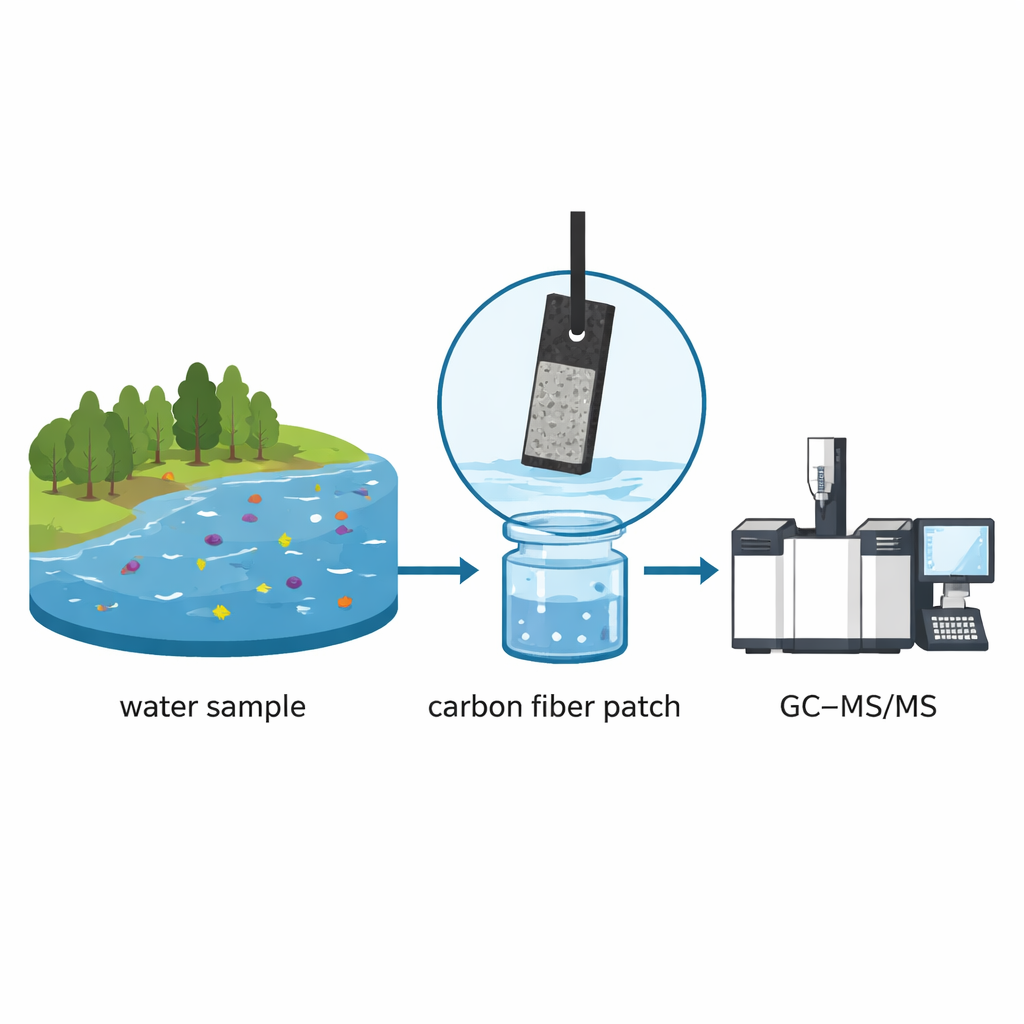
The heart of the work is a thin, finger-sized patch made from carbon fiber, a strong, lightweight material also used in bicycles and airplanes. The researchers coated this patch with a special plastic layer that loves to grab oily, chlorine-rich pesticides while ignoring most of the water around them. When the patch is dipped into contaminated water, pesticide molecules naturally move from the water onto the coating. After a set time, the patch is removed and rinsed with a small volume of solvent to release the trapped chemicals, which are then fed into a sensitive instrument that can tell not only which pesticides are present but also how much of each one.
Cleaning up the way we measure pollution
Standard methods for concentrating pesticides from water often rely on shaking liters of water with large amounts of toxic solvents, or pushing samples through bulky cartridges. These steps are time-consuming, use a lot of chemicals, and generate hazardous waste. In contrast, the new patch works on only a few milliliters of water and needs just about one milliliter of solvent to wash off the pesticides for analysis. Because the patch is thin, it has a large surface area that speeds up how quickly molecules can be captured. Tests showed that the carbon fiber patch could successfully collect 21 different organochlorine pesticides over a broad range of concentrations, with detection limits down to roughly one part per billion or lower—a level suitable for checking whether water meets regulatory guidelines.
Putting the patch through its paces
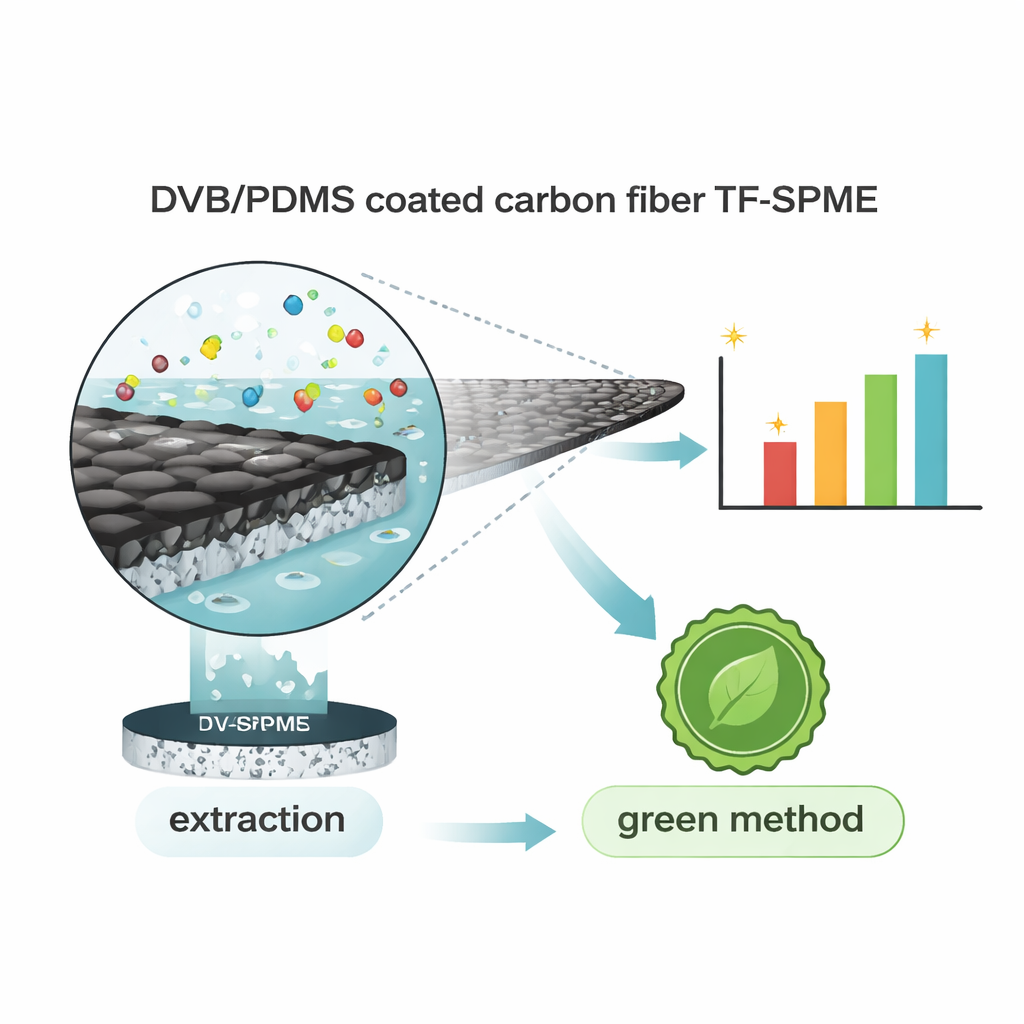
To make sure the patch truly worked as intended, the team systematically tuned the conditions. They studied how long the patch should stay in the water, how warm the sample should be, which liquid best removes the pesticides from the patch, and how long this removal step should last. They found that about three hours of contact with water at a moderate temperature and an hour and a half of desorption gave strong, reliable signals for all 21 pesticides. They also compared their homemade patch with a commercial product. Performance was similar overall, and for some pesticides the new patch actually did better—all while being cheaper to produce because of the simple carbon fiber base.
Greener chemistry in practice
Beyond sensitivity, the researchers wanted the method itself to be kind to the environment. They evaluated it with several “green chemistry” scoring tools that consider solvent use, energy demand, waste, and safety. The patch-based approach earned solid scores, mainly because it uses very little solvent, relies on a compact piece of material instead of large cartridges, and can be run with modest energy input. These assessments suggest that laboratories can adopt this technique without greatly adding to their environmental footprint, an important consideration as chemical testing grows worldwide.
What this means for everyday water safety
For non-specialists, the key message is that this simple patch makes it easier to find dangerous, long-lasting pesticides in water before they reach taps and food chains. It offers a sensitive, affordable, and cleaner way to monitor pollutants that are otherwise hard to track at very low levels. With further development—such as linking the patches directly to portable instruments or testing real-world river and groundwater samples—local agencies could use this tool for faster spot checks and early warnings of contamination. In short, the study brings us a step closer to routine, greener surveillance of some of the most persistent pollutants in our water.
Citation: Poojary, H., Ghosh, C. Development of a carbon fiber-based microextraction sample preparation patch for the detection of 21 organochlorine pesticides from water. Sci Rep 16, 6543 (2026). https://doi.org/10.1038/s41598-026-36604-0
Keywords: water pollution, pesticide monitoring, green chemistry, sample preparation, organochlorine pesticides