Clear Sky Science · en
Microwave reflection and transmission measurements for evaluating water reaction within geopolymers with different precursors
Greener Concrete Under the Microscope
Concrete is everywhere, but making its key ingredient—Portland cement—pumps out large amounts of carbon dioxide. Geopolymers, a new class of “green” binders made from industrial by‑products instead of cement, promise to slash these emissions. Yet to use them safely in buildings and bridges, engineers must understand what happens to water inside these materials as they harden. This study explores a clever, non‑destructive way to watch that invisible water behavior using microwaves, potentially giving builders a new tool to monitor eco‑friendly concretes in real time.
From Cement Blocks to Cleaner Building Materials
Conventional concrete relies on cement made in high‑temperature kilns, a process that accounts for roughly 7% of global CO2 emissions. Geopolymers replace much of this cement with aluminosilicate powders such as fly ash from coal plants, ground granulated blast furnace slag from steelmaking, and calcined clay known as metakaolin. When these powders are mixed with alkaline liquids, they form a hard, rock‑like material without the energy‑intensive calcination step, potentially cutting emissions by up to 80%. But the way water moves and changes state during this binding process is more complex than in ordinary cement, and it strongly influences strength, durability, and cracking.
Using Microwaves as a Gentle X‑ray
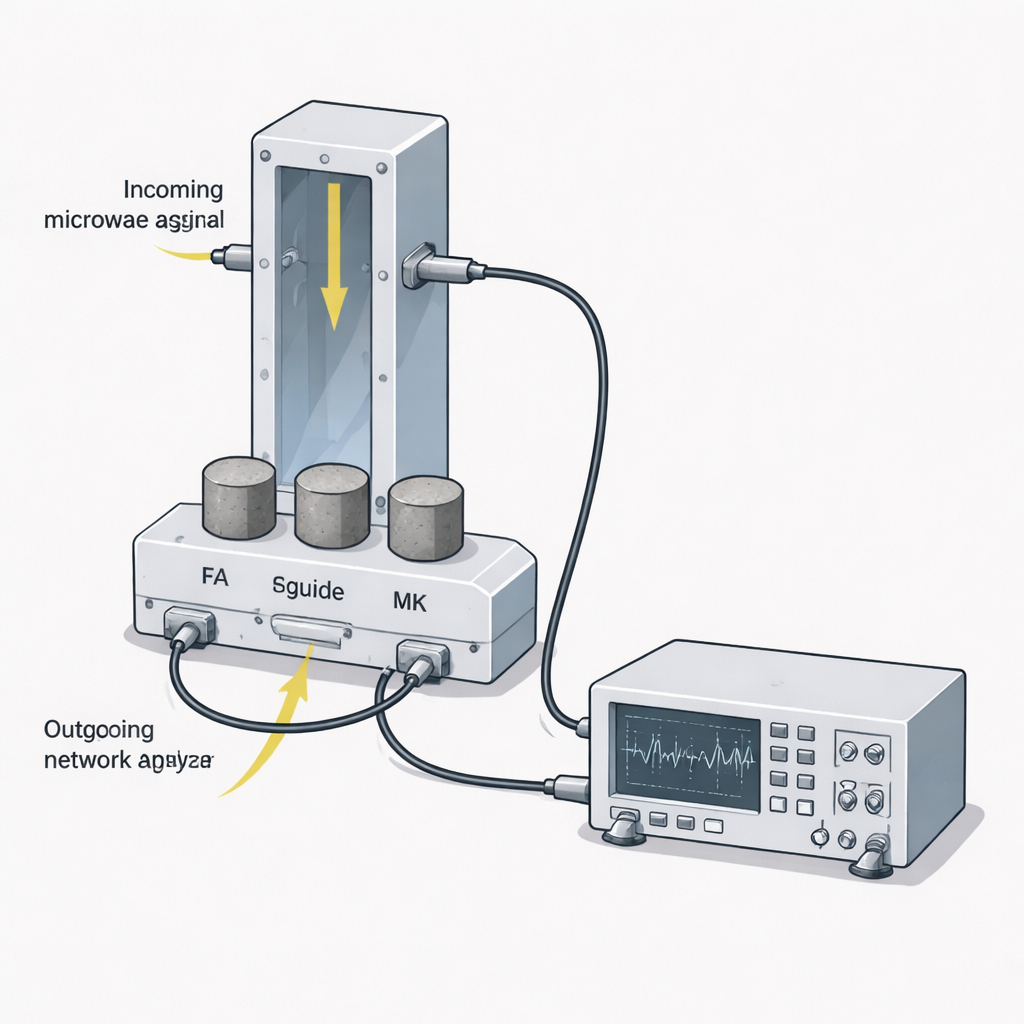
Water molecules interact strongly with microwaves, meaning tiny changes in how water is held inside a material can be picked up as changes in the microwave signal passing through it. The researchers used a standard rectangular metal tube, called a waveguide, connected to a vector network analyzer—a precise microwave instrument. Fresh geopolymer pastes made from fly ash (FA), slag (GGBFS), and metakaolin (MK) were poured into the waveguide and left there for about 30 hours while microwaves were sent in and the reflected and transmitted signals were recorded. Two different alkaline solutions, with sodium silicate to sodium hydroxide ratios of 1 and 2.5, allowed the team to vary water content and chemistry without changing the basic setup.
Listening to Water’s Hidden Transformations
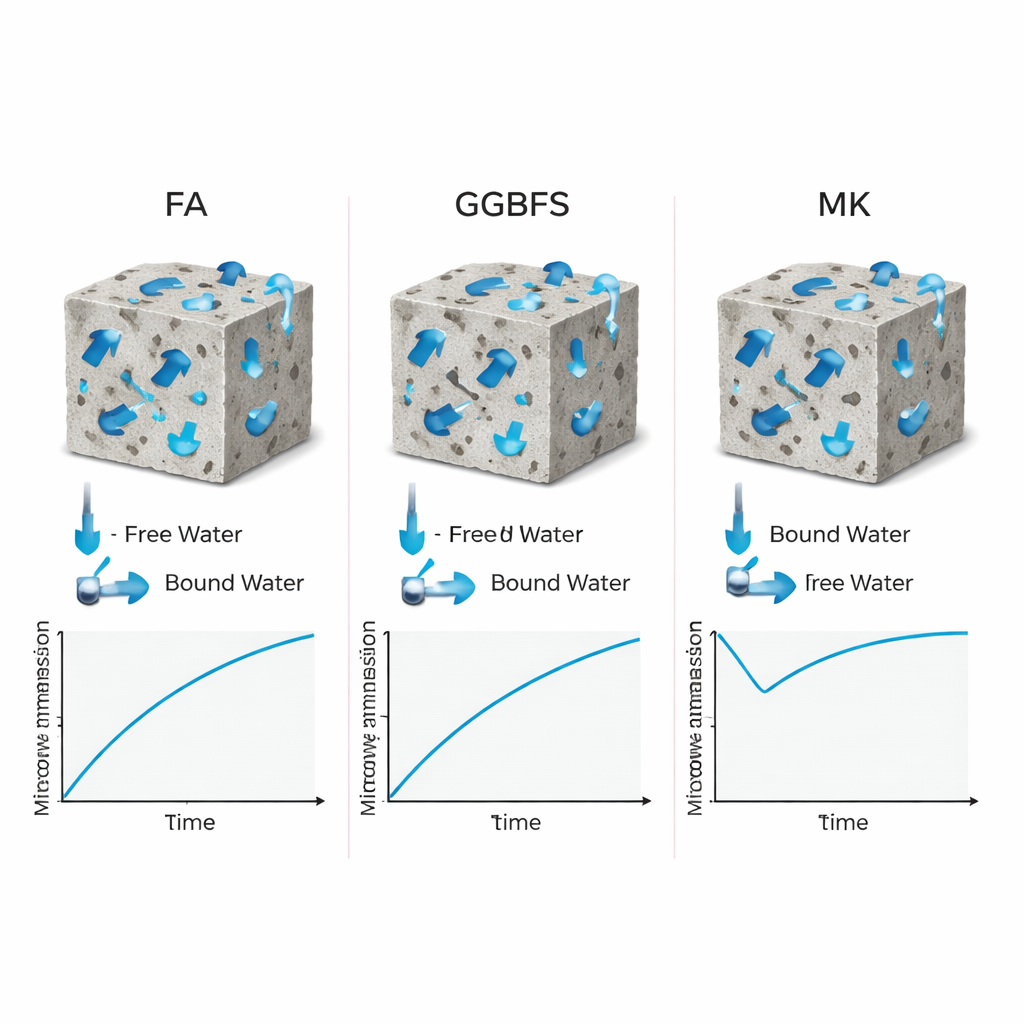
The key insight was that the amount of microwave energy getting through the sample (transmission) was far more sensitive to internal changes than the amount bouncing off the surface (reflection). Reflection changed by less than half a decibel when sample thickness doubled, while transmission changed by as much as 35 decibels, clearly revealing what was happening inside. By tracking transmission over time and extracting an electrical property called permittivity, the team could infer whether water was present as mobile “free” water or more tightly held “bound” water. Careful weighing showed that all samples lost less than 2.5% of their mass, so the changing microwave signal mainly reflected how water was binding within the structure, not simply evaporating.
Different Powders, Different Water Stories
Fly ash and slag, which both contain significant calcium, behaved much like traditional cement: as the mixtures hardened, free water gradually became bound into the growing solid network, and microwave transmission increased accordingly. Fly ash powder showed especially high microwave loss, meaning it absorbed more of the signal and produced stronger changes. Metakaolin, with very little calcium, told a different story. For one solution, the material seemed to absorb additional water into its fine, reactive structure over time, lowering transmission as more water acted like a microwave sponge. For the other solution, metakaolin showed a more cement‑like shift from free to bound water. Microscopy (SEM) images and chemical (EDS) analyses confirmed that metakaolin formed the densest, least cracked microstructure, while fly ash was more porous and partially reacted.
What This Means for Future Buildings
In plain terms, the study shows that microwave transmission can act like a stethoscope for green concretes, listening to how water goes from loose to locked‑in as the material gains strength. It reveals that different industrial by‑product powders do not all harden in the same way: calcium‑rich fly ash and slag follow a hydration‑like pathway, while low‑calcium metakaolin can display the opposite trend depending on the activating solution. This non‑destructive monitoring method could help engineers optimize mix designs, curing regimes, and quality control for geopolymer concretes, speeding the safe adoption of lower‑carbon building materials in real structures.
Citation: Hasar, U.C., Korkmaz, H. Microwave reflection and transmission measurements for evaluating water reaction within geopolymers with different precursors. Sci Rep 16, 7759 (2026). https://doi.org/10.1038/s41598-026-36602-2
Keywords: geopolymer concrete, microwave sensing, water binding, fly ash slag metakaolin, sustainable construction