Clear Sky Science · en
Machine learning-based evaluation of shear strength factors in soil-rock mixtures for mountain substation fills
Why this matters for keeping the lights on
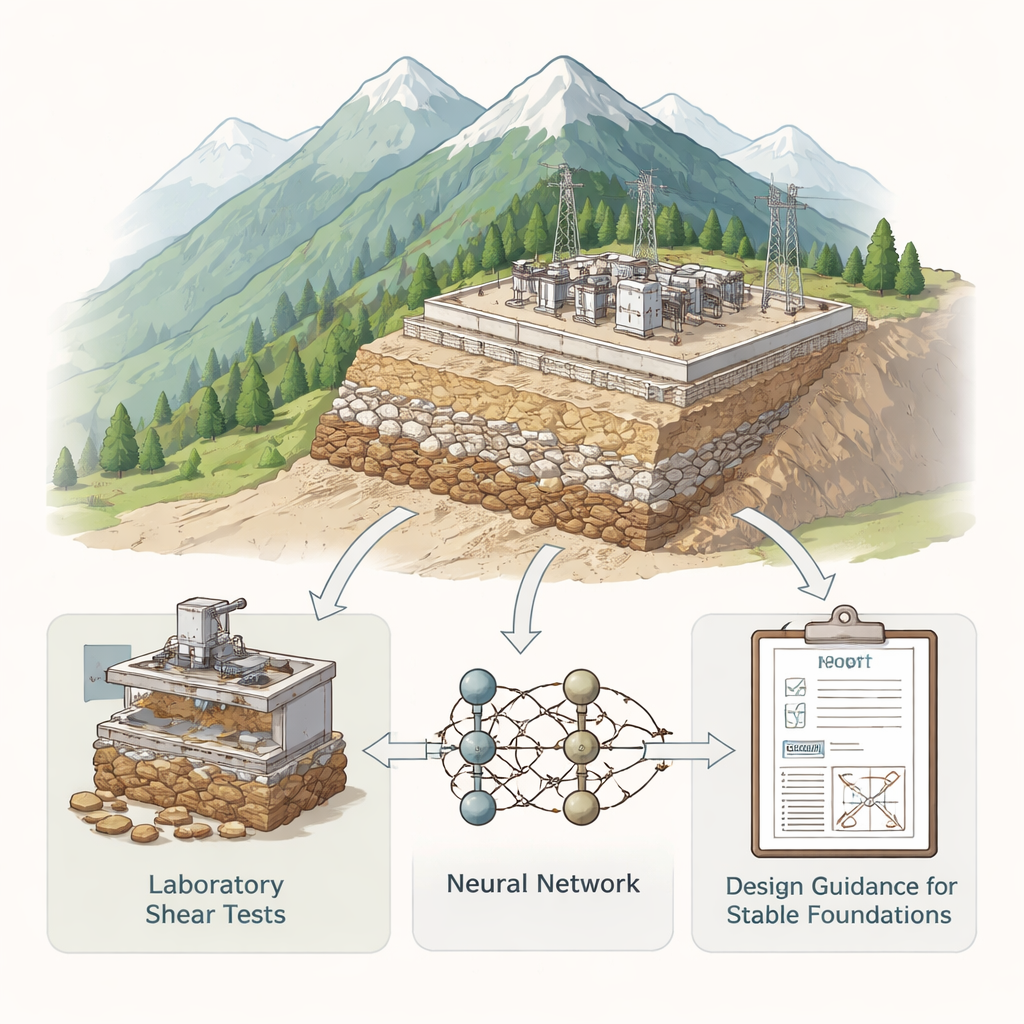
Growing cities in mountain regions need substations that can safely deliver electricity, often perched on carved and filled hillsides. Instead of hauling in perfect construction soil, engineers increasingly reuse on-site spoil made of mixed soil and broken rock. These soil–rock mixtures are cheap and sustainable, but their behavior under load is hard to predict, raising the risk of uneven settlement or even slope failure beneath vital power equipment. This study shows how a simple form of artificial intelligence can sort through many interacting ground properties to pinpoint which ones matter most for keeping these mountain substations stable.
Recycled ground, complex behavior
In steep terrain, building a level platform for a substation usually means cutting into some slopes and filling others. To control costs and truck traffic, contractors often reuse local spoil made of clay, weathered volcanic rock, and fragments of harder basalt. Together these form soil–rock mixtures: awkward, patchy materials whose strength depends on how much water they hold, how tightly they are packed, and how the fine soil glues the larger stones together. Because the mixture can vary from place to place and layer to layer, the ground may settle unevenly under heavy transformers, threatening delicate electrical components that demand very small movements.
From lab tests to a learning model
The researchers collected representative materials from a substation site in southwestern China, then crushed, sieved, and blended them to create controlled mixtures. In the laboratory, they compacted these blends into standard samples and performed direct shear tests under different pressures, mimicking the loads within the fill layers. For each sample they measured key physical properties: how dense it was when dry, how much water it contained, how much empty space lay between grains (the void ratio), and two simple limits that describe how wet the fine soil can get before it behaves more like a paste or a liquid. These measurements, paired with the resulting shear strength (split into friction and cohesion), formed a dataset of 112 carefully prepared cases.
Teaching a neural network about soil and rock
Rather than trying to force these tangled relationships into simple formulas, the team trained a feedforward neural network, a basic machine-learning model that learns patterns directly from data. The model took the five measured ground properties as inputs and learned to predict two outputs: how much the mixture sticks together (cohesion) and how much it resists sliding (internal friction angle). They tuned the network’s settings and compared its performance with more traditional tools such as linear regression, nearest-neighbor methods, and random forests. Using repeated cross-checks on withheld data, the neural network consistently produced accurate predictions, closely matching measured strength values and slightly outperforming the alternatives on this modest-sized dataset.
Which ground properties really count?
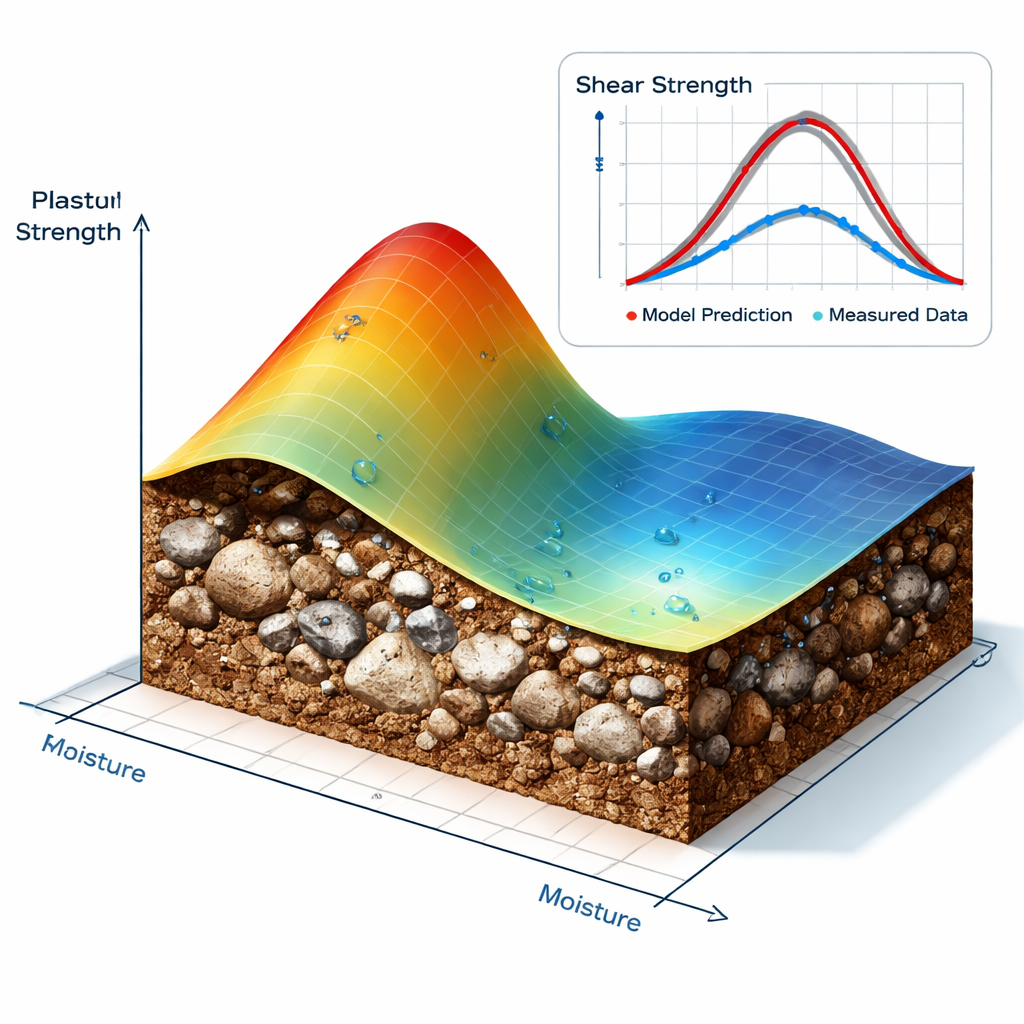
Once they had a reliable model, the authors probed it to see which inputs drove its predictions. They used the network’s internal connection weights as a kind of “influence score” for each property. Moisture content emerged as the star player, accounting for roughly a quarter to a third of the variation in both cohesion and friction. When the mixture gets too wet, water films lubricate grain contacts and weaken the bonds between particles, sharply reducing strength. The plastic limit of the fine soil—the water content where it stops behaving like a brittle solid and starts to flow—was nearly as important, especially for friction. Dry density and void ratio also mattered, but to a lesser degree, mainly by changing how tightly particles interlock. Together, these results confirm long-standing geotechnical intuition while putting numbers on the relative importance of each factor.
Practical guidance for safer mountain substations
For engineers, the main takeaway is straightforward: in recycled soil–rock fills beneath substations, controlling water and the plastic behavior of the fine matrix is more critical than any other single property. By focusing testing and construction controls on moisture content, plastic and liquid limits, and compaction quality, designers can better predict how the ground will carry load and where settlement risks are highest. Although the exact numbers come from one region in southwestern China, the workflow—combining targeted lab tests with a transparent neural-network analysis—offers a reusable playbook for similar projects worldwide, turning messy spoil into a more predictable foundation material.
Citation: Huang, X., Liao, J., Ke, H. et al. Machine learning-based evaluation of shear strength factors in soil-rock mixtures for mountain substation fills. Sci Rep 16, 5775 (2026). https://doi.org/10.1038/s41598-026-36601-3
Keywords: soil-rock mixtures, mountain substation foundations, shear strength, moisture content, machine learning in geotechnical engineering