Clear Sky Science · en
The human Zona-Pellucida shear modulus before and after fertilization and its implications in IVF embryo selection
Why the Shell Around an Egg Cell Matters
For people going through in vitro fertilization (IVF), every egg and embryo is precious. Yet today’s embryo selection still relies mainly on how embryos look in the microscope and how fast they divide. This study asks a different question: could the physical “feel” of the tiny shell around the egg—the zona pellucida, or zona for short—help doctors choose embryos that are more likely to implant and lead to pregnancy?
The Protective Coat Around the Egg
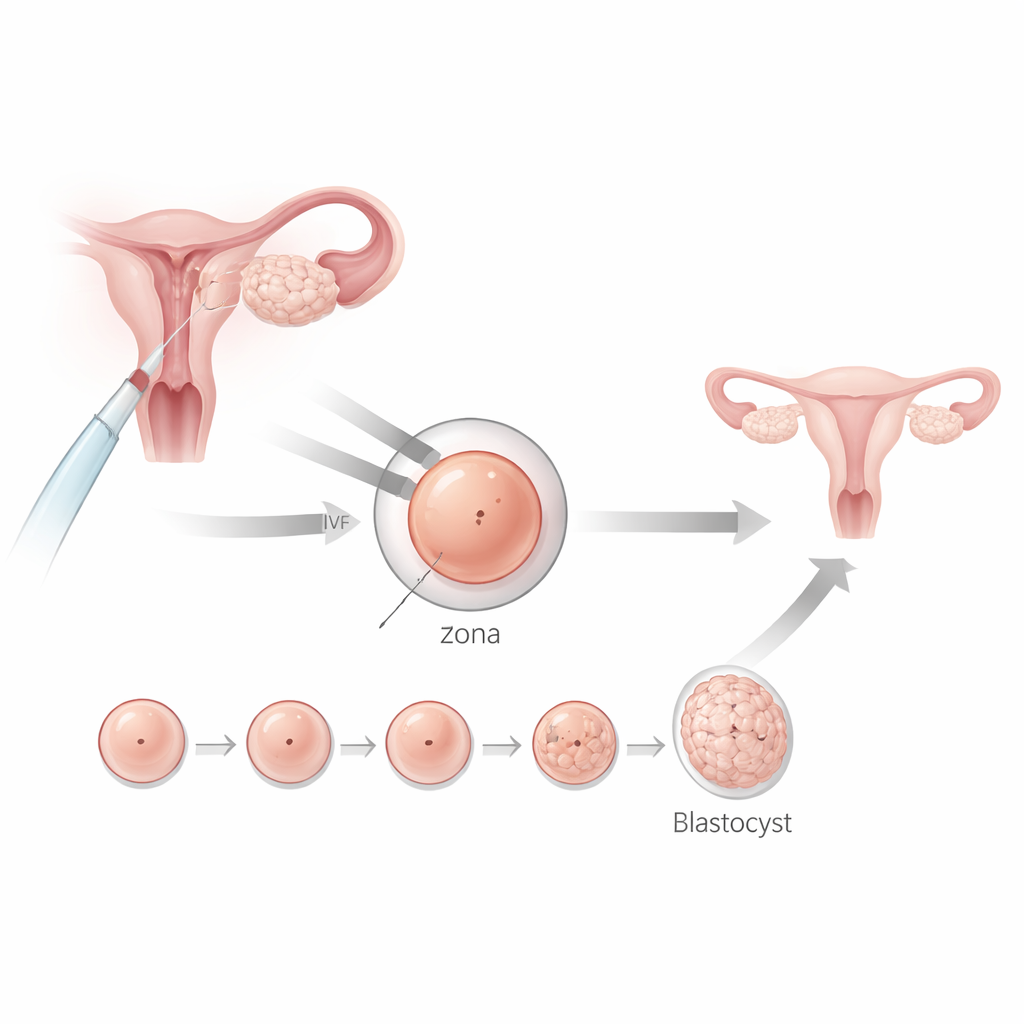
Every human egg and early embryo is wrapped in a clear, gel-like coat called the zona pellucida. This coat protects the egg, helps control which sperm can get in, and later must stretch and crack open so the embryo can “hatch” and attach to the uterus. That hatching step is essential for pregnancy. Earlier work by the same team suggested that how stiff or soft this coat is before fertilization—described by a measure called the shear modulus—relates to whether the resulting embryo is likely to implant. Eggs whose zona fell in a middle range of stiffness were more often linked to successful pregnancies, hinting that mechanics could complement visual grading in IVF labs.
What Changes After Fertilization
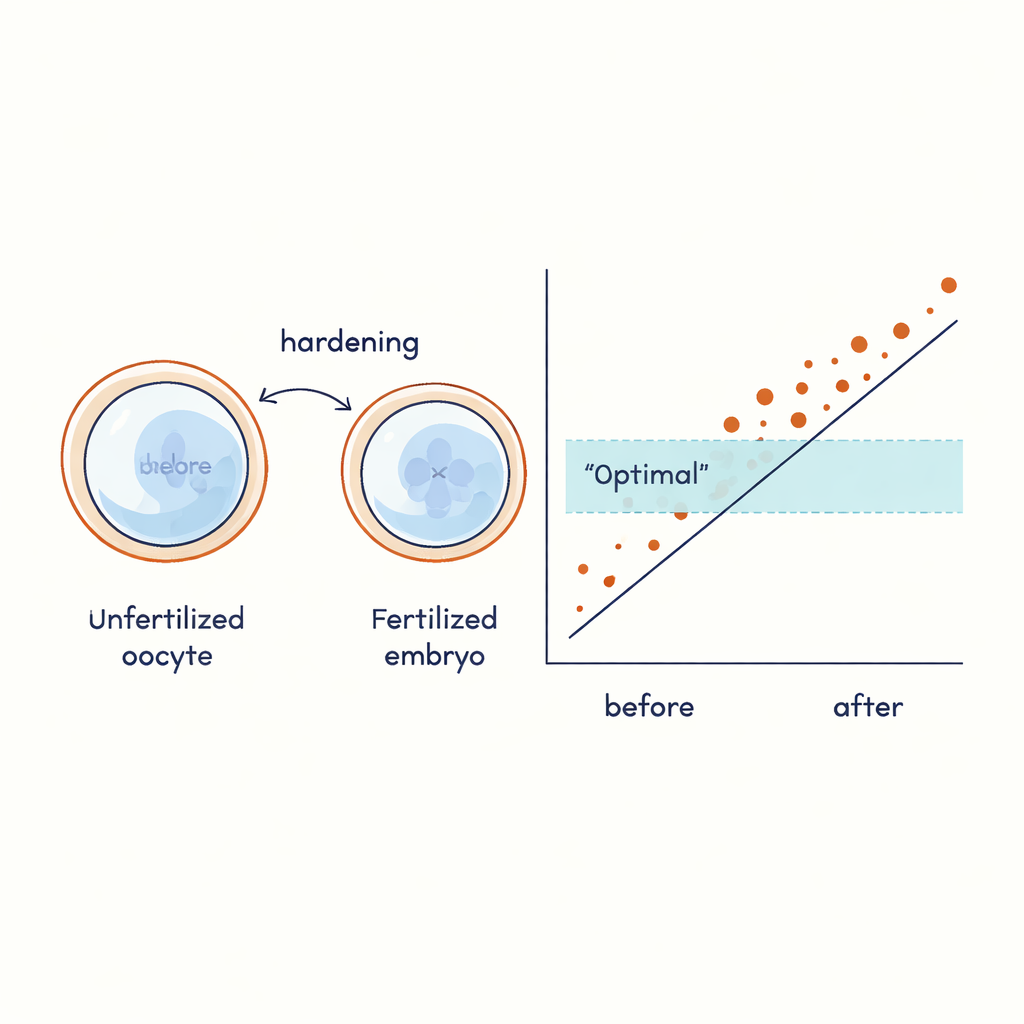
Once an egg is fertilized, its zona normally hardens. This prevents additional sperm from entering and may also affect how the embryo develops and hatches. Animal studies and a few human experiments had already shown that the zona becomes stiffer after fertilization, but it was unclear whether this new, hardened stiffness might be an even better signal of embryo quality. To explore this, the researchers revisited their earlier computational method, which uses images from routine IVF procedures—specifically intracytoplasmic sperm injection (ICSI)—to estimate how stiff each egg’s zona is, both before fertilization and again two to three days later.
Measuring Stiffness Without Touching the Embryo
Because doctors cannot add extra pokes or tests to human embryos, the team relied on data already created during standard care. During ICSI, each egg is gently held in place with a tiny glass pipette that applies suction, causing the zona to deform slightly. The same type of holding is done again for the early embryo on days two or three. The researchers took microscope images at these stages and built a custom computer model for each egg and embryo. Using finite element simulations—essentially, virtual mechanical tests—they adjusted the assumed stiffness until the simulated deformation matched what was seen in the images. This allowed them to estimate the zona’s shear modulus before and after fertilization for 33 eggs from 24 women, all under age 35.
How Much the Coat Hardens—and What It Predicts
The team confirmed that the zona almost always hardens after fertilization: in 31 of 33 cases, its stiffness increased, on average by a factor of about 1.8. However, the amount of hardening varied a lot from one egg to another. Some zonae barely stiffened; others nearly tripled in stiffness. When the researchers compared these measurements with actual implantation outcomes for the transferred embryos, a clear pattern emerged only for the pre-fertilization values. Eggs whose zona stiffness fell in a specific moderate range before fertilization (about 0.4–0.8 kilopascals) were more likely to implant, continuing a trend seen in their earlier, larger study. In contrast, when they looked at stiffness measured two to three days after fertilization—even after adjusting the “optimal” range upward to reflect the average hardening—they found no meaningful link to implantation.
What This Means for IVF Patients
To put it simply, this work suggests that how firm the egg’s protective coat is before fertilization may offer useful clues about which embryos are most likely to succeed, while measurements taken a few days later are less informative. The early zona seems to carry a mechanical “sweet spot” that relates to embryo potential, but once fertilization triggers hardening, differences become too scattered to guide selection reliably—at least with a single time point. If confirmed in larger studies, noninvasive estimates of zona stiffness extracted from routine ICSI images could one day be combined with current visual and timing-based embryo scores to refine embryo selection and, potentially, improve IVF success rates without adding risk or extra handling of embryos.
Citation: Priel, E., Yosef, Y., Priel, T. et al. The human Zona-Pellucida shear modulus before and after fertilization and its implications in IVF embryo selection. Sci Rep 16, 5667 (2026). https://doi.org/10.1038/s41598-026-36595-y
Keywords: in vitro fertilization, embryo selection, zona pellucida, egg quality, implantation